Wednesday, October 18, 2006

Ranting Isiah


Wanna know how much pressure Isiah Thomas, he of the one-year contract to coach the Knicks (and sexual harassment defendant), is under this year? Just check out how he went off on ESPN analyst Greg Anthony, as reported by CNNSI.com's Marty Burns.

The surprising play of rookie forward Renaldo Balkman this preseason has Knicks GM/coach Isiah Thomas feeling good. And he's letting ESPN analyst Greg Anthony, a former Knick, hear about it.

Still upset over Anthony's draft night criticism after the Knicks selected the unheralded Balkman with the No. 20 pick, Thomas ripped his fellow former point guard Wednesday.

"This so-called former Knick, on draft night with millions of people watching, had the audacity to take me to task on a player that I'm pretty sure he had never seen before in his life," Thomas said. "But he stands on national television and talks about a kid he has absolutely no idea about. I'm just glad that all of New York doesn't think like Greg Anthony."

Thomas went on to question Anthony's credentials as a TV commentator, and even took a slap at his 12-year NBA playing career.

"Greg Anthony should never ever be in a position to question myself on anything about basketball," Thomas said. "I do remember the kind of player he was. I'll leave it at that. ...

With Balkman off to a good start, Thomas felt free to vent some of his pent-up anger.

"This is between Greg and I," Thomas said in a lengthy diatribe about Anthony to the media after the Knicks practice. "The things he said on draft night ... after all the good solid work we had done in the draft ... for him to take that position he took ... I thought he was way way way out of bounds." ...

Thomas went on to refer to Anthony several more times during the remainder of the 15-minute session with reporters, sometimes even on unrelated questions.

When asked whether he could see Balkman someday defending LeBron James or Tracy McGrady, Thomas replied, "Wait a minute, hold on now ... you can run him out there but he'll probably get stepped on a little bit ... Unlike Greg Anthony, I do have respect for others."

When asked about the Knicks' dismal season a year ago, and what role all the injuries played, Thomas said, "We all were in a funk last year ... Greg Anthony was in a funk."

Later, when talking about Balkman's ability to handle the ball, a reporter jokingly asked if he had a better handle than Greg Anthony. "Most definitely," Thomas said. "Greg could only go left."

Anthony declined to comment through an ESPN spokesman.
Uncredited AP photo of Isiah Thomas via CNNSI.com.

Tuesday, October 17, 2006

Eternal life


There's a USA Today article, They were never born, but they'll live forever, about the 101 Most Influential People Who Never Lived. The list is from a book by three guys from Jersey, one of whom told the paper "the point of the book is to entertain." And provoke discussion; here's the list:

1. The Marlboro Man
2. Big Brother
3. King Arthur
4. Santa Claus (St. Nick)
5. Hamlet
6. Dr. Frankenstein's Monster
7. Siegfried
8. Sherlock Holmes
9. Romeo and Juliet
10. Dr. Jekyll and Mr. Hyde
11. Uncle Tom
12. Robin Hood
13. Jim Crow
14. Oedipus
15. Lady Chatterly
16. Ebenezer Scrooge
17. Don Quixote
18. Mickey Mouse
19. The American Cowboy
20. Prince Charming
21. Smokey Bear
22. Robinson Crusoe
23. Apollo and Dionysus
24. Odysseus
25. Nora Helmer
26. Cinderella
27. Shylock
28. Rosie the Riveter
29. Midas
30. Hester Prynne
31. The Little Engine That Could
32. Archie Bunker
33. Dracula
34. Alice in Wonderland
35. Citizen Kane
36. Faust
37. Figaro
38. Godzilla
39. Mary Richards
40. Don Juan
41. Bambi
42. William Tell
43. Barbie
44. Buffy the Vampire Slayer
45. Venus and Cupid
46. Prometheus
47. Pandora
48. G.I. Joe
49. Tarzan
50. Captain Kirk and Mr. Spock
51. James Bond
52. Hansel and Gretel
53. Captain Ahab
54. Richard Blaine
55. The Ugly Duckling
56. Loch Ness Monster (Nessie)
57. Atticus Finch
58. Saint Valentine
59. Helen of Troy
60. Batman
61. Uncle Sam
62. Nancy Drew
63. J.R. Ewing
64. Superman
65. Tom Sawyer and Huckleberry Finn
66. HAL 9000
67. Kermit the Frog
68. Sam Spade
69. The Pied Piper
70. Peter Pan
71. Hiawatha
72. Othello
73. The Little Tramp
74. King Kong
75. Norman Bates
76. Hercules (Herakles)
77. Dick Tracy
78. Joe Camel
79. The Cat in the Hat
80. Icarus
81. Mammy
82. Sindbad
83. Amos 'n' Andy
84. Buck Rogers
85. Luke Skywalker
86. Perry Mason
87. Dr. Strangelove
88. Pygmalion
89. Madame Butterfly
90. Hans Beckert
91. Dorothy Gale
92. The Wandering Jew
93. The Great Gatsby
94. Buck (Jack London, The Call of the Wild)
95. Willy Loman
96. Betty Boop
97. Ivanhoe
98. Elmer Gantry
99. Lilith
100. John Doe
101. Paul Bunyan
Their top choice struck me as ridiculous, until I read their explanation, "The most famous killer of the last two hundred years."

Yeah, that does make sense--a fictional character that helped cut short God knows how many lives, thus keeping unfathomable numbers of ideas and products from coming to fruition is pretty influential, even in an entirely negative way.

It's actually a pretty classic list (assuming #7 indeed isn't Roy's partner; it's funny how they wrote the Greek spelling for #76).

Next, let's make a list of people who may have existed but whose influence rests on outsized myths.

Uncredited image of Wayne McLaren as the Marlboro Man in various places online.

Not quite red, not quite blue


Jennifer Steinhauer has a funny article in Sunday's Times, Twins, Not Really. But Not Far Off., in which she points out the interesting similiarities between the dimunitive Michael Bloomberg and the once-pumped Arnold Schwarzenegger. She notes:

Both men are moderate centrists, estranged from their party’s mainstream, who first ran for office on what seemed like a lark. After making a slew of goofy comments and odd policy pronouncements, they both found themselves, shockingly, in their first political jobs.

Both watched their popularity sink mid-term to embarrassing levels. Mr. Bloomberg came back to beat handily — and greatly outspend — a Democratic machine politician whose attempts to claw away at the mayor and paint him as the president’s buddy flopped.

Mr. Schwarzenegger’s re-election bid does not end until next month, but his campaign has uncannily mirrored Mr. Bloomberg’s 2005 race. Like the mayor, he distanced himself from his party, cut deals with lawmakers, and outspent his opponent while also more or less ignoring him. The outcome, polls show, is likely to be the same.

Each had two careers that made him buckets of money before settling into a $1-a-year job as a high-profile public servant, their old lives informing how they govern. ...

And they like each other. Mr. Bloomberg is hosting a fund-raiser for the governor in his home on Monday; the mayor’s recent visit here to promote environmental legislation was like one big buddy movie. During one news conference, Mr. Schwarzenegger announced that the mayor was, “My soul mate. He’s the man.”

It is not terribly surprising that the re-election campaigns of Mr. Bloomberg and Mr. Schwarzenegger are so similar. The week after Mr. Bloomberg won reelection last year, Maria Shriver, Mr. Schwarzenegger’s wife, called Kevin Sheekey, Mr. Bloomberg’s campaign manager, and said that she wanted her husband’s re-election campaign to be just like the mayor’s.
Makes you wonder how much of Shriver's Kennedy shrewdness is behind Arnold's success.

I like both men, although I disagree with a lot of Schwarzenegger's policies, and think Bloomberg post-transit strike and landslide re-election has become increasingly petty and at times surly.

I like them because they're not afraid to think big, and refuse to be held hostage to 'that's the way it's done.' I also like them because they understand the importance of, and seem to enjoy acting like, leaders--making speeches, using the bully pulpit, cajoling and even threatening.

A lot of who they are, and why they could be considered soulmates, is due to both being self-made, highly successful men. Unlike a lot of other politicians, when stacked up against businessmen they seem to suffer neither envy nor harbor an inferiority complex. As Steinhauer notes,
Mr. Bloomberg, who is sometimes mentioned as a 2008 presidential candidate, and Mr. Schwarzenegger, who by law cannot be, both see themselves as the answer to gridlock. “Perhaps fame and money sets them free to set their own course,” said Bruce E. Cain, director of the Institute of Governmental Studies at the University of California, Berkeley. “Maybe plutocracy is the answer to our partisan problems.”

Together, they promote causes (like environmental programs), raise cash (for the governor) and offer moral support in a political arena with few natural allies. “The Republican Party does not really meet either of their needs,” said Louis DeSipio, a professor of political science at the University of California, Irvine. “They learn from each other’s mistakes.”
Not only do they learn from mistakes, but because they're not really bound to any party they can act on them too. They speak plainly, expect their staffs to deliver measureable results, and see government as about fixing fixable problems.

Neither of them, of course, will be president; Arnold because he wasn't born here, Bloomberg because of bad timing--at 64 he'll be too old after the 2008 election, which already has three New Yorkers who've been running for a long time.

But Barack Obama will. He's Colin Powell before Powell joined the second Bush administration, the perfect way for America in 2016, when he'll be 55, to vote for hope, for history, for competence over ideology.

And for one of their own--immigrants are already 12.4% of the total population, toss in the sons and daughters of immigrants and a sizeable chunk of America will directly relate to Obama, whose father came from Kenya.

Like Schwarzenegger and Blomberg, Obama has the basic likeability that John Kerry will tell you is critical in presidential candidates. He comes across as real, as sincere and as highly competent. [I've written before about why he shouldn't run in 2008, though.]

The Times' famously tough Michiko Kakutani touches upon all of these traits in her laudatory (but poorly-headline) review of Obama's The Audacity of Hope, Obama’s Foursquare Politics, With a Dab of Dijon :
... But while Mr. Obama occasionally slips into the flabby platitudes favored by politicians, enough of the narrative voice in this volume is recognizably similar to the one in “Dreams From My Father,” an elastic, personable voice that is capable of accommodating everything from dense discussions of foreign policy to streetwise reminiscences, incisive comments on constitutional law to New-Agey personal asides. The reader comes away with a feeling that Mr. Obama has not reinvented himself as he has moved from job to job (community organizer in Chicago, editor of The Harvard Law Review, professor of constitutional law, civil rights lawyer, state senator) but has instead internalized all those roles, embracing rather than shrugging off whatever contradictions they might have produced.

Reporters and politicians continually use the word authenticity to describe Mr. Obama, pointing to his ability to come across to voters as a regular person, not a prepackaged pol. And in these pages he often speaks to the reader as if he were an old friend from back in the day, salting policy recommendations with colorful asides about the absurdities of political life. ...

Mr. Obama eschews the Manichean language that has come to inform political discourse, and he rejects what he sees as the either-or formulations of his elders who came of age in the 60’s: “In the back-and-forth between Clinton and Gingrich, and in the elections of 2000 and 2004,” he writes, “I sometimes felt as if I were watching the psychodrama of the Baby Boom generation — a tale rooted in old grudges and revenge plots hatched on a handful of college campuses long ago — played out on the national stage. The victories that the 60’s generation brought about — the admission of minorities and women into full citizenship, the strengthening of individual liberties and the healthy willingness to question authority — have made America a far better place for all its citizens. But what has been lost in the process, and has yet to be replaced, are those shared assumptions — that quality of trust and fellow feeling — that bring us together as Americans.”
I think he gets this just about right--so much of the political fights of the last two decades have been about rehashing Vietnam, a last shot at framing the arguments for the history books, an effort to shoehorn old wines into new bottles.

The baby boomers will, I think, go down as a maddening generation, capable of great idealistic good, but also oh-so-petty and selfish behavior. It's definitely time enough for them to retire--for new leaders, either too young or too newly-arrived to have been tainted by the scorched earth legacy of recent years--to sprout forth.

Getty Images pool photo of Schwarzenegger and Bloomberg at an environmental meeting in NYC by Susan Watts.

Uncredited photo of Obama posing in front of the Superman Statue in downtown Metropolis, Illinois from Obama's website.

Known for


Do we recognize greatness when we see it? I thought about this recently when I heard that Orhan Pamuk had won the Nobel Prize for Literature.

I saw him speak earlier this year, and wrote in part:

Turk Orhan Pamuk, the famous novelist and now political figure, looking suave and distinguished--not at all like his goofy picture. Also a bit nervous, I think, he kindof wasn't paying attention when the others were reading, like a kid anxious to get his turn over with. He apparently lives and writes in the same building that he grew up in; he read an excerpt from a memoir, Istanbul, that was essentially one long, amazing sentence, very Walt Whitman-esque in that it was just one phrase and image after another, each preceded by 'Of', describing his beloved Istanbul. My favorite was: "of everything being broken, worn-out, past its prime." He started out wanting to be an artist and photographer, can totally tell, each phrase was like a little photograph.

He also said he thought a word that summed up the Turkish people was their equivalent of the word 'melancholy', but the Turkish word apparently connotes also a 'nobility of failure' meaning, essentially the entire country was living in the ruins of an empire, but it was somehow okay, not to be celebrated, but nothing to be ashamed of, either, just sad.
Pamuk was one of five wonderful novelists on a panel devoted to 'The Global City.' He read an excerpt from his memoir, Istanbul; answered a few questions, and that was about it.

If you had asked me at the time, of these five, which one is most likely to win a Nobel, I may have picked Pamuk--but only because of what I knew of his career, of the raves his works draw, of his interesting role as a bridge between East and West in this post-9/11 era.

But on this panel, he was truly one among peers; pretty much everyone was, at a glance, thoughtful, warm, brilliant yet gentle. I've only read the opening chapter of one of his novels--it didn't suck me in, the words swirled too much for what I was in the mood for, so I left it on the shelf, to be picked up again, soon.

[Incidentally, I'd put Pamuk's Turkey on the short list of countries most likely to play an outsized role in the world in the coming decades. Israel, Iran and North Korea would be there too, for pretty different reasons; you can't really put the U.S. on the list because the word 'outsized' doesn't really apply to us. Ditto for China and India, both of whom have long punched below their weight.]

Here are the last 33 years of Pamuk's fellow winners:
2005 - Harold Pinter
2004 - Elfriede Jelinek
2003 - J.M. Coetzee
2002 - Imre Kertész
2001 - V.S. Naipaul
2000 - Gao Xingjian
1999 - Günter Grass
1998 - José Saramago
1997 - Dario Fo
1996 - Wislawa Szymborska
1995 - Seamus Heaney
1994 - Kenzaburo Oe
1993 - Toni Morrison
1992 - Derek Walcott
1991 - Nadine Gordimer
1990 - Octavio Paz
1989 - Camilo José Cela
1988 - Naguib Mahfouz
1987 - Joseph Brodsky
1986 - Wole Soyinka
1985 - Claude Simon
1984 - Jaroslav Seifert
1983 - William Golding
1982 - Gabriel García Márquez
1981 - Elias Canetti
1980 - Czeslaw Milosz
1979 - Odysseus Elytis
1978 - Isaac Bashevis Singer
1977 - Vicente Aleixandre
1976 - Saul Bellow
1975 - Eugenio Montale
1974 - Eyvind Johnson, Harry Martinson
You're struck, of course, by the geographical diversity of winners. Wikipedia's version of this list comes with helpful little flags--a glance shows the UK, Austria, South Africa, Hungary, Trinidad & Tobago, China, Germany, Portugal, Italy, and Poland as the countries of origin of the prior 10 winners.

It makes you wonder where's the U.S., particularly since we dominate many of the other Nobel prize categories. Toni Morrison is the only American to win the award in recent tyears--you have to go all the way back to John Steinbeck in 1962 to find another one who's not a bi-national (although I always thought of Saul Bellow as an American, turns out he's originally Canadian).

What gives? Well, there's the oft-repeated criticism that politics plays a big role in the selection of winners, that the Nobel isn't an accurate barometer of literary merit since so many obvious worthies have never won--Salman Rushdie, Philip Roth, Norman Mailer, Margaret Atwood, John Updike among those still living so therefore theoretically eligible.

In an article headlined The Nobel as a mysterious joke, Susan Salter Reynolds of the San Francisco Chronicle puts together this list of authors who died Nobel-less:
Critics point to the glaring omissions of Leo Tolstoy, James Joyce, Virginia Woolf, Franz Kafka and Marcel Proust, among others (but then again, Gandhi was never awarded the Nobel Peace Prize, so maybe there's some kind of freakish reverse psychology thing happening).
It's a pretty damning list, to which I'd add Vladimir Nabokov, Jorge Luis Borges, and Graham Greene.

To paraphrase Groucho Marx, any author's club without these guys is not really one worth getting into (in part because it'd be pretty dull).

But you could also say there aren't more Americans on the discredited-or-not Nobel list because in this day and age determining someone's nationality can be a tricky thing.

I'd wager half of the more recent winners have spent significant time in the U.S. during their adult careers, either teaching/lecturing, or else living in New York City.

For reasons of convenience if nothing else, most of what they read is probably in English; and I'd guess that America in general and American letters in particular is for almost all of them a major force shaping their worldview, even if in opposition.

We were never all really Berliners, but it's not that wrong to say in this world, for a certain type of people, we're all Americans.

Or, at least, we'd like to think so when it comes to explaining why the lack of American Nobel winners isn't an indictment of what we think of as our leading, even guiding, role in world literature.

Incidentally, alt.Muslim makes the interesting point that Pamuk's win and Muhammad Yunnis'Peace Prize means two Muslims have won Nobels this year.

Oddly enough, I've yet to see anywhere the headline Muslims Commit Great Acts of World Renown....

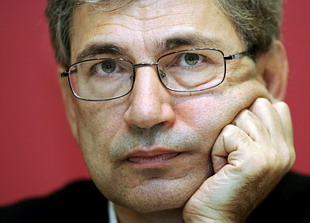
Uncredited photo of Pamuk found in various places online.

Dream life


Flickr has a feature where you can see "random selection of some of the interesting things discovered on Flickr within the last 7 days."

There are a lot of talented people out there, many busy shooting travel, kids, animals, nature, architecture photos. Generally with great color and lighting; mostly 'obvious' yet well-composed shots.

Sometimes startling beautiful.

Nomads child, by Mielna

Round house, by hyperfocusing

Monday, October 16, 2006

Thousand by thousand


What is it about men that makes them make lists? Especially lists of the best--usually without qualification. I guess to name, to enumerate, to define, to exclude is to assert power; and guys tend to go for that kind of thing.

I was pointed to Piero Scaruffi's site by a Times article on him and it, The Greatest Web Site of All Time (I mean, how can you resist a headline like that, if only to scoff when it doesn't go here?!

It turns out Scaruffi and his self-titled site consist mainly of a very large collection of lists--primarily focused on music, but not exclusively. I shudder at how much time Scaruffi must have put into the site....

Since I know very little about music, I looked first at his Rock section, at the list of Best Rock Albums of All Time:

1. Captain Beefheart: Trout Mask Replica
2. Robert Wyatt: Rock Bottom
3. Faust: Faust I
4. Velvet Underground: & Nico
5. Doors: The Doors
Uh, okay--I mean why not, I really don't know that much about rock, and sure it's weird that no other similar list I've ever seen has even listed 1-4, but maybe I haven't come across the lists of true rock afficienados like Scaruffi.

Besides which, of all the arts music is probably the most intensely personal--it's in some ways the most accessible art form, with lower barriers to entry than the others (all you really need is ears, hence every 14-year-old can style himself somesortof expert on some genre), so I'm willing to accept Scaruffi's list as being valid, even if I have some doubts.

But then I took a look at his list of The 1,000 Best Films of all Times (copyrighted, like all his other lists), and found:
Orson Welles: Citizen Kane (1941)
Alfred Hitchcock: North By Northwest (1959)
Orson Welles: Touch Of Evil (1958)
Roman Polanski: Chinatown (1974)
Robert Altman: Nashville (1975)
Sam Peckinpah: The Wild Bunch (1969)
Francis Ford Coppola: The Godfather Part II (1974)
Elia Kazan: Splendor In The Grass (1961)
John Ford: The Man Who Shot Liberty Valance (1962)
Lars von Trier: Riget/ Kingdom (1995)
Now I know a fair amount about cinema, and have seen most of the films on this list, so two things struck me right away: 1) Scaruffi's list is absolutely generic; 2) he has pretty pedestrian taste.

You have to go to #39 on his list to find a single film by a non-Western director (any guesses as to which director, which film?!); indeed, of his top 100 films, exactly 5 are from non-Western directors.

Having seen all five of his films, I can tell you they're the most accessible of the non-Western works that usually appear on film lists; the two Kurosawa films and the Ozu work usually appear much higher on serious film lists than they do on Scaruffi's. And the other two films, while interesting, are also the kind of films that people who think they're cinema insiders cite when asked for their 'sleeper' great films picks.

At least he qualifies his The best novels of all times list with 'in the English language.' This list is better than his cinema list, but even so it's the type of list an English major might pull together after his freshman year:
Henry James (USA, 1843): "The Golden Bowl"
James Joyce (Ireland, 1882): "Ulysses"
Emily Bronte (Britain, 1818): "Wuthering Heights"
Vladimir Nabokov (Russia, 1899): "Ada"
Thomas Pynchon (USA, 1937): "Gravity's Rainbow"
William Faulkner (USA, 1897): "Light in August"
Virginia Woolf (Britain, 1882): "To the Lighthouse"
William Gaddis (USA, 1922): "The Recognitions"
Joseph Conrad (Poland, 1857): "Nostromo"
John Barth (USA, 1930): "Giles Goat Boy"
Salman Rushdie is the only non-white author on his ranked list of 35, with no non-Western authors in translation represented among the first few hundred selections that I could see.

As for his section on politics... his 'analysis' pieces on the News of 2006 are little more than sophisticated twaddle--they have the rhythmn and sound of serious op-eds that you might read in the Times or the Post, but he both gets little facts wrong and piles up nutty conclusions. Plus the writing style is painfully convoluted and has that strident tone common to oblivious political dilettantes. A little knowledge, indeed....

Based on the Times piece, Scaruffi seems like quite an interesting guy. But if his website is any indication, he's less than the sum of his knowledge. You wonder if you'd even get a word in edgewise with him.

Uncredited photo of Piero Scaruffi from his website.

Mine. All mine.


Best of the Best Cali, short hair manx, 4, of Trenton, N.J., is seen with her medal at the 2006 Cat Fanciers' Association-Iams Cat Championship at Madison Square Garden, Sunday, October 15, 2006 in New York. Three hundred pedigreed cats representing 41 recognized breeds competed in the show. AP caption and photo by Shiho Fukada.

Sunday, October 15, 2006

Leave it


The great thing about having a worldview is it allows you to quickly and generally effectively synthesize new data. You don't have to invent the wheel from scratch everytime--you simply relate something new to what you already think, figure out how well it matches, and depending on the degree and importance of the overlap either square it with your beliefs, or else put it aside as something the needs further thought.

The problem with having a worldview is it makes you predictable; and it's not always easily recognizable when new thought is required. As armies always fight the last war unless explicitly prodded otherwise, likewise humans tend to keep thinking the way they always have, especially if your worldview has always been to your benefit.

Republicans in this country tend to have a worldview that came of age in the post-WWII era, where White Male Americans staved off the Nazis and the Japanese, saving Western civilization in the process. This actually happened; although women and the Brits et al certainly played their part, WMAs provided the key muscle that knocked out Hitler and Tojo.

Once they got home, however, WMAs found a country that had changed in their absence. Women and minorities had, by necessity, gone to work in factories and had their own taste of leadership, with good results. They weren't willing to go back on the farm.

WMAs reacted poorly to this. They were used to being kings in their own castle; they felt they deserved more than gratitude for dying in Europe and the Pacific and for forging a world where America was supreme, at least in the non-Soviet sphere.

Naturally, the 'children' rebelled; the Civil Rights and later Women's Rights movement, coupled with Vietnam and actually Watergate shook WMAs' confidence in themselves. For a while, it seemed as if they might be pushed off or abdicate their top-down model (bye-bye Archie, hello Alan Alda).

But the fall of Communism and, more recently, the threat of terrorism has WMAs feeling vindicated, with many of them thinking they've been called back into the saddle.

Shows like '24' and 'House' and movies like 'Superman Returns' overtly play into WMAs' need to see a world as in peril, relying and awaiting their strong hand.

We're not. This new world is inherently changeable and diverse in all senses of the world. One worldview ain't gonna cut it anymore; we need lots of different types of people, with varied life and cultural experiences who aren't just there for window-dressing.

In this environment, the WMAs organizational chart approach to the world is outmoded. Or, in more personal terms, father doesn't always know best, and non-WMAs aren't children anyway.

George Lakoff's book Whose Freedom? The Battle Over America’s Most Important Idea seems to touch on this line of thought. I haven't read it yet, but Tobin Harshaw's brief review of it in the Times concludes this way:

Lakoff uses a parenting metaphor to explain the worldviews that produce these anathematic ideas of liberty: progressive thought stems from the “nurturant parent family” model (based on “empathy and responsibility”), while the conservative outlook is shaped by the “strict father family” model (in which the “moral authority . . . of the father must not be seriously challenged”). In case you’re wondering which household is more promising for the family politic, Lakoff helpfully informs us (without statistical attribution) that “strict father families have high rates of spousal and child abuse and divorce.”

So how does the strict father morality devolve into a political agenda? According to Lakoff, conservatives believe that “fundamental” freedoms to be cherished include “freedom from coercion by the state or by the liberal elite”; “the freedom to use any kind of vehicle anywhere”; “the freedom to hunt — regardless of whether I am hunting an endangered species.” After they get back from riding snowmobiles over northern spotted owls, these troglodytes apparently have bigger game in mind: “What they want to conserve is, in most cases, the situation prior to the expansion of traditional American ideas of freedom: before the great expansion of voting rights . . . before Social Security and Medicare.”

O.K., we can stipulate that conservatives share a distrust of government and would love to slash programs that have improved the nation over the years (as well as, perhaps, some that haven’t). But does anybody not wearing a tinfoil hat believe that Republicans really want to take the vote away from women, blacks and non-landowners? Or that President Bush’s poorly managed Medicare prescription-drug expansion was a clever ruse to destroy the program?
Of course, the GOP doesn't want to literally repeal the 14th Amendment; that'd be too messy and politically infeasible. But their emperical efforts to supress voter turnout makes that pro forma move unnecessary.

If you believe, either consciously or subconsciously, that WMAs are either biblically or culturally the natural leaders of the world, but are also open to the reality that demographically WMAs are an ever-shrinking proportion of the American electorate, the only viable solution is to try and dilute the influence of non-WMAs. Why wouldn't you, if this is the worldview you grew up on and the only one that you know?

So you take actions, coordinated or not, conscious or not, consistently or not, but all cumulatively acting to lessen and denigrate the participation of non-WMAs in the electoral system.

Or, you act to co-op non-WMAs to support the leadership of WMAs. For example, evangelical Christians opt for the latter by emphasizing the 'helpmate' role of women, in some cases barring women from teaching Sunday School to boys.

It's all in vain; the WMA backlash we're currently experience may stave off change for a while, but in the end the world changes and WMAs will have to adapt. If your worldview is built on sexist and racist foundations and brute force is slipping away, you have to be effective to maintain your grip.

But the WMA worldview no longer functions well--if it ever did in the pre-communications age--as exemplified with Bush et al having become the worldwide poster child for incompetence.

In our world today, the Allies are gonna look a lot less like Roosevelt, Churchill and Stalin; and more like Gandhi, King and Chavez... and even Rodham Clinton.

Uncredited 'Leave it to Beaver' photo found in various places online.

Saturday, October 14, 2006

Nightfall for the wasps


What makes the Times great? Certainly the big things, like great reporters, editors and news judgment.

But also little things, like keeping editorial calendars where they make sure to follow up on their own stories.

Nine months ago, the Times' Sam Roberts wrote a story that started:

If the experts are right, some time this month, perhaps somewhere in the suburban South or West, a couple, most likely white Anglo-Saxon Protestants or Hispanic, will conceive a baby who, when born in October, will become the 300 millionth American.
That day, apparently, has come. And, like clockwork, Sam's back with
The 300 Millionth Footprint on U.S. Soil:
By one count, more than half of all the people who have ever lived in the United States are living today. And their ranks are expanding. On any given day, 11,000 babies are born and 3,000 immigrants arrive, outnumbering the people who die or emigrate.

At the current rate, the person who tips the population past 300 million will emerge in a week or so.

The recent surge of immigrants actually makes America’s diversity closer to what it was in 1915, when the 100 millionth arrived, than in 1967, when the 200 millionth was born (chances are nearly even that a baby born today will be Hispanic). At all three milestones, the nation was either on the verge of war or already in one.
This second story is shorter than the first, but its accompanying charts are well worth checking out.

That first story inspired a post, One day 1/5th the Size of China, about the 200th million American, an Asian American according to Life magazine in 1967.

Too bad a magazine of Life's stature isn't around today to annoint the 300th millionth American. Whoever he or she is, it's a fair bet that they'll grow up speaking more than one language--maybe Spanish, or one day Chinese.

To again quote what might well be the unofficial anthem of our epoch, the times indeed are a changing. As the Times found out shortly after the first piece ran--an appended correction online reads:
A front-page article on Jan. 13 about the expectation that the United States population would reach 300 million in October misstated the proportion of Americans who are Anglo-Saxon Protestants. According to current surveys, about 40 percent of the population is white Protestant. Anglo-Saxon Protestants, therefore, do not account for "most Americans."
Photo of non-Anglo-Saxon Protestant baby found online.

In harmony


Vienna Teng is one of my favorite singer/songwriters. I first heard her at a convention, of all places. Afterwards I waited in a long line to buy her CD and get her autograph (I've learned the hard way not to pass up a chance for some personal contact with someone whose work you like; likewise, don't miss out on buying a piece of original artwork that catches your eye (regardless of its bulk)).

She's got a great, mellow yet intelligent sound--you just want to keep listening to her (she's compelling, and not always quietly), and the words and melody chase themselves around in your head afterwards. They're the kind of songs that draw out whatever emotion's inside of you at the moment--and somehow, even when it's sadness, it's all good.

Teng doesn't have the standard musician's background, nor seemingly the personality. And she has an interesting 'scrapbook'/blog up, and you can also listen to songs via a jukebox at her website.

Boy, whatever did rising musicians--and erstwhile fans--do before the Web?!

Uncredited photo of Vienna Teng from her website.

Friday, October 13, 2006

Best words, best place?

The latest entry in the ongoing harshest (yet possibly entirely justified) letter to the New York Times Book Review. How do you recover from opening up the paper and reading something like this?

To the Editor:

With regard to your review of Charles Wright’s new volume of poems, “Scar Tissue” (Sept. 17): I cannot bring myself to believe that I am the only serious follower of contemporary poetry who is getting sick of reading reviews by young literary nonentities posing as Randall Jarrell, and with cheap and superficial sarcasm standing in for genuine wit quoting out of context and generally manipulating the work of a master like Wright for the purpose of proving some artistic or prosodic theory of their own, usually one that has little or nothing to do with the book under discussion.

Wright is one of a very small handful of poets widely considered to have made, over decades, a significant contribution to the body of American literature in our time, and he long ago earned the right — regardless of any particular reviewer’s aesthetics — to be discussed, even to be disliked, with some degree of thoughtful reverence, as opposed to the still stylishly ironical and arrogant condescension to which even The New York Times Book Review unfortunately remains far too hospitable. Taking up space in a relatively brief discussion of a serious book to speculate, for example, on the state of the author’s keyboard (“I picture his comma key worn down to a nub and the period filmed with dust”) is simply pathetic, and makes me wish I could take that sharp stick the reviewer fantasizes poking Charles Wright with and giving him a good spanking — proof, perhaps, that stupid writing produces a stupid state of mind, in this reader and I suspect in others, just as surely as fair and profound writing tends to produce a serious and objective one.

I have a suggestion: Why not assign beginners to review other beginners, and when dealing with the work of proven contemporary masters like Wright, take the trouble to enlist the mind of someone capable of writing intelligent prose?

Franz Wright

Waltham, Mass.

The writer won the Pulitzer Prize for poetry in 2004.
Uncredited photo of Franz Wright via New York State Writer's Institute, SUNY. Uncredited photo of review writer Joel Brower via Saint Lawrence College.

What we remember


It seems you can no longer skip reading the Times' Sunday magazine--every issue has at least one article that sticks with me, that helps me think about things in a different way; even the rotating serial cartoons are interesting.

This week's wow! piece is Charles Siebert's unfortunately-headlined An Elephant Crackup?. The article's about how scientists are applying to elephants techniques and lessons learned from treating post-traumatic stress syndrome in soldiers, refugees and other victims of extreme trauma.

It's not at all one of those touchy-feely, naval-gazing dog whisperer pieces. It's very much rooted in reality; as Siebert notes,

All across Africa, India and parts of Southeast Asia, from within and around whatever patches and corridors of their natural habitat remain, elephants have been striking out, destroying villages and crops, attacking and killing human beings. In fact, these attacks have become so commonplace that a new statistical category, known as Human-Elephant Conflict, or H.E.C., was created by elephant researchers in the mid-1990’s to monitor the problem. In the Indian state of Jharkhand near the western border of Bangladesh, 300 people were killed by elephants between 2000 and 2004. In the past 12 years, elephants have killed 605 people in Assam, a state in northeastern India, 239 of them since 2001; 265 elephants have died in that same period, the majority of them as a result of retaliation by angry villagers, who have used everything from poison-tipped arrows to laced food to exact their revenge. In Africa, reports of human-elephant conflicts appear almost daily, from Zambia to Tanzania, from Uganda to Sierra Leone, where 300 villagers evacuated their homes last year because of unprovoked elephant attacks. ...

For a number of biologists and ethologists who have spent their careers studying elephant behavior, the attacks have become so abnormal in both number and kind that they can no longer be attributed entirely to the customary factors. Typically, elephant researchers have cited, as a cause of aggression, the high levels of testosterone in newly matured male elephants or the competition for land and resources between elephants and humans. But in ‘‘Elephant Breakdown,’’ a 2005 essay in the journal Nature, Bradshaw and several colleagues argued that today’s elephant populations are suffering from a form of chronic stress, a kind of species-wide trauma. Decades of poaching and culling and habitat loss, they claim, have so disrupted the intricate web of familial and societal relations by which young elephants have traditionally been raised in the wild, and by which established elephant herds are governed, that what we are now witnessing is nothing less than a precipitous collapse of elephant culture.

It has long been apparent that every large, land-based animal on this planet is ultimately fighting a losing battle with humankind. And yet entirely befitting of an animal with such a highly developed sensibility, a deep-rooted sense of family and, yes, such a good long-term memory, the elephant is not going out quietly. It is not leaving without making some kind of statement, one to which scientists from a variety of disciplines, including human psychology, are now beginning to pay close attention.
There are many interesting moments like this in the piece; I had no idea, for example, of how dependant elephants are on living with other elephants.
Elephants, when left to their own devices, are profoundly social creatures. A herd of them is, in essence, one incomprehensibly massive elephant: a somewhat loosely bound and yet intricately interconnected, tensile organism. Young elephants are raised within an extended, multitiered network of doting female caregivers that includes the birth mother, grandmothers, aunts and friends. These relations are maintained over a life span as long as 70 years. Studies of established herds have shown that young elephants stay within 15 feet of their mothers for nearly all of their first eight years of life, after which young females are socialized into the matriarchal network, while young males go off for a time into an all-male social group before coming back into the fold as mature adults.

When an elephant dies, its family members engage in intense mourning and burial rituals, conducting weeklong vigils over the body, carefully covering it with earth and brush, revisiting the bones for years afterward, caressing the bones with their trunks, often taking turns rubbing their trunks along the teeth of a skull’s lower jaw, the way living elephants do in greeting. If harm comes to a member of an elephant group, all the other elephants are aware of it. This sense of cohesion is further enforced by the elaborate communication system that elephants use. In close proximity they employ a range of vocalizations, from low-frequency rumbles to higher-pitched screams and trumpets, along with a variety of visual signals, from the waving of their trunks to subtle anglings of the head, body, feet and tail. When communicating over long distances — in order to pass along, for example, news about imminent threats, a sudden change of plans or, of the utmost importance to elephants, the death of a community member — they use patterns of subsonic vibrations that are felt as far as several miles away by exquisitely tuned sensors in the padding of their feet.
I mean, how can anyone support keeping elephants in zoos and circuses after reading this piece?!

Interlaced throughout Siebert's article are the parallels between the de facto elephant genocide going on in the wild and the mass slaughter of humans in Africa. The same forces that throw handgrenades at elephants to get at their ivory think nothing of killing parents in front of their children, and then forcing the orphans to join their 'army.'

But I wonder how many people will remember only the elephant part of the piece, long-ago having become desensitized to the constant drumbeat of war/famine/death/suffering we associate with that so-far-away part of the world.

Maybe if we frame the problem in terms of what can be done to save these majestic animals, it'll be easier to break through the clutter and we can wind up saving our fellow humans, and ourselves--and we won't wind up having to explain to our children why elephants went extinct on our watch and how Africa left the civilized world. It is all, as Siebert makes clear, interlinked.
The other part of our newly emerging compact with elephants, however, is far more difficult to codify. It requires nothing less than a fundamental shift in the way we look at animals and, by extension, ourselves. It requires what Bradshaw somewhat whimsically refers to as a new ‘‘trans-species psyche,’’ a commitment to move beyond an anthropocentric frame of reference and, in effect, be elephants. Two years ago, Bradshaw wrote a paper for the journal Society and Animals, focusing on the work of the David Sheldrick Wildlife Trust in Kenya, a sanctuary for orphaned and traumatized wild elephants — more or less the wilderness-based complement to Carol Buckley’s trauma therapy at the Elephant Sanctuary in Tennessee. The trust’s human caregivers essentially serve as surrogate mothers to young orphan elephants, gradually restoring their psychological and emotional well being to the point at which they can be reintroduced into existing wild herds. The human ‘‘allomothers’’ stay by their adopted young orphans’ sides, even sleeping with them at night in stables. The caretakers make sure, however, to rotate from one elephant to the next so that the orphans grow fond of all the keepers. Otherwise an elephant would form such a strong bond with one keeper that whenever he or she was absent, that elephant would grieve as if over the loss of another family member, often becoming physically ill itself.

To date, the Sheldrick Trust has successfully rehabilitated more than 60 elephants and reintroduced them into wild herds. A number of them have periodically returned to the sanctuary with their own wild-born calves in order to reunite with their human allomothers and to introduce their offspring to what — out on this uncharted frontier of the new ‘‘trans-species psyche’’ — is now being recognized, at least by the elephants, it seems, as a whole new subspecies: the human allograndmother. ...

I thought back to a moment in Queen Elizabeth National Park this past June. As Nelson Okello and I sat waiting for the matriarch and her calf to pass, he mentioned to me an odd little detail about the killing two months earlier of the man from the village of Katwe, something that, the more I thought about it, seemed to capture this particularly fraught moment we’ve arrived at with the elephants. Okello said that after the man’s killing, the elephant herd buried him as it would one of its own, carefully covering the body with earth and brush and then standing vigil over it.

Even as we’re forcing them out, it seems, the elephants are going out of their way to put us, the keepers, in an ever more discomfiting place, challenging us to preserve someplace for them, the ones who in many ways seem to regard the matter of life and death more devoutly than we. In fact, elephant culture could be considered the precursor of our own, the first permanent human settlements having sprung up around the desire of wandering tribes to stay by the graves of their dead. ‘‘The city of the dead,’’ as Lewis Mumford once wrote, ‘‘antedates the city of the living.’’

When a group of villagers from Katwe went out to reclaim the man’s body for his family’s funeral rites, the elephants refused to budge. Human remains, a number of researchers have observed, are the only other ones that elephants will treat as they do their own. In the end, the villagers resorted to a tactic that has long been etched in the elephant’s collective memory, firing volleys of gunfire into the air at close range, finally scaring the mourning herd away.
Uncredited elephant image via Puzzlehouse.

Falling far from the tree


R.W. Apple, the legendary New York Times political reporter, died October 4th at the age of 71. Although I knew he's lionized as the best print political reporter of his generation, I remember him mainly for his wonderful food articles the last few years, filed from all over the world and always including a mention of "my wife Betsey."

Todd Purdum's aptly-headlined Times obituary, R. W. Apple Jr., Globe-Trotter for The Times and a Journalist in Full, Dies at 71, opens with:

With his Dickensian byline, Churchillian brio and Falstaffian appetites, Mr. Apple, who was known as Johnny, was a singular presence at The Times almost from the moment he joined the metropolitan staff in 1963. He remained a colorful figure as new generations of journalists around him grew more pallid, and his encyclopedic knowledge, grace of expression — and above all his expense account — were the envy of his competitors, imitators and peers.
Apple, with his searching intelligence, limitless ego, tireless work ethic, and at-times bullying personality, seems to me the epitome of a famed journalist. He never won the Pulitzer, although as Purdum notes:
Mr. Apple enjoyed a career like no other in the modern era of The Times. He was the paper’s bureau chief in Albany, Lagos, Nairobi, Saigon, Moscow, London and Washington. He covered 10 presidential elections and more than 20 national nominating conventions. He led The Times’s coverage of the Vietnam War for two and a half years in the 1960’s and of the Persian Gulf war a generation later, chronicling the Iranian revolution in between. ...

In later years, he turned the same searching, childlike curiosity to writing about food, architecture and travel from around the globe.
The Times obit led me to a long but worthwhile Calvin Trillin profile of Apple that appeared in the New Yorker a few years back. There's Trillin's usual mix of sly observation and telling anecdote; you understand Apple's burning ambition, his desire to make something of himself in the world and then to get all that he was entitled to once he did. Including this doozy:
I once suggested to Apple that he bequeath his expense accounts to the Smithsonian Institution. “But the Times has them,” he said. “I turned them in.” He sounded a bit regretful, it seemed to me, that he was not in a position to give posterity an opportunity to inspect some of his more stunning creations. At the Times, the various departments have what is called a cost center—what amounts to a budget line. The foreign desk has a cost center. The editorial board has a cost center. R. W. Apple, Jr., has a cost center. “It’s been my fate and privilege over the years to sit next to various people who were approving Apple’s expense accounts,” Al Siegal says. “There were hoots, and once in a while you’d look up and the person—these were various assistant managing editors—was shaking his head and reading off ‘Wine from my cellars . . .’ ” Siegal, who is a great admirer of R. W. Apple, Jr., thinks that, all in all, the Times has received good value.

Asked about having his own cost center, Apple is suddenly overcome with modesty. “It’s because I write for all these different parts of the paper,” he told me.
Too many of today's journalists, I think, hunger for Apple's expense account without possessing anywhere near what it takes to deserve it.

The last article of his I read before his death, Singapore: A Repressed City-State? Not in Its Kitchens, seemed to me a great example of travel and food writing as journalism. The last article that he wrote, originally slated to be published later this fall, was The Global Gourmet.

It centers around "10 restaurants abroad that would be worth boarding a plane to visit, even in these fraught days," and since he knew he was near death contains the line, "What will you order for your last meal on earth?” The places listed are nearly all in the West; but unlike many of his fellow reporters, Apple consciuosly acknowledges his tastes and recognizes them as limiting even if authentic.

Apple's words always prompted hunger in me, and I usually felt he knew what he was talking about even as I marveled at the vast scope of his canvas. The Times has put online an archive of Apple's articles. There are 1,753 of them.

Of course, this being the modern Times, the web version of Apple's obit ends with this appended.
Correction: An obituary yesterday about R.W. Apple Jr., a correspondent and editor at The New York Times, omitted the city of residence of one survivor and omitted the surname of another. Mr. Apple’s stepson, John Brown, lives in Alexandria, Va., and Mr. Apple’s sister is Barbara Pittman.
Photo of Apple dining at Galatoire's Restaurant in New Orleans in April 2006 by Ozier Muhammad.

There's no Nobel for war


The 2006 Nobel Peace Prize went today to Muhammad Yunus, a Bangladeshi who came up with the idea of lending tiny amounts of money to poor women who wanted to become entrepreneurs.

This 'microlending' by Yunus' Grameen Bank let families buy truly simple things like cows or cell phones that often were the only things they needed to pull themselves out of systemic poverty. Sums as low as $10 allowed them to start selling milk or find out how much their crops were really worth--and, since the vast majority of the bank's 6.6 million lenders since 1983 have been women, Yunus has profoundly changed society in his Muslim homeland.

I saw Yunus speak one night four years ago; I'd gone to a work-related event mainly for the chance to meet Walter Cronkite, but came away marveling that everyone didn't know Yunus' name.

He struck me as singularly modest but highly intelligent; someone who just went about directly helping people the way he best knew how, and who because of his startling effectiveness now found himself traveling in circles entirely foreign--but because of his charisma and the strength of his passion Yunus was able to interest pretty much everyone he met in his world.

It's a world that post-9/11 most Westerners know in only cartoon terms. Yunus' successes, as detailed below in the Times article, makes you realize how much better off we'd all be if instead of spending $200 million a day on the war in Iraq, with a total economic cost estimated at $1 trillion (!), we simply gave it all to Yunus to distribute to Muslim women all over the world.

Microloan Pioneer and His Bank Win Nobel Peace Prize

Anand Giridharadas and Keith Bradsher in the Times: ... Since its creation in 1983, Grameen has made a total of $5.72 billion in such small loans, and has turned a profit in all but three years, including $15 million in 2005. ...

Dr. Yunus reacted joyously to the news of the prize, The Associated Press reported. “I am so, so happy,” he said in a telephone interview from Dhaka, the capital of Bangladesh, shortly after the prize was announced. “It’s really great news for the whole nation.”

The son of a prosperous goldsmith, Dr. Yunus has said that his mother’s generosity to the poor instilled in him from a young age a sense of duty to the poor. ...

The inspiration for Grameen Bank came to Dr. Yunus during a trip to the village of Jobra in Bangladesh during the devastating famine of 1976. He met a woman who was struggling to make ends meet as a weaver of bamboo stools. She needed to borrow to buy materials, but because she was poor and had no assets, conventional banks shunned her, and she had to turn instead to local moneylenders whose extortionate rates of interest consumed nearly all her profits.

Dr. Yunus, then a professor of rural economics at Chittagong University, gave the woman and several of her neighbors loans totalling $27 from his own pocket. To his surprise, the borrowers paid him back in full and on time. So he started traveling from village to village, offering more tiny loans and cutting out the middlemen. Dr. Yunus was determined to prove that lending to the poor was not an “impossible proposition,” as he put it.

When he later formalized the loan-making arrangement as the Grameen Bank in 1983, the bank adopted its signature innovation: making borrowers take out loans in groups of five, with each borrower guaranteeing the others’ debts. Thus, in place of the hold banks have on wealthier borrowers who do not pay their debts — foreclosure and a low credit rating — Grameen depends on an incentive at least as powerful for poor villagers, the threat of being shamed before neighbors and relatives.

The bank’s 6.6 million borrowers so far have paid back 98.5 percent of their loans.
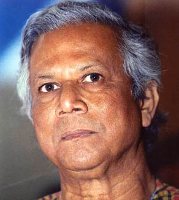
Photo of Yunus from Libertad Digital's Ideas.

Tuesday, October 03, 2006

Thin air in Washington


Another piece of evidence that NBA players are the nuttiest of athletes, and quite possibly pound for pound the weirdest collection of people in the world.

Or maybe it's just all that money frees them up.

Arenas sorry for Team USA vent; thins air in house

The Associated Press: ... Take a deep breath, and get ready for the latest in Gilbertology: Washington Wizards point guard Gilbert Arenas is thinning the air in his house.

"I had my house converted to the Colorado altitude, so I am always above sea level," Arenas said Monday at the Wizards annual pre-training camp media day.

Say what? He's going to live at high altitude in the nation's capital?

"You know, that's kind of weird," Arenas said.

He'll get plenty of nods with that statement, but, yep, he's really doing it. Instead of going to the mountains to train -- as some endurance athletes do -- Arenas has hired a company to simulate those conditions in a home environment.

"I had to put a tent in one room, and then they are going to come during training camp and fix the whole house," Arenas said. "Then I have a portable tent I'm taking on the road."

Arenas hopes the living arrangement will give him more energy in the fourth quarter of NBA games, when everyone else is getting tired from breathing the same old heavy air.

"How I start the game is how I finish the game," he said.

There's always something up with Arenas, whether it was his revelation last year that he played online poker during halftimes, or the multitude of ways he finds to keep chips on his shoulders. No wonder coach Eddie Jordan said last week that he hadn't spoken much to Arenas this summer because he could stand only so much "Gilbertology."

Despite the extra-curriculars -- or maybe because of them -- Arenas is one of the best in the game. He was fourth in league in scoring last season, averaging 29.3 points, and made his second consecutive All-Star team.

Even so, there's a feeling he's never really been given his due. That's why he wears the No. 0 -- he was supposed to get zero minutes at the University of Arizona. Yes, he was an All-Star last season, but only as a late replacement for an injured player.

Fuel was added to the fire this summer, when Arenas was among the final cuts for the U.S. world championship team. The convenient excuse was that he had a strained groin, but Arenas said he essentially withdrew after learning that he probably wasn't going to make the team anyway.

Shortly afterward, Arenas vented his frustration, telling The Washington Post that he was going to exact revenge on Team USA assistant coaches Nate McMillan and Mike D'Antoni by scoring 100 points each on their respective teams, Portland and Phoenix.

On Monday, Arenas apologized -- not a bad idea if he wants to make the Olympic team in two years.

"I said some things, and I vented out against Phoenix and Portland, but those teams actually had nothing to do with anything," Arenas said. "That was wrong of me. I really want to say sorry for it and I want to say sorry to Mike D'Antoni. That was the immature Gilbert two months ago. I'm growing as a person, and I'm ready to be a leader for the Washington Wizards."
Uncredited photo of Arenas via the Washington Post.

Sunday, October 01, 2006

Invisible minority


Media outlets love comparing whites to non-whites. The story line generally is [minority group] falls short of whites. When that isn't the case, it's news too--as an aberration to poked and prodded.

In order to maintain this worldview, however, journalists have redefined minority to exclude Asian Americans.

Think about all the headlines that read 'Minorities lag in test scores,' when the fine print reads and common knowledge tells you that white kids always trail Asian American kids.

Instead of focusing the article on why white kids are under-performing against the new standard, or switching to a less punchy but accurate headline, journalists stick with the underperforming minorities story and edit Asian Americans out of the story.

Latest example in the behind-the-Times is a story trumpeting the discoveryBlack Incomes Surpass Whites in Queens , with Sam Roberts writing:

Across the country, the income gap between blacks and whites remains wide, and nowhere more so than in Manhattan. But just a river away, a very different story is unfolding.

In Queens, the median income among black households, nearing $52,000 a year, has surpassed that of whites in 2005, an analysis of new census data shows. No other county in the country with a population over 65,000 can make that claim. The gains among blacks in Queens, the city’s quintessential middle-class borough, were driven largely by the growth of two-parent families and the successes of immigrants from the West Indies. Many live in tidy homes in verdant enclaves like Cambria Heights, Rosedale and Laurelton, just west of the Cross Island Parkway and the border with Nassau County.
The article reels off a bunch of reasons as to why this departure from the norm has taken place, with a focus on the immigrant experience.

But a solitary fact, buried in paragraph 19, makes clear this latest development merely bumps whites down to third, and blacks up to second, rendering the story not-so-unique (as well as not that timely):
According to the latest analysis, black households in Queens reported a median income of $51,836 compared with $50,960 for non-Hispanic whites (and $52,998 for Asians and $43,927 among Hispanic people).
Uncredited photo of Queens Unisphere via Forgotten NY Street Scenes.

Tuesday, September 19, 2006

Speed reporting


You could say we live in the Jokey era, where even serious topics are looked at slant, with irony or derision or tongue-in-cheek.

Many times it's to compensate for a lack of understanding or knowledge--if it turns out what you write or say misses the point and/or is wrong/stupid/offensive, you can always hide behind the 'I was just kidding' defense and then employ the 'anyway chill out' strikeback.

It also feeds into our natural inclination to divide the world into us and them, snickering at their odd food/culture/customs, except when we erupt with indignation when we're being laughed at.

Why does it have to be that way? Why not just do your best to get it--talk to people in the know, do some reading, ask lots of questions? It's not that hard, it won't take that much time, and at the end of the day you get to trade that slick feeling of hipness in for genuine fulfillment.

And when you do chuckle, it's not out of ignorance but rather shared mirth.

As always, the Times provides fodder. In this case, Neil MacFarquhar, in his It’s Muslim Boy Meets Girl, but Don’t Call It Dating article.

So here’s the thing about speed dating for Muslims.

Many American Muslims — or at least those bent on maintaining certain conservative traditions — equate anything labeled “dating” with hellfire, no matter how short a time is involved. Hence the wildly popular speed dating sessions at the largest annual Muslim conference in North America were given an entirely more respectable label. They were called the “matrimonial banquet.”

“If we called it speed dating, it will end up with real dating,” said Shamshad Hussain, one of the organizers, grimacing.

Both the banquet earlier this month and various related seminars underscored the difficulty that some American Muslim families face in grappling with an issue on which many prefer not to assimilate. One seminar, called “Dating,” promised attendees helpful hints for “Muslim families struggling to save their children from it.”
I wanted to like the article--it's great to see a piece about Muslims with nary a mention of terrorists. How great would it be if we could all sit back and laugh because we love, poking gentle fun at foibles that ultimately cut across all religious and ethnic lines.

But Neil's overly-familiar style and word choice and general tone fall more into the let's all sit back and laugh at the unwitting foreignness of Muslims, befuddled by trying to adhere to a 7th century religion in modern America. Even the photo choice left me flat.

Yo, Neil--satire depends on two things that are entirely missing in post-9/11 America when it comes to Islam: common knowledge, and good intentions. Journalists don't have the luxury of working in a vacuum.

Photo of Fatima Alim, who "has strong views about the kind of woman her son Suehaib, 26, should marry," by James Estrin.

Wednesday, September 13, 2006

Jihad by any other name


It's human nature to want to be part of something bigger than yourself. Who wants to die having been just one out of billions, a drop in the ocean of human history?

Much better to try and create something--a work of art, a big family, a name--that will last long after your bones have returned to earth.

Of course, if you're not that talented, you can always glom onto someone else. Attach your name to something they did; in some way, being mentioned in an Oscar acceptance speech must count for something, right?

But what if you don't even know anyone talented? No sustaining skills of your own, no friends worth much... then what?

Well, then you're in trouble. You're stuck with waking up, eating, sleeping; repeat until dying. Looking for love, maybe finding it maybe not--but in any case, living on only in the fading memories of a few.

Unless, of course, you can latch onto some history-shaking group that'll have you. Then, if nothing else, you can die with a smile on your face, knowing that for a few moments in time you were part of something--perhaps even a vital cog?--that truly mattered. That will never be forgotten.

If you lived in 1930s Germany, for example, maybe you'd have joined the Nazis. Heck, they promised a Reich that would last for a 1,000 years. True, they were a bit bloody, but given that you probably defined your victims as 'other' at best, sub-human at worse, what matter a few million pounds of flesh if you could cleanse Christiandom of dirty Jews forever?

Likewise, if you found yourself in the American South in the 1950s, you could just don your white robes and go hunting blacks in the dead of the night to get away from the 9 to 5, yes sir no sir grind. A few lengths of rope, some torches and a bunch of your closest white friends and poof, you were a force to be reckoned with--not to mention master of your domain for a few hours to boot.

But, what now? In a world of 6 billion? What to do to make your mark, go down in history as a savior of your people, rise above the mundane day-to-day?

Well, as the Washington Post's David Ignatius writes in an insightful column, Young Anger Foments Jihad, for many the answer seems clear. Let loose the dogs of war and march forth to defend our 'civilization'! If we don't get them first you can bet your last dollar they'll surely come get us!

Lock up the women and children, this isn't a sight fit for their eyes. Above all, remember the overiding justice of our cause--you can't make an omelette without breaking some eggs, and brother, we sure are out to make ourselves a doozy of an omelette, one that they're going write odes about and sing songs to for generations.

During Monday's commemorations of the fifth anniversary of Sept. 11, 2001, I found myself wondering what the world will look like on the 10th anniversary, or the 20th. Will the catastrophe that began five years ago become a permanent feature of life -- a "long war" that won't end for many decades? Or will it gradually wane with time?

President Bush made an emphatic case for the long war in his speech to the nation Monday night. In his account, America is locked not simply in a war but in a meta-conflict, "the decisive ideological struggle of the 21st century and the calling of our generation." He described a global enemy of Muslim fanatics that imprisons women in their homes, beats impious men and attacks Americans at will. I admire Bush's toughness, but I disagree with his analysis

As it happened, I spent the hours before Bush's speech moderating a discussion of the meaning of Sept. 11, which was hosted by the World Affairs Council here. One of the panelists was Marc Sageman, a man who comes to these issues with an unusual background -- he was a CIA case officer in Pakistan and then became a psychiatrist. I found in his comments a similarly unusual clarity.

Sageman argues in his book, "Understanding Terror Networks," that we are facing something closer to a cult network than an organized global adversary. Like many cults through history, the Muslim terrorists thrive by channeling and perverting the idealism of young people. As a forensic psychiatrist, he analyzed data on about 400 jihadists. He found that they weren't poor, desperate sociopaths but restless young men who found identity by joining the terrorist underground. Ninety percent came from intact families; 63 percent had gone to college; 75 percent were professionals or semi-professionals; 73 percent were married. ...

What transformed these young Sunni Muslim men was the fellowship of the jihad and the militant role models they found in people such as Osama bin Laden. The terrorist training camps in Afghanistan were a kind of elite finishing school --

Sageman likened it to getting into Harvard. The Sept. 11 hijackers weren't psychotic killers; none of the 19 had criminal records. In terms of their psychological profiles, says Sageman, they were as healthy as the general population.

The implication of Sageman's analysis is that the Sunni jihadism of al-Qaeda and its spinoff groups is a generational phenomenon. Unless new grievances spawn new recruits, it will gradually ebb over time. In other words, this is a fire that will gradually burn itself out unless we keep pumping in more oxygen. Nothing in Sageman's analysis implies that America should be any less aggressive in defending itself against terrorism. But he does argue that we should choose our offensive battles wisely and avoid glamorizing the jihadist network further through our rhetoric or actions. ...

There's another small detail about Iran that strikes me as relevant, now that I'm back home. As I explained in an earlier column, Tehran is a city of crazy drivers who nearly collide at every intersection. But the police are quite strict about requiring seat belts -- something I don't often see in the Muslim world. Even fatalistic taxi drivers buckle up. Another surprise: When I was traveling last week from Tehran to the holy city of Qom, there were actually police on the highway with radar guns, stopping pilgrims who might be tempted to speed. And I'm told the new mayor of Tehran, Mohammad Qalibaf, who succeeded the rabble-rousing Mahmoud Ahmadinejad, has created a special hotline so people can call and get potholes filled and trash collected.

Now I submit to you: A nation that is wearing seat belts is probably not a mortal enemy of the United States.

This is a week when we remember, with horror, that there are dangerous killers in the Muslim world. But unless we make big mistakes, we should not find ourselves condemned to a permanent war, much less a clash of civilizations.
Matania's Battle of Acre painting of Richard the Lionheart via History UK.

Monday, September 11, 2006

Now and then


'Try to Remember'
NPR's All Things Considered, December 13, 2001 The Fantasticks, the longest running musical in history, is closing in New York City in January after a nearly 42-year run. And, as NPR's Margot Adler reports, its famous music has resonated in a very different way since Sept. 11.


AP photo of the 'Tribute in Light' over lower Manhattan as seen from Brooklyn on the fifth anniversary of 9/11 byPeter Morgan.

Friday, September 08, 2006

Want fries with that?


You can't make up some of this stuff. There are so many funny quotes in the Detroit Free Press' day-after coverage of the suspension of an assistant coach for the Lions that even the unprecedented bizarreness of the situation can get lost.

Lions suspend assistant coach for opener

Nicholas J. Cotsonika: The Lions have suspended defensive line coach Joe Cullen for Sunday’s regular-season opener against Seattle because of his two recent arrests, NFL sources said Thursday.

Lions coach Rod Marinelli informed the players of the suspension during a team meeting Thursday morning, but he declined to discuss the situation when he met with the media after practice Thursday afternoon.

“I’m not going to talk about Joe right now,” Marinelli said. “It’s an in-house decision what we’re dealing with. The team knows, I know, and that’s what’s important.”

Cullen coached the defensive line as usual Thursday and is expected to continue coaching in practice. He was unavailable for comment.

Lions chief operating officer Tom Lewand declined to comment, and team president Matt Millen could not be reached for comment.

Cullen met with the defensive linemen Wednesday.

“He was just like, ‘This is what happened. I apologize,’" defensive end Kalimba Edwards said. “He was real professional about it.”

Cullen was arrested and charged with indecent and obscene conduct Aug. 24, the night before the Lions’ third exhibition at Oakland. A worker at a Dearborn fast-food drive-thru window saw him naked behind the wheel of his SUV and called the police, according to police reports.

Then Cullen was arrested and charged with drunken driving Sept..1, the night after the Lions’ exhibition finale against Buffalo. After he sped down a Dearborn street without his headlights on, someone called the police, and when the police found him, a breath test determined his blood-alcohol content was .12, over the legal limit, according to police reports.

“In pro football — in life, period — in this day and age, it’s hard to be shocked by anything,” Edwards said. “When he told us, we were just like, ‘All right. We play football on Sunday, dog. Keep on coaching. We’re going to keep on playing.’"

Some players learned of the incidents by listening to sports talk radio as they drove to team headquarters Thursday morning.

When Marinelli addressed the situation in the team meeting, he didn’t go into detail about what Cullen did.

“I’ve been trying to find a paper to get exactly what happened,” wide receiver Eddie Drummond said.

Marinelli — who called it a “great, great talk” — discussed how he expected the Lions to handle the potential distraction. He said this kind of thing was why he put the Lions through a tough training camp and why he flew them to the Bay Area the day of their exhibition at Oakland instead of the day before.

“Who can forget that airplane trip and concentrate on the game?” Marinelli said. “We had 13 guys who could do that. … That’s how you handle these situations with the team. They seemed to respond very well. We’ll find out. We’ll come and we’ll go put ourselves on the field on game day.”

Marinelli has only one team rule — the “Do Right” rule, which essentially means use your common sense and do the right thing. He also has a “Do Right” list. Mess up — in ways little or large — and you’re on it.

Cullen is “on the ‘Do Right’ list today,” wide receiver Roy Williams said, speaking figuratively. Cullen was not actually on the list. “I’ve been on the ‘Do Right’ list, too,” Williams said.

Williams said the Cullen situation wasn’t a distraction for the offensive players because they “don’t even know the guy, really.” But as for the defensive linemen, Williams said: “It might be a distraction for those guys.”

The defensive linemen insisted they could see Cullen the same way they had before and respect his authority.

“We’re supporting the guy,” defensive tackle Marcus Bell said. “We’re behind him. That’s all that matters.”

“The thing is, he’s a Lion, he’s family and we’re going to support him because all he does is support us,” defensive tackle Tyoka Jackson said.

“As a professional athlete, man, what goes on in a person’s personal life ain’t got nothing to do with the job,” Edwards said. “All kinds of stuff’s going on in these cats’ lives. You’ve still got to go out and play ball on Sunday.”
Uncredited Detroit Lions photo of Cullen via the Free Press.