Tuesday, June 13, 2006

Deja vu all over again


As the historian John Lewis Gaddis has written, "It was not that the Americans lacked the capacity to force their allies into line.. . .What is surprising is how rarely this happened; how much effort the United States put into persuading — quite often even deferring to — its NATO partners."
I thought this was an interesting quote when I saw it in the middle of a long essay the historian Peter Beinart wrote for the April 30th New York Times Magazine.

Oddly enough, when I googled it later, not only did it pop up on the Times website--but the Washington Post's as well. In slightly different form, as part of Beinert's opinion column on June 1:
As the historian John Lewis Gaddis has written, "It was not that the Americans lacked the capacity to force their allies into line . . . [but] what is surprising is how rarely this happened; how much effort the United States put into persuading -- quite often deferring to -- its NATO partners."
My original point was going to be something about how true power is when you choose not to exercise it, and instead do the hard work of persuasion, relying on the same weapons that your opponents or allies have, without thinking in the back of your mind if all else fails I can always nuke them.

I was going to cite the scenes in Schindler's List where Liam Neeson talks to the Nazi camp commadant (Ralph Fiennes) about how real power is when you choose to 'pardon' someone... but how per usual Spielberg is only half right, missing that telling someone you pardon them isn't powerful, just doing it and keeping it to yourself is.

I was going to wax eloquent on Iraq, arrogance, international organizations, Republicans, Gibbons, and history measured in centuries.

But instead I find myself wondering what the heck is going on at the Post? They won more Pulitzers than the Times this year, but they're okay with running what's essentially the Cliffs Notes version of the Times article? Did his editor not notice?

Very odd. Obviously the same news quotes frequently appear in different articles published in different newspapers. But most papers have a pretty strict policy for their op-ed pages, that they won't reprint something that's already appeared elsewhere. Not just quote-wise, but idea-wise as well.

Yo Post--you guys can run with the big dog now, at least when it comes to politics. You don't have to settle for history repeating itself.

Uncredited photo of Beinart in various places on the web.

Monday, June 12, 2006

By any means necessary


For 2 Ex-Detectives, Life Terms and Tales of Grief

Alan Feuer in the Times: Calling their crimes the "most heinous" he had ever seen in court, a federal judge issued — but did not officially impose — life in prison sentences yesterday for two retired New York detectives convicted in April of taking part in at least eight murders for the mob.

The sentencing of the men, Louis Eppolito and Stephen Caracappa, drew to a conditional close a stunning case of police corruption that began 20 years ago when they stopped a jeweler on the highway, helped to kill him and later left his body buried under concrete in an auto-body shop.

The judge, Jack B. Weinstein, issued the harshest penalty he could, but held up its imposition until he conducts a hearing later this month to determine if the men had shoddy lawyers, as they contend, and deserve a new trial.

There was little reaction from either man in Federal District Court in Brooklyn and both returned to jail, where Mr. Caracappa's face has grown skeletal and Mr. Eppolito has grown a white goatee and gotten somewhat slimmer.

By law, the friends and family of a victim can address the court at sentencing, and before the penalty was read, there were brutally emotional — and achingly personal — accounts from the survivors.

One of them was Michal Weinstein, daughter of the jeweler, Israel Greenwald, who on Feb. 10, 1986, disappeared after giving young Michal a hug as she waited for a bus. She was 10 years old then, and as she spoke from the stand, addressing both defendants by name, it was with a caged fury that only now, after 20 years, had found release.

"You took away our daddy," she said, "and by doing that you took away our childhood. You took away our mother. You stole our innocence. You filled our nights with nightmares and our days with torture."

She posed a list of questions to the men: Did they know what it was like to be asked about your father and not have an answer? To be treated with fear and pity? To watch from the window as your mother's car is repossessed? To leave the only home you ever knew and loved because you could not afford the mortgage? To take charity from the very charities your father once gave to? To visit a friend who had lost a loved one and be envious? Because they had a grave?

"To be envious of a grave," she said.
My gosh, 20 years of caged fury... what's the sentence for imposing that on someone? Who would serve it?
It seemed impossible after such a speech for another syllable to be spoken, but three more family members of victims took the stand and then, sheepishly, Mr. Eppolito rose to speak.

He began contritely, saying that he understood the families' pain and that, in 22 years as a detective, he had often had to deliver news about a death. He had knocked on doors, he said, had spoken to grieving widows — "I know the feelings."

He then invited the families of his victims — the Greenwalds, the Hydells, the Linos — to visit him in jail, where he promised he could prove to them he was an innocent man.

It was at this point that without warning and certainly without permission, a large man wearing a seashell necklace suddenly stood up.

"Mr. Eppolito!" he yelled from the gallery. "Do you remember me?"

Apparently baffled, Mr. Eppolito said, "No."

"I'm the guy you put away for 19 years! I'm Barry Gibbs! You don't remember me? You don't remember what you did to me? To my family?"

The marshals quickly led the man outside, as the courtroom burst into applause.

Mr. Gibbs went to prison 19 years ago for murder, but was released in September when a judge in Brooklyn found that Mr. Eppolito had intimidated the only eyewitness in the case into lying on the stand. Mr. Gibbs's startling appearance put something of a kink in Mr. Eppolito's speech, which he amended on the spot, repeating that he did not know the man.
I think everyone who watches and loves the Sopranos should every so often read newspaper articles like this, in between chortling over Johnny Cakes and Tony's fashion sensibilities.

I hope that the family members of crime victims, and the victims themselves when they're still alive, get some sort of closure from being able to stand up in public and vent for a few minutes at least some of their emotion on the criminals.

It's an interesting system we have, with trials and sentencing conducted in public. There's a bit of the Puritan pillaries and stocks still in our soul--which I see as inherently optimistic, actually, stemming from a belief that words can have an impact, whether therapeutic for the victim or punitive on the criminal.

So long as crime victims and their families continue to attend trials and express themselves--whether via victim impact statements, or outbursts--our system works. It's when you see them in the defendant's chair that things will have broken down....
Anthony DeStefano in Newsday: The mother of a 13-year-old boy molested when he was a Boy Scout lashed out Monday at the scoutmaster who admitted abusing him and another youth, just before a state judge hit the man with a 20-year prison sentence.

"This was the worst thing that had ever happened in my life," the woman said to Ronald E. Occhipinti, 46, of Bayside, the former scoutmaster of Troop 183 in Great Neck. "It is unthinkable that this had happened to my beautiful little boy."

The mother, who was not identified in State Supreme Court in Kew Gardens, said that her son had been adopted at the age of 8, an event that was celebrated with a brunch that Occhipinti attended.

"It is a wonder he didn't choke on his food," the woman said of the ex-troop leader.
Photo of Michal Weinstein by Robert Stolarik for the Times.

Sunday, June 11, 2006

From John to Marlon


'The Searchers': How the Western Was Begun

A.O. Scott in the Times: ... Especially in his westerns, [John] Ford loved to create bustling, busy interiors full of life and feeling, and he was equally fond of positioning human figures, alone or in small, vulnerable groups, against vast, obliterating landscapes. Shooting from the indoors out is his way of yoking together these two realms of experience — the domestic and the wild, the social and the natural — and also of acknowledging the almost metaphysical gap between them, the threshold that cannot be crossed. ...

Ernest Hemingway once said that all of American literature could be traced back to one book, Mark Twain's "Huckleberry Finn," and something similar might be said of American cinema and "The Searchers." It has become one of those movies that you see, in part, through the movies that came after it and that show traces of its influence.
The Searchers is one of my favorite films, mainly because of its second half.

The first half is good--sets up the story of Ethan Edwards (John Wayne), who returns to his family in Texas after the Civil War only to go back on the warpath after his niece is kidnapped by nearby Indians. It's got the usual great cinematography, conflicted characters and interesting plot of Ford films.

But the second half adds in Hitchcock, with psychological twists and scenes that at first seem like they're from another film. In particular there's a sequence set on an Indian reservation, Wayne's encounter with Natalie Wood, and that famous last scene with its shot of Wayne on the outside looking in. It's just one of those films where afterwards you shake your head and wonder what you've just seen, there's no feeling of satisfaction or closure, and you don't think about Westerns the same way again.

As Scott notes, the film's been quoted so many times, consciously and not, that it's embedded in our filmgoing mind even for people who haven't seen it. It's interesting how little respect many intellectuals give Westerns; makes me wonder how many Westerns they've actually seen.

In my opinion it's a great film genre--the perfect canvas to explore the age-old issues of man vs. nature, man vs. man, man vs. society. Some of my favorites are:
-The Good, the Bad, and the Ugly, Clint Eastwood, Eli Wallach and Lee Van Cleef in Sergio Leone's lyrical epic

-Seven Samurai/Magnificent Seven, Akira Kurosawa's original may be my favorite film of all time with its great characters, plot, cinematography and sountrack; Hollywood's remake is a worthy echo

-The Big Country, Gregory Peck and Burl Ives are two people you'd never think of in tandem but in this underated movie they're definitive in their respective roles

-High Noon, the Gary Cooper/Grace Kelly classic as-the-clock-ticks exploration of McCarthy-era issues

-Once Upon a Time in the West, another Leone film that's the definition of brutal, purpopseful violence, with an unforgettable performance by Charles Bronson as Harmonica

-Butch Cassidy and the Sundance Kid, Paul Newman and Robert Redford in a totally original and screwy Western for the hippie generation

-Giant, with James Dean--another unconventional Western but one that has all of the genre's hallmarks, as the wide-open is encroached upon by civilization

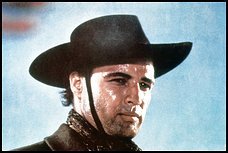
-One-Eyed Jacks, with a smouldering Marlon Brando and a pitch-perfect Karl Malden in a rarely-seen California setting.

The Western really was the genre where Hollywood's greatest actors during its Golden Age went to give their most memorable performances. It's almost like in this carefully-structured field, sneered at by critics and where nobody expected anything more than a good yarn, they were more free than any other to experiment with character and overarching themes.

Ken Ringle in a Washington Post article about One-Eyed Jacks includes some astonishing facts about that film, as well as some lines that you could apply to all the other films on this list:
It cost the then-staggering sum of $6 million -- three times its original budget -- in part because of Brando's insistence on filming hundreds of takes, improvising dialogue and fight scenes, and firing the original director, Stanley Kubrick. Brando never forgave Paramount for re-cutting the picture to 141 minutes and not letting it run the five hours he wanted. ...

Whatever demons were unleashed during its production, it remains today a film of mesmerizing dramatic power and one of the most beautifully filmed westerns ever made. It was shot in Death Valley and on the Monterey Peninsula, and Charles Lang Jr. was nominated for an Oscar for his color cinematography. Lang captured stunning horseback scenes against the thundering surf and pine-shaded sand hills of Big Sur country. When was another western ever filmed on the beach? ...

Brando is never less than mesmerizing in his on-screen journey from charming rogue to explosive avenger, and there is nothing in his career, not even "Viva Zapata" or "On the Waterfront," to match the savage power of his fight scenes or the cold fury of his resolve. Near the climax of the film, he sneers out one of the great lines beloved by all Brando impersonators: "Get up, you scum-suckin' pig!" ...

As much as it toys with the conventions of the western, "One-Eyed Jacks" transcends the genre to become a cinematic meditation on human character. There is no other film remotely like it.
Warners Brothers image of John Wayne in The Searchers via the Times.

Photofest image of Marlon Brandon in One-Eyed Jacks via the Washington Post.

Saturday, June 10, 2006

Frosted Swedes


Sweden vs. Trinidad & Tobago. It's supposed to be a rout for Sweden, which is good for my fantasy team, have Henrik Larsson on it.... Early Swedish free kick, like 19 yards away; no go.

Still scoreless 12 minutes in, even though Sweden's totally dominated play it's a victory for T&T to keep it 0-0 so far. T&T has a good coach, he seems to have drawn up a game plan of staying back, maybe after a while as pressure grows on Sweden they'll attack more.

0-0 32 minutes in, this is actually shaping up to be a pretty interesting match. T&T has had a couple good scoring opportunities, Sweden a few more, but nothing super-threatening. Swedish fans starting to get a bit restless.

No score, approaching halftime. Some decent shots on goal for Sweden, but T&T is beginning to counter attack a bit more effectively. Except for Germany riding the home crowd, the favored team has struggled in every match so far. English fans must be taking heart from Sweden's troubles so far.

ABC announcers saying the T&T goalkeeper was a very late substitution before the game, their starter apparently was injured; he's made some pretty good saves, announcers say he's becoming the storyline. It's a pretty good announcing team, not as judgmental as the first one.

Halftime. This is very surprising... Sweden had been averaging a ridiculous 3 goals/game in qualifying, they've got to be frustrated and a bit worried. As the match wears on the over-matched T&T team might be in trouble, but so far they're playing pretty disciplined and not at all awed by the stage.

Univision is much more serious about showing all aspects of the match--they've got the players coming back out onto the field, milling around. Ready to restart, will be interesting to see what kindof adjustments Sweden made. Oh my gosh! T&T's best player just got his second yellow card and thus is gone, Avery John is out--on what just looked like a strong tackle, the Swede is limping off. So now it's 11 vs. 10... on top of everything else. Very bad luck... but whatever the result at least T&T shutout Sweden at full strength.

Boy, you gotta root for these guys, still 0-0 nearly 10 minutes into the second half. They substitute with an attacking player, instead of a defender; heck, they're going for the win! Longer this match goes on, more pressure on Sweden. If they can't get 3 points out of this, it really doesn't bode well for their chances to get out of the group.

Socca Warriors are really playing with a lot of heart, they've rarely gotten into the Sweden end this half so far but keep trying. Once the Swedes get their first goal, they could then score a flurry... but we'll see. Wow, T&T on a breakaway, a clean shot at goal--hits the crossbar, the best scoring chance of the second half!

Wow, then at the other end T&T goalkeeper makes a great save at point blank range... Shak Hislop, officially the story of the game, at age 37 no less. 11 shots on goal by Sweden, 5 by T&T.

T&T players and coaches have been saying they're for real, aren't just here to enjoy the experience. Nobody believed them, but now.... Is this them being good, or Sweden bad? Swedes make a substitution, see if this helps. 30 minutes left in the match. So far Sweden hasn't had any odd man rushes, can't really tell they have a man advantage--the entire second half has been played in T&T's end, but really, just a couple of dangerous moments for T&T.

Corner kick for Sweden, see if they can take advantage. Their 6th corner announcers say, T&T have none. Another substitution for them, their players have got to be getting a bit tired--and now their fans making a lot of noise.

It's weird, soccer players are always falling down and seemingly getting injured from a level of contact that's absolutely normal in the NBA (not to mention football). Now a Swede's injured and taken off--from running into another player. How?! A few minutes later, and he's stnading up, ready to come back in.

Collision with the T&T goalkeeper, but no other Swede around to take advantage, defender knocks the ball out. Some chatting going on between a Swedish and a T&T player--now more Swedes are laughing, this is insane; they should be upset and going for the win, not being good-natured with their opponents. 20 minutes late, still nothing from the Swedes.

Another yellow card to T&T, for wasting time on a free kick. The Swedes have really been imprecise today, have not looked good. If this score stands up, it's really going to be a shocker. Really, ever single team from Latin America has played better than people thought... maybe I've just been reading the wrong reports.

About 10 minutes left in the match, more sloppy play from the Swedes. Looks like two subs coming in for them, no more substitions left for them, T&T still has one. Oh, and Sweden's best chance of the game, clean shot at goal, goalkeeper comes out and saves it!

And now T&T gets their first corner kick of the game. T&T coach is smiling, fans are excited, but nothing going on the kick. Another chance for Sweden on the other end, no go; then a clean tackle from behind kills another close opportunity. 8 minutes left....

Mayhem, as Sweden gets more chances, but nothing. Now their 7th corner kick; poorly executed. Now just 2 minutes left in normal time... and Larsson gets a yellow card on a tackle outof frustration. 3 minutes of stoppage time... announcers speculating if T&T will go for the win now. Swedes pouring it on, going all out but its sloppy play continues, fans are deflated, whistling.

And that's the game! And the smallest country ever to qualify for the World Cup ties Sweden, which continues its streak of never winning its World Cup opener. T&T players and fans are celebrating like mad, Swedes are in disbelief. Wow, what a great game.

Odd, it's not until in the studio afterwards that they mention Hislop, who was Howard University's goalie (in the 80s!), was a NASA intern. They make the requisite rocket science joke, then toss to golf without showing any match highlights; thank god for Univision.

AFP photo of John Stern and Olof Mellberg via FIFA.

St. George cross


Rooting for Paraguay against England, despite picking England to win this group. So far the English have looked pretty flat; they're up 1-0, but only on the strength of a (bent) free kick by Beckam that went in off the head of a Paraguayan player in minute 3.

ABC's pro-English tilt feeds my cheering for Paraguay... it's interesting, there's a couple seconds delay on ABC vs. Univision. Appropriate that Spanish-speaking fans in the U.S. are experiencing the World Cup before everyone else.

The English fans have been pretty restless, they know this is not a good opener for their team, even if they're able to pull it out. The first-string goalkeeper for Paraguay was injured in the opening minutes as well, but England's been able to do nothing.

England traditionally collapses under the weight of the great expectations from its fans; the criticism will be searing if an English player fails to score in the game. This does not look like a World Cup winning side; as ABC's pretty insightful Marcelo Balboa said, it looks like they need 11 balls out there, the stacked English team isn't playing together. By the way, why do the Brits field one Olympic team, but separate World Cup squads?

The English supporters have just broken into a rendition of God Save the Queen, with 5 minutes left in regulation they must feel like the game's over. How great would a last-second goal from Paraguay be!

Now Al Michaels throws in the fact that there's never been a 1-0 game decided by an own goal in the World Cup. Wow... the poor English, they can't win even when they win. They're gonna get blistered by their tabloids.

Game ends, Paraguay had a late flurry, but doesn't make up for their odd lack of urgency the rest of the match--maybe getting a couple of yellow cards early took the steam out of them. An odd result, neither team seems very high or low. For some reason the stadium speakers are blasting out Andrea Bocelli.

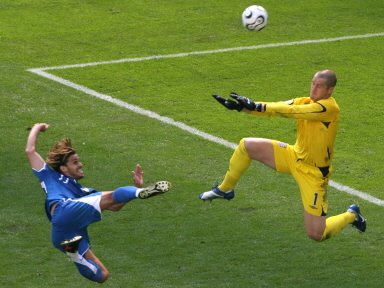
AFP photo of Carlos Paredes and Paul Robinson via FIFA.

Friday, June 09, 2006

Madness kicks off


The World Cup's underway, and already a big surprise, with Ecuador--which has never won in Europe--putting away the Poles 2-0. It was a great match, 1-0 for much of it after Ecuador scored on a nifty header combination off a throw-in. They iced it with a late, relaxed touch pass goal, but Poland made things exciting with two late strikes that hit the crossbar and the post. I feel bad for all the Polish fans who packed the stadium, for whom this World Cup was supposed to be the highlight of their year.

It was a 'stunning' win for Ecuador, not because Poland was so strong but because Ecuador was supposedly so weak away from the high altitude of home. But their manager, Columbian Luis Fernando Suarez, based on body language during the match, seems like a tough, confident taskmaster. He'd said beforehand the team was in great physical shape, and they played like it today, repeatedly darting to balls ahead of the bigger Poles.

Even though I had picked Poland to advance outof this group, the beauty of the World Cup is discovering teams like Ecuador--which played a lot cooler and more deftly than people thought. I'm officially on board their bandwagon; they should beat Costa Rica in the next game, setting the stage for their match with Germany where just maybe there could be a huge upset....

In the early game, which I saw just a bit of, Germany put up 4 goals but surprisingly Costa Rica stuck in 2 of their own in a match that shows how poor the Allemande defense can be, and will restir debate over whether Germany's famed goalkeeper Oliver Kahn should be the one starting.

Granted, da Germans didn't have their best player, midfielder Michael Ballack, but they shouldn't have given up two goals, both to Paulo Wanchope. At least Miroslav Klose matched him with two of his own (good news for my fantasy team... by the way, I'm picking Ukraine's Andriy Shevchenko to score the most goals in the first round).

Of course, a big part of the World Cup story is that it's being held in Germany, which has a problematic history when it comes to the overt displays of nationalism that the world's biggest sporting event engenders. Der Spiegel's Cup blog has an interesting post on how Germans are feeling it's okay again to be proud of being German; although, apparently, not too proud:

The World Cup opening ceremony has just concluded leaving over one billion viewers ever so slightly baffled. The German footballing authorities' decision to stage the first game in Munich now looks a little shortsighted as the ceremony was forced to accommodate a host of lederhosen-wearing, cowbell chiming Bavarians.

Opening ceremonies are always surreal, that is half the fun. Viewers expect to be titillated and exacerbated in equal measure and Germany did not disappoint. But, an army of men in Lederhosen banging drums and swinging cowbells between their legs in joyous enthusiasm pushed the boundaries of taste as well style. And the team of butch Bavarians rhythmically cracking their agricultural whips paid more tribute to the Village People than it did to modern Munich.
But storyline of the day is the strong play of the Latin Americans... it doesn't bode well for much-hyped England, which seems a bit distracted going into tomorrow's early-morning match vs. defensively-tough Paraguay.

To quote the Ecuadorean crowd at the Poland match (via the Times' live match blogger):
Si se puede! Si se puede! (Yes, we can! Yes we can!)
AFP photo of Germany's Mirsolav Klose via FIFA.

AFP photo of Ecuador's Edison Mendez and Poland's Michal Zewlakow via FIFA.

Thursday, June 08, 2006

Amateur writer

B
One of my favorite blogs to pop in on every now and then is The Amateur Gourmet, a theater grad student's account of eating in NYC. It's not great literature, but is consistently entertaining; and even though I don't share the blogger's food taste at all it sometimes points me to restaurants worth a visit.

The other day the blogger mentioned he has a quotation from Vladimir Nabokov, one of my favorite writers, posted on his wall: "Great ideas are hogwash, style and structure are the essence of a work."

I've never heard the quote before, but it fits my view of Nabokov. He's one of those gruff Russian geniuses, a classic hedgehog to borrow Isiah Berlin's term in that he has life philosophies that he applies to his writing in a disciplined, hard-working manner and someone who as a result hates dilettantes/dabblers/sloppy thinkers above all.

The genius of his writing stems from exact and telling description, whether of character or situations, along with inventive plots that unfurl in unexpected--to the reader--ways, stirred with a deep psychological understanding of the human condition. He's all concrete--what happens matters in his books, it's not about mood or talk. Even his love of butterflies was as a collector rather than as a head-in-the-clouds poet. And his letters to Edmund Wilson (Bunny) reveal not great minds communing, but rather are filled with pithy comments and revolve around money.

So maybe it's not surprising that he'd value style and structure--things that can be learned and worked at--over great ideas, which seem to just come to you (although in reality they require the foundation of a lifetime of awareness). It fits the Russian mentality of head-down, straight at 'em, an attitude that compensates for inferior materials, whether in sending waves of soldiers at the Nazis in WWII or in stockpiling nuclear warheads during the Cold War.

I actually disagree with Nabokov (for one thing I like science fiction, which is nothing if not great ideas wrapped in bad style inside bad structure) although I can see his point that having great ideas means nothing unless one also does the hard work of making the most out of them, a process that in writing requires structure and style. It's why Russians love poetry, where every word is absolutely necessary and one idea is enough to inform an entire work (too many indeed leave it bloated).

It was unexpected to see the quote on the Amateur Gourmet's website--he's pretty slapdash--and my guess is Nabokov would've detested the blog as a format ('you must be disciplined in your writing; you must spend time to revise and revise and revise; and you must receive money for your work.').

It's especially ironic that the Amateur Gourmet misquotes Nabovkov... the actual quote from Lectures on Literature appears in the foreword and reads:

Style and structure are the essence of a book; great ideas are hogwash.
Inscription by Nabokov via the Times.

At home and abroad


Coexistence, via the Times.

Diary of North Vietnam Doctor Killed in U.S. Attack Makes War Real

lost wartime diary by a doctor in which she tells of love, loneliness and death on the Ho Chi Minh Trail has become a best seller in Vietnam, bringing the war alive for a new generation of readers.

The journey of the diary itself has given it a special postwar symbolism for people here. It was returned to the doctor's family just last year by a former American soldier who recovered it after she died on the battlefield in 1970.

The writer, Dang Thuy Tram, was killed at the age of 27 in an American assault after she had served in a war-zone clinic for more than three years. Among the intertwining passions she expressed were her longing for a lost lover and her longing to join the Communist Party. ...

"Just yesterday," she wrote at one point, "a badly wounded soldier 21 years old called out my name, hoping I could help him, but I could not, and my tears fell as I watched him die in my useless hands."

When the diary was serialized in newspapers last year, people cut out and saved the articles, passed them among their friends and read them aloud to one another. When it was published as a book, its print run was a sensational 300,000 or more in a country where books are generally published in small numbers, well under one-tenth that number. ...

The visits to Hanoi of the American soldier who saved her diary, Fred Whitehurst, have drawn wide attention and he has been welcomed almost as a member of the family by Dr. Tram's mother, Doan Ngoc Tram, 81, and three sisters.

In a telephone interview from North Carolina, Mr. Whitehurst, who is now a lawyer, said he had been a military interrogator whose job included sifting through captured documents and destroying those that were of no tactical value.

He said he had come to feel that his discovery of the diary linked him and Dr. Tram in a shared destiny, and he now calls her "my sister and my teacher."

"We were out there at the 55-gallon drum and burning documents," he said, describing that moment, "when over my left shoulder Nguyen Trung Hieu said, 'Don't burn this one, Fred, it already has fire in it.' "
The Times tags Fred the American soldier who saved her diary? He was going to burn it, until his Vietnamese translator stopped him!

It's astonishing how gracious Vietnam has been toward America in recent years. Somewhere around 3 million Vietnamese died in our 'stop the dominoes' war, yet they've now normalized relations with us and Secretary Rumsfeld on a recent trip even hailed them for their economic development and cooperation with the U.S.

And I doubt Senator John McCain during his years in a bamboo cage and later prison cell ever thought he'd live to see this:
The Vietnamese greeted their guest with a resplendent military honor guard, which played "The Star-Spangled Banner" before the talks began at the Defense Ministry.
We're lucky that, driven by economic need and a keen desire to keep up with the Chinas of the world, Vietnam has for the most part just tried to forgive and forget when it comes to the war.

Not sure we'd do the same in their place.

Under Oz, a Land of Weird Wonders
William Grimes: Tasmania is a funny place. Under the land down under, nearly off the map, it has been a synonym for isolation ever since the days when it was known as Van Diemen's Land. As Nicholas Shakespeare puts it in "In Tasmania," his rambling, whimsical portrait of the island, "it is like outer space on earth and invoked by those at the 'center' to stand for all that is far-flung, strange and unverifiable. ...

Who could blame Mr. Shakespeare, a British novelist, for taking up residence on the island? It offers breathtaking natural beauty, a pristine rain forest and clean air. "The air of Hobart Town is perfect air," wrote Anthony Trollope, whose ecstatic descriptions of Tasmania in 1873 inspired a mini-migration from Britain. He didn't know the half of it.

Tasmania's far northwest, cleansed by southerly winds, boasts the purest air ever recorded on the planet. All this, and fabulous Tasmanians like Errol Flynn and Merle Oberon. ...

Here and there Tasmanians come to the rescue. Some are contemporary, like the wondrous cricketer David Boon, also known as the Keg on Legs, who upheld a proud Tasmanian tradition when he managed to consume a record-breaking 52 cans of beer on a flight to London in 1989. Some, like Anthony Fenn Kemp, are long dead, and, intriguingly, related to the author.

Kemp, called by some Tasmanians the father of his country and by others "a great Ass," offers Mr. Shakespeare an irresistible point of entry into the history of Tasmania and, it turns out, of his own family. Kemp, a thoroughgoing rascal, was the business partner and brother-in-law of Mr. Shakespeare's great-great-great-grandfather, whom Kemp defrauded of about a million dollars in modern money, promising to send back precious cargoes from Tasmania. Instead, Kemp gained a stranglehold on the liquor trade and set up as a local lord, naming his estate Mount Vernon in honor of George Washington, whom he had visited during his radical youth.

Kemp was volatile, underhanded and universally despised. He was also incredibly lucky, always in hot water, but never burned. As Mr. Shakespeare riffles through the archives, he develops a sneaking fondness for this man, who, for completely selfish reasons, established the first white settlement on Tasmania.

"A monster and a rogue he may have been, and yet there was something satisfying about the repeated pattern of his life — one minute facing catastrophe, the next getting off scot free," Mr. Shakespeare writes.
Wonder what it'd have been like to be Boon's seatmate, or anywhere near Kemp. I think you'd have needed all that clean air to clear your head.

In the Body of an Accounting Professor, a Little Bit of the Mongol Hordes
The first American to be able to claim descent from Genghis Khan has been discovered. He is Thomas R. Robinson, an associate professor of accounting at the University of Miami in Coral Gables, Fla.

Dr. Robinson's descent from Genghis Khan emerged in a roundabout way. The Y chromosome of that Mongol emperor was identified in 2003 by geneticists at the University of Oxford in England. Surveying the chromosomes of Asian men, they noticed a distinctive genetic signature in populations from Mongolia to Central Asia. Their common feature was that all but one lay within the borders of the former Mongol empire.

The geneticists concluded that the far-flung Y chromosome must have belonged to Genghis Khan and had become so widespread because of the vigor with which he and his sons labored in their harems, a fact noted by contemporary historians.

While the geneticists were collecting blood samples from the Oxus to Xanadu, Dr. Robinson was researching his family tree and had established that his great-great-grandfather, John Robinson, had emigrated from Cumbria in England to Illinois. Reaching a dead end, in 2003 he submitted a scraping of cells from the inside of his cheek to Oxford Ancestors. The company traces people's ancestry to specific regions of the world based on their Y chromosomes, which track paternal descent, or on their mitochondrial DNA, which is inherited through the female line.

"They told me my mother's side of the family came from France and Spain and my father's side probably originated in Central Europe," Dr. Robinson said in an interview yesterday.

Recently, Bryan Sykes, the geneticist who founded Oxford Ancestors, decided to look through his database of some 50,000 people to see if there were any anomalous matches with Genghis Khan's Y chromosome. "We get people wanting to know if they are related to Genghis Khan and they never are unless they come from China or Mongolia," he said yesterday in an interview from England.

Among his non-Asian customers was one hit: Dr. Robinson. "Someone rang him up and I think it came as a nice surprise," Dr. Sykes said. ...

Although Genghis Khan was the most spectacular progenitor, several other prolific patriarchs have since come to light, including Giocangga, the founder of the Manchu dynasty in China, and Niall of the Nine Hostages, an Irish king considered by some historians as more of a legend than real.
So much for the stereotype of Asian men as shy and retiring.

[6/22 update: The Times, in the perfectly-headlined article Falling From Genghis's Family Tree, says:
DNA tests have furnished a double surprise for Thomas R. Robinson, an associate professor of accounting at the University of Miami. The first was being told he was descended from Genghis Khan. The second was learning last week that the first test was wrong.

Mr. Robinson's own caution was one cause of this vicissitude. His temporary induction into the Mongol royal house began in April, when he received a call from Oxford Ancestors, an English DNA testing company he had asked in 2003 to test his Y chromosome. The company said that on a recent scan of its database Mr. Robinson's chromosome had emerged as having a genetic signature very close to Genghis Khan's.

Mr. Robinson's male ancestors were British. Perhaps because of that apparent incongruity — and the contrast between his profession and Genghis Khan's — the finding was reported in several newspapers, including The New York Times.

Then a movie company offered to fly Mr. Robinson out to Mongolia. But instead of sitting back and basking in the posthumous fame of his new ancestor as many people might have done, Mr. Robinson decided to get a second opinion before matters went any further.

He sought the view of Family Tree DNA of Houston, only to learn last week from its president, Bennett Greenspan, that he belonged to a different branch of the Y chromosome family tree from that of the Mongol emperor, and could not be descended from him.
I don't think an Asian American who thought he was descended from Attila the Hun would've gotten either media attention or the offer of a free flight to Hungary.]

She and Her Graduation Robe Had to Come a Long Way
It was not the usual gown seen at a college commencement ceremony.

Sarah L. Smith graduated from Hunter College yesterday wearing a handmade cloak of feathers and shells that had traveled more than 8,800 miles but almost couldn't get past inspection at Kennedy International Airport.

Ms. Smith, 32, is a Maori, a New Zealander whose Ngati Kuri tribe made the cloak to celebrate her achievements. She is, she said, the first Maori to graduate from a college in the City University system.

"You have to show you are a worthy recipient," she said, after explaining that her family had submitted a request to tribal officials to have the cloak made.

That was months ago, before 50 people had collected the materials to make it and before her parents had brought it from New Zealand to New York. ...

She lifted it out of its carrying case and pulled it over the robe, explaining that the tribe had sought permission from the New Zealand government to obtain the feathers of three species. Each figures in the story she said the cloak tells.

There are feathers from the kiwi to symbolize stability, she said — their feet are planted firmly on the ground because they do not fly.

There are the feathers from the kuaka, also known as the bar-tailed godwit, a migratory bird that goes from the Southern Hemisphere to the Northern, as she has already done. Then the kuaka returns to the Southern, as she intends to do.

And there are feathers from the native New Zealand pigeon.
Next season on Broadway: Sarah and Her Amazing Technicolor Dreamcoat?

Soldier of Fashion
Whether you are a hawk or a dove or just a peacock, the trappings of war remain resiliently stylish and often go way beyond standard-issue camouflage. To anyone not fluent in the proud tongue of war arcana, the references embedded in our wardrobes are all but invisible, but that's where Bob Melet comes in. One of the world's most exclusive and knowledgeable vintage-clothing dealers, Melet always goes to the source. Which in this case is located in South Wing A of the Kentucky Exposition Center, across the parking lot from the Six Flags amusement park, in Louisville, Ky. Here, at the 14th annual Show of Shows, a three-day event as large as its name, hundreds of military enthusiasts buy and sell collectibles from every era, nation and war. And Melet is shopping. ...

Similarly captivating to him are the "thousand-stitch belts" for sale by a vendor wearing a shirt that reads "I buy Japanese militaria." The five-inch-wide strips of silk or cotton were worn by Japanese soldiers as symbols of protection; the women who made them were required to solicit 1,000 people to add one stitch each. "A thousand people's hands touched each one," Melet marvels. "You can call it whatever you want. I call it folk art." More likely, one of Melet's less sentimental clients will call it next season's wide belt.
If I came across one of those belts, I'd frame it and put it on the wall. How anybody could knowingly use it to prop up their pants is beyond me.

Photo of Dang Thuy Tram from her family via the Times.

Photo of the summit of Tasmania's Cradle Mountain by Hugh Watts for Lonely Planet Images via the Times.

Photo of Sarah L. Smith by Chang W. Lee in the Times.

Photo of senninbari found online.

Wednesday, June 07, 2006

Scoring in Germany


Ah, what the heck--have been reading all about the teams as of late, may as well give it a shot. Thought up top: with Adidas unveiling a new ball (the most perfectly spherical ever, they say), there should be more goals than ever--which means teams that rely on clogging defenses and set plays to score may be in trouble.

Group A
Everyone has Germany coming out first in this weak group; even though it's not a great team they do have the home field advantage. Second spot out is a lot more wide open, with Poland the leading contender and Ecuador and Costa Rica going for the upset. I'm picking Poland, despite their recent poor play--the Ticos have some injuries and Ecuador reportedly doesn't play well away from home.

B
England gets more hype than any other team except Brazil, due to the crazy British press--looks like Wayne Rooney has recovered from his broken foot, so put them down to come out first. Sweden, which hasn't lost to England since 1968, is probably going to see that streak end here; it may also get pushed a bit by Paraguay, but with a recent injury to one of their strikers Paraguay's overmatched. Trinidad & Tobago is just there for fun.

C
This is a hard group, it's this tournament's group of death. Argentina is one of the handful of could-win-it-all-if-Brazil-screws-up teams, but basically tends to choke at the World Cup. They'll win the group, though; and I think the Netherlands will be right behind them. However, Serbia and the Ivory Coast both think they've got a shot at that second slot; don't see it happening, but with a key injury here and there....

D
The experts think is an easy group, with everyone picking Portugal and Mexico. I agree about Portugal--they have a Brazilian coach who's going to be able to get the most out of their 'golden generation's' last go-around. But Mexico... their goaltender's dad just died so he's now back in Mexico, unclear whether he'll be back in time for their first game--against Iran. Which has a bunch of veteran players who all play in Germany; all that, coupled with Mexico's history of underachievement, has me picking Team Melli to take the second spot. Angola's just there to be there.

E
Ah, what may be the toughest group to pick. I keep going back and forth--most experts expect Italy and the Czech Republic to make it out, with the U.S. just missing. I don't know; the U.S. has the following going for it: a brilliant, strong-willed coach in Bruce Arena; an opening game against a beaten-up Czech team in Kaiserslautern, which has a big American military base and thus will have a home feel; and no real pressure from fan expections. So I think they tie the Czechs and their great goalkeeper Petr Cech, then beat Italy--which is preoccupied by a huge soccer scandal back home, has been hit by a late injury bug and seems to be going through a bit of an identity crisis. So I've got the U.S. and the Czechs coming out. The real question will be if the U.S. can win the group, which would allow it to avoid Brazil in the next round... I don't think they will, the Czechs can pile up more goals. Ghana not a bad team and could upset someone, but I don't see them making it out.

F
Brazil will of course win; then Japan, Croatia, and Australia will fight for the second spot. The opening game between Japan and Australia will be key; I'm picking Japan, which has had some very strong results against top teams the last few months and has a lot of Cup experience. But really, Croatia could easily sneak in there, it's a hard group to pick.

G
A totally mixed-up group, you've got France as a slight favorite, but South Korea and
Switzerland right behind, only Togo is out of the mix. France, in any other group, wouldn't make it out, they're in their usual state of disarray. I've got them winning, and then South Korea proving that their run four years ago wasn't a total fluke.

H
An easy one to pick--Spain and Ukraine are the favorites, Tunisia and Saudi Arabia have no chance. I'll say Ukraine beats the always-underachieving Spaniards out in first.

So, then the second round. I've got Germany vs. Sweden, which Germany should win. England vs. Poland, with England moving on. Argentina vs. Iran, Argentina wins. Portugal vs. Netherlands... hmm, a tough one. I'll go with a mild upset and pick Portugal, think the Dutch will be pretty banged up from their first round matches. Brazil vs. the U.S., Brazil of course. Czechs vs. Japan, the Czechs. France vs. Spain, I'm going with Spain in a mild upset. Ukraine vs. South Korea, Ukraine.

Quarters: Germany vs. Argentina, a classic match-up, in an upset I'm going with the South Americans over the home team. Czechs vs. Spain, I have the Czechs. England vs. Portugal, I'm going with the Brits. Brazil vs. Ukraine--I'll tell you right now, if Brazil is gonna get upset, it'll happen here; their goalie's a bit suspect, and Ukraine has a great striker. But I don't think they will, going with Brazil.

Semis: Argentina vs. Czech Republic, a tough one to pick; I'm going with the Argentinians. I think the Czechs will be fatigued by this point; whereas not only is Argentina younger, but most of them have been playing with each other--and their coach--from the juniors on up, it's an unusually tight team. As for Brazil vs. England, I'm sticking with the Brazilians.

Which sets up an all-South American final. Argentina actually beat Brazil 3-1 in Buenos Aires last year, but I'm pretty sure Brazil will win their third Cup in four tournaments.

AFP photo of Brazilian midfielder Ronaldinho Gaucho jumping over Jeremy Christie of New Zealand, 04 June 2006, during a friendly match by Antonio Scorza via FIFA.

Reuters photo of an Iranian fan cheering during a friendly with Costa Rica, March 1, 2006 by Morteza Nikoubazl.

Reuters photo of U.S. coach Bruce Arena during a press conference in Hamburg, Germany, June 2, 2006 by Carlos Barria.

World Cup gone bananas


In football, everything is complicated by the presence of the other team.
-Jean-Paul Sartre
Well, it's almost World Cup time. Which means, even more so than usual, the most-viewed article in the world today is likely to be: Ronaldo's model girlfriend says she won't pose nude

It's interesting how the world's biggest sporting--some would say any--event is beginning to catch on in the U.S. The rest of the world is beginning to react as we start to pay more attention to their sport, and of course as we start beating them at their own game.

London's Guardian newspaper writes:
The United States always feels challenged by the World Cup. Unlike the Olympics, where Americans tend to dominate, the US has rarely shone in the tournament, although it famously defeated England in 1950. It is an 80-1 long shot this time and may struggle to overcome group stage opponents Ghana and the Czech Republic, let alone Italy. For Americans used to winning, there is something vaguely shocking about this.

But US soccer-related insecurity is political and cultural, too. For four weeks, the world shows its back to the number one nation. The usual hierarchies of power are turned upside-down; the agenda is no longer Washington's to command. It is not often that old enemies, such as Mexico, or relatively new ones, such as Iran, get the chance to "beat" the US. But either may do so in Germany if their teams progress.
It's an interesting piece that goes on to spell out exactly how much this sport matters to the rest of the world, in at times chilling ways.

The U.S. is currently ranked #5 in the world by FIFA, and although the rankings aren't taken as gospel they do mean something. Maybe more telling is the U.S. advancing to the quarterfinals of the last World Cup, where it clearly outplayed Germany and were it not for a ridiculous hand goal no-call we'd have found ourselves in a shoot-out with that most traditional of European powers.

Since World War II we've always been the exception, in everything; the only country that exerted its own gravity, that really could, to paraphrase Donald Rumsfeld, create our own reality.

But post-Iraq War I think we've started to come back down to earth a bit (a bit). Part of it is other nations finally getting their acts together and chipping away at our economic and cultural dominance, tying us--especially economically--into global systems that we no longer entirely control.

Part of it is our own internal decay--things like our crumbling infrastructure, deteriorating educational system, broken political system. Related to that is a psychological tiredness that we've got a long slog ahead of us against terrorism and really, it's no fun doing it all alone.

Undoubtedly, though, the main reason the U.S. seems more plugged into the rest of the world is that more of us are originally from or related to the rest of the world. This diversity means that what once may have seemed foreign or exotic literally no longer is so. So we are more interested in what's going on beyond our oceans, whether it's movies or politics or literature.

For the next month, it'll be all soccer, all the time for billions around the world, and millions here in the U.S. I'm very curious to see how much of a light is shone on Germany and Europe's imbedded racism, which for whites is perhaps most readily seen in the football stands.

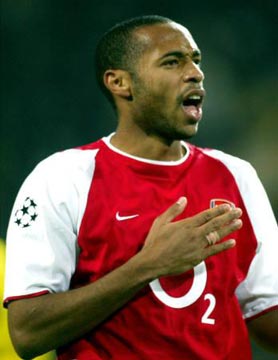
ESPN's investigative series, Outside The Lines, had a well-done story over the weekend that focused on France's Thierry Henry (one of Time magazine's 2005 European heros), a black soccer star who got tired of the monkey/banana/spitting/diatribes/chants that are par for the course for black players in Europe. He got his sponsor Nike to help him film some commercials basically telling fans not to be racist.. and started a foundation to spread the message.

Watching the story, it's astonishing that in 2006 Europeans consider it normal for thousands of fans at games to hold up Nazi flags, scream abuse at non-white players, and openly parade their racism. Of course the majority of fans don't act that way, but it's insane that they essentially shrug their shoulders and say what can you do, there will always be some crazies.

Especially because it's not just some crazies--extreme right wing parties like Jean-Marie Le Pen's National Front (who won 15% of the votes in France's presidential election in 1995) are part of the mainstream political landscape in Europe, regularly garnering substantial numbers of votes and parliamentary seats. And, as I've mentioned before, the biggest problem in Europe today is many white Europeans do not consider non-whites to be really French/German/Dutch/etc.; they still see them as a foreign element in their society, to be tolerated (or beaten) but in either case identified as other.

The ESPN story made the point that Europe never went through our civil rights struggles of the 60s, in part because there weren't large numbers of minorities on the continent at the time, and so naturally their views are behind ours when it comes to race. Naturally.

I'd say they are now going through that struggle; which means they're going to have their firehoses and dogs moments, their firebombings, their lunch counter sit-ins, their bloody Selmas, and ultimately their last stand in the schoolhouse door.

Which makes it odd that FIFA, which like most European institutions loves to lecture non-European countries about their societal shortcomings, would choose to stick a World Cup right in the midst of all this. In some ways it'd be like if they played a soccer tournament in South Africa during apartheid (instead of in 2010).

The Times, in their usual soft shoe manner when it comes to racism in Europe, sortof wrote about the topic, Surge in Racist Mood Raises Concerns on Eve of World Cup :
As he left the soccer field after a club match in the eastern German city of Halle on March 25, the Nigerian forward Adebowale Ogungbure was spit upon, jeered with racial remarks and mocked with monkey noises. In rebuke, he placed two fingers under his nose to simulate a Hitler mustache and thrust his arm in a Nazi salute.

Marc Zoro, right, an Ivory Coast native, was a target of racial slurs from the home fans in Messina, Italy. Adriano, a star with Inter Milan, tried to persuade him to stay on the field.

In April, the American defender Oguchi Onyewu, playing for his professional club team in Belgium, dismissively gestured toward fans who were making simian chants at him. Then, as he went to throw the ball inbounds, Onyewu said a fan of the opposing team reached over a barrier and punched him in the face.

International soccer has been plagued for years by violence among fans, including racial incidents. But FIFA, soccer's Zurich-based world governing body, said there has been a recent surge in discriminatory behavior toward blacks by fans and other players, an escalation that has dovetailed with the signing of more players from Africa and Latin America by elite European clubs.

This "deplorable trend," as FIFA has called it, now threatens to embarrass the sport on its grandest stage, the World Cup, which opens June 9 for a monthlong run in 12 cities around Germany. More than 30 billion cumulative television viewers are expected to watch part of the competition and Joseph S. Blatter, FIFA's president, has vowed to crack down on racist behavior during the tournament.

Underlining FIFA's concerns, the issue has been included on the agenda at its biannual Congress, scheduled to be held this week in Munich. A campaign against bigotry includes "Say No to Racism" stadium banners, television commercials, and team captains making pregame speeches during the quarterfinals of the 32-team tournament.

Players, coaches and officials have been threatened with sanctions. But FIFA has said it would not be practical to use the harshest penalties available to punish misbehaving fans — halting matches, holding games in empty stadiums and deducting points that teams receive for victories and ties.

Players and antiracism experts said they expected offensive behavior during the tournament, including monkey-like chanting; derisive singing; the hanging of banners that reflect neofascist and racist beliefs; and perhaps the tossing of bananas or banana peels, all familiar occurrences during matches in Spain, Italy, eastern Germany and eastern Europe.

We have to differentiate inside and outside the stadium," said Kurt Wachter, project coordinator for the Vienna-based Football Against Racism in Europe, a network of organizations that seeks to fight bigotry and xenophobia in 35 countries.

"Racism is a feature of many football leagues inside and outside Europe," said Wachter, who expects most problems to occur outside stadiums where crowds are less controlled. "We're sure we will see some things we're used to seeing. It won't stop because of the World Cup."

Particularly worrisome are the possibilities of attacks by extremist groups on spectators and visitors in train stations, bars, restaurants and open areas near the stadiums, Wachter and other experts said. To promote tolerance, he said his organization would organize street soccer matches outside World Cup stadiums.

Recent attacks in the eastern Germany city of Potsdam on an Ethiopian-born engineer and in eastern Berlin on a state lawmaker of Turkish descent, along with a government report showing an increase in right-wing violence, have ignited fears that even sporadic hate crimes and other intolerant behavior could mar the World Cup, whose embracing motto is A Time to Make Friends. ...

In mid-May, a former government spokesman, Uwe-Karsten Heye, caused a furor when he tried to assist visitors by advising that anyone "with a different skin color" avoid visiting small and midsize towns in Brandenburg and elsewhere in eastern Germany, or they "may not leave with their lives." ...

Gerald Asamoah, a forward on Germany's World Cup team and a native of Ghana, has been recounting an incident in the 1990's when he was pelted with bananas before a club match in Cottbus. "I'll never forget that," he said in a television interview. "It's like we're not people." He has expressed anger and sadness over a banner distributed by a right-wing group that admonished, "No Gerald, You Are Not Germany."

Cory Gibbs, an American defender who formerly played professionally in Germany, said there were restaurants and nightclubs in eastern Germany — and even around Hamburg in the west — where he was told "You're not welcome" because he was black.

"I think racism is everywhere," said Gibbs, who will miss the World Cup because of a knee injury. "But I feel in Germany racism is a lot more direct."
It's astonishing the Times starts the article with the misleading item of a black player making a Nazi salute, before explaining deep inside the story behind it. Word choice is also interesting, from the headline--racism isn't a 'mood'! people getting beat up is more than a 'concern'--to lumping hate crimes in with "other intolerant behavior".

People can soft-pedal it all they want, but Europe has got to deal with its racist core. There's something rotten with your society if in the 21st century large numbers of people feel comfortable throwing bananas at black players in public.

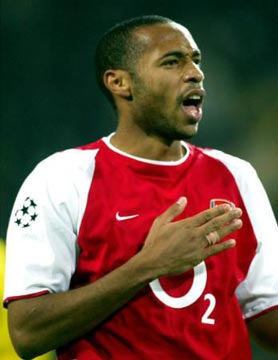
Uncredited image of Thierry Henry found in various places online.

Friday, June 02, 2006

Conveying foreignness


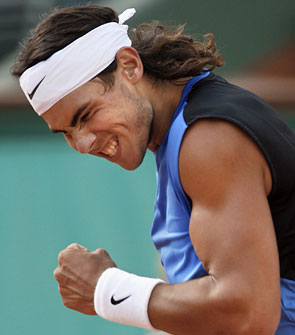
Rafael Nadal on his ATP blog: I've been reading some of your comments about my blog on one of the web pages. Believe me, it is me doing it. I'm not physically writing it, I don't have the skills to write so fast. But I talk to someone from the ATP and he types it in English. My team and I have been talking about doing a blog since January or February. We thought the best time to do it was during Roland Garros. It is me doing it and I enjoy it. ...

Also, people have asked me about my diet. I don't have a special diet but obviously I have to take care with what I eat. I eat pasta, meat and pizza. One thing I don't like is tomato. Even with pasta I prefer to have it without tomato. Also, I don't like cheese. Some people tell me I will like it when I get older but for the moment I don't like it.
Ah, Europe and America--two continents separated by a common cuisine. He loves pizza, but doesn't like tomato or cheese... just tells you how far afield our version of pizza has become.

Nadal's blog is great, he makes all sortsof of interesting and funny comments, sometimes without intent; and does a good job of showing what the life of a professional tennis player is like (lots of time in the hotel, and on the massage table). I especially like the way the blog reads; either whoever's transcribing it for the ATP either isn't a native speaker of English, or s/he is purposely trying to convey Nadal's 'Spanishness.'

It's like in an English-language movie set in Japan when they have all the Japanese characters speaking fractured English, even though obviously that person would really be speaking fluent Japanese.

Nadal, by the way, in the first round at the French Open broke the record for most consecutive victories on clay, previously held by Guillermo Vilas at 53. As someone on CNNSI's excellent tennis section mentioned, now he only needs 71 more to match Chris Evert's mark of 125 straight wins. The men's game is too competitive for that to ever happen, but it does bring to mind that tennis is one of the only sports where the women's game is as much as and at times more popular than the men's game.

Uncredited Getty Image photo of Rafael Nadal moving to the second round at the French Open via the ATP website.

Thursday, June 01, 2006

Spelldown

Who will win? We handicap the spellers

Darren Rovell in ESPN.com: The National Spelling Bee has gone prime time, and we all know what that means: Sports books are now taking bets on particular letters in the championship word and whether the winner will be wearing glasses. Folks, this is not a joke anymore.

With that in mind, here are my top eight picks in this year's competition, all of whom survived Wednesday's early rounds.

1. Samir Sudhir Patel, Colleyville, Texas: This kid is amazing. It's his fourth appearance in the event and, to put it simply, he has the best credentials. As a 9-year-old in 2004, he finished third; and last year, he tied for second. He's also the most entertaining speller I've ever seen. He'll say things like "I know that one," or "Thanks, mom!" His nerves of steel should get him through the pressure of being on in prime time. Here are a few additional bits of research to support Patel's bid: (1) Boys have taken the last six spelling bees after the girls won from 1996-1999; (2) Five of the past seven champions have been of Indian descent; (3) Texas has had more winning spellers (nine) than any other state. Spelling Bee officials clearly acknowledged Patel's marketability on Wednesday afternoon by halting Round 4 just before his turn came up, meaning he can lead the ESPN broadcast on Thursday.
It should be a great night--I hope the ratings are blockbuster and prompt the network to put more 'nerd' programming in prime time. If nothing else, it should boost the pool of contestents for next yera.

There's definitely an audience for it; and if this country is serious about raising our educational standards so we can compete against the Chinese and the Indians of the future, pop culture has got to lead the way.

Speaking of Indians, of the eight competitors ESPN touts as favorites (10 years ago their column could only have run in the Onion), half are of Indian descent:
-Samir Sudhir Patel, Colleyville, Texas
-Bonny Jain, Moline, Ill.
-Nidharshan Subra Anandasivam, Harligen, Texas
-Rajiv Tarigopula, St. Louis

I've got my money on one of them to win; probably the favorite, Samir.

Iranian in Paris


19-Year-Old Muslim Shakes Off Chills and Snubs in Paris

For members of the tennis establishment like Roger Federer and Amélie Mauresmo, the nasty, clammy conditions at this year's French Open seem like a hardship as the tarps go on and off the clay and the big shots do not penetrate the way they would in sunnier times and climes.

"It's actually pretty mild, for winter," joked Mauresmo, the No. 1-seeded woman, after her 6-1, 7-6 (5) victory over the Russian teenager Vera Dushevina in the second round Wednesday.

But Aravane Rezai is not feeling the chill. Compared to her everyday existence, which includes sleeping in the family van to save money at tournaments, Roland Garros is nothing short of a theme park.

"It often happens that I cry during training," she said. "Many times I have trained with the snow falling or in the rain or outside when temperatures are below 10 degrees. That's tough, but when I come here, it's really Club Med."

It is turning into an extended vacation for Rezai, a solidly built 19-year-old French player of Iranian descent with limited mobility but big-time power.

She was denied a wild card into the main draw by French tennis federation officials who are in conflict with her father and coach, Arsalan Rezai. But the daughter has used that snub for fuel at the federation's showcase event.

Last week, Rezai won three matches to qualify for the Open. Before Federer won his rain-punctuated second-round match against Alex Falla, 6-1, 6-4, 6-3, Rezai reached the third round on the same damp stretch of clay by upsetting 22nd-seeded Ai Sugiyama, 6-4, 4-6, 6-3. ...

Rezai has been coming to the tournament by subway instead of official transport, because she is staying with friends in Paris to save money.

"We've had some problems," she said calmly of the French federation. "I prefer not to talk about them and focus on my next match."
Maybe Aravane Rezai should just come to America....

AP Photo of Aravane Rezai by Francois Mori via Canada.com.

Murderer's row

A Reporter's Reporter

Kurt Anderson review of 'A Writer's Life' in the Times: It's hard to overstate Gay Talese's gold-standard reputation. A few years ago, David Halberstam called him "the most important nonfiction writer of his generation, the person whose work most influenced at least two generations of other reporters."

The bedrock of that reputation consists of several exceptional magazine profiles from the 1960's, in particular "Frank Sinatra Has a Cold," published in Esquire in 1966. Helped along by one of the great modern magazine headlines, the piece became a canonical archetype of the so-called New Journalism — nonfiction conceived and written in the manner of fiction, with fully rendered scenes, extended conversations and plainly subjective depictions of mood. In 1969, Talese published "The Kingdom and the Power," an institutional portrait of The New York Times, where he had been a reporter for nine years. That book became a best seller, certifying him as a literary pop star as well as a reporter's reporter. Just two years after the Times book, he published another first-rate best seller, his story of a Mafia family called "Honor Thy Father." ...

He's now 74, and one's instinct is to let him take his victory lap and applaud respectfully for the good work he has done. "A Writer's Life," I figured, would be a traditional memoir that picked up where "Unto the Sons" left off, in the 1940's, when he was 12. But this book is something else. It's mostly an account of Talese's inability these last 14 years to find a story that he and his editors were excited about. His dead ends and dry holes might have been usefully deconstructed and illuminated with careful, tough-minded, craftsmanlike introspection — something akin to the way, for instance, that Joan Didion created a masterpiece last year out of the death of her husband. But instead he has simply recapitulated and redoubled his botches by aggregating old notes and manuscript pages and interlarding them with bits of autobiography and self-abasement. The whole is less than the sum of its mostly arbitrary parts. It's a saga of serial professional failures that is itself a failure. ...

Rather than a memoir, though, Talese had decided to write a book "set within the milieu of a restaurant." He had accumulated files of notes since the 70's, although by the summer of 1999 he had written only 54 pages. So instead of working one Saturday afternoon in 1999, he's watching baseball on TV — and happens to change channels to the final game of the Women's World Cup soccer championship, the United States versus China. This prompts many pages of weirdly generic text about modern China, of which this is a typical passage: "Brand-name merchandise from the West had been distributed and also made in China for many years, encouraged by the trade policies of Deng Xiaoping, who became the Party ruler in 1978 (two years after Mao's death) and proclaimed, 'To get rich is glorious.' But now in 1999, as this nation of 1.3 billion people was about to mark a half-century of Communist rule that had been inaugurated by Mao's triumphant entrance into Tiananmen Square in October of 1949, China was hardly rich."

We know all this, of course, so why do we need to read it again? It is setup. It is drumbeat. Because the quietly desperate Talese is deciding he has stumbled onto his next Big Story. ...

It's one thing to rummage through the files and cut and paste together enough material to fulfill a very old book contract. Talese has hustled enough over the years to be permitted a punt. But a great deal of the prose in "A Writer's Life" is shockingly, inexcusably bad. ...

He's naturally old-school — always wears a suit and tie, writes longhand, flies on "a jet airplane," takes a "motor ride," calls blue jeans "dungarees" and China "the mainland." Fine. But most of the bad writing seems faux-old-fashioned in a stilted, wordy, strenuously highfalutin way — Restoration Hardware prose. "We journalists, in my view, were the pre-eminent chroniclers of contemporary happenings," he writes, and "I still respond inharmoniously to home cooking." About nepotism, he writes of employees "on the Times payroll in part (if not entirely) because of their cosanguinity or their conjugal affiliation with the Ochs patrilineage."
Are these guys overated? This group of ambitious white male authors who came of age after the war, the Doctorows and Mailers and Updikes and Wolfes and Roths (and to a lesser extent Talese), these old lions whose every new release is still scrutinized, pondered over for what it tells us about us.

Or, rather, has their time just passed by? Maybe once they were American letters; now, are they just musty relics, paddling madly under the surface to keep their heads in the limelight.

Or maybe these guys just were never that great, and spoke mainly to their cohorts--who happened to make up the reviewers, professors and critics of their time. As times change and everyone now can weigh in on anyone, perhaps they've lost their echo chamber cheering section.

Here's the Times' Michiko Katuni on John Updike's 'Terrorist' Imagines a Homegrown Threat to Homeland Security
John Updike writing about terrorism? The bard of the middle-class mundane, the chronicler of suburban adultery and angst, tackling Islamic radicalism and the call to jihad?

In theory Mr. Updike's shopworn new novel, "Terrorist," not only gives him an opportunity to address a thoroughly topical subject but also represents an effort to stretch his imagination — to try to boldly go where he has never gone before, as he did with considerable élan in his African novel, "The Coup" (1978), and with decidedly less happy results in "Brazil," his misbegotten 1994 variation of the Tristan and Iseult legend.

At the same time, it offers Mr. Updike a chance to explore some of his perennial themes from a different angle: to look at the sexually permissive mores that his other characters have embraced through the disapproving eyes of an ascetic, religious man, and to contemplate this man's absolute and unwavering faith, which is so unlike the existential doubts and tentative yearnings for salvation evinced by Mr. Updike's earlier creations.

Unfortunately, the would-be terrorist in this novel turns out to be a completely unbelievable individual: more robot than human being and such a cliché that the reader cannot help suspecting that Mr. Updike found the idea of such a person so incomprehensible that he at some point abandoned any earnest attempt to depict his inner life and settled instead for giving us a static, one-dimensional stereotype.
I don't know--I've never read much Updike aside from his looong short stories in the New Yorker; but I did hear him on the radio the other day talking about his new book, and he struck me as an intelligent, well-meaning but slightly befuddled man, someone who has to do research to find out that airport luggage-scanning machines aren't anything like x-rays and display in living color (reminds me of President Bush I and his supermarket scanners). I'm not sure how good he is at getting into the heads of people who aren't like him and his friends; in the same way that Thomas Wolfe's Charlotte Simmons reportedly read like an old man's idea of what young people are like.

It would once upon a time have mattered more that writers like Talese, Updike and Wolfe may no longer understand America, a society that to some extent has been shaped by their generation's literary works. But American letters is no longer dependent on their wise old heads; as evidenced by Toni Morrison's Beloved being chosen as the answer to the Times' question, What Is the Best Work of American Fiction of the Last 25 Years?

It's an interesting choice--I've never read anything by Morrison, but it struck me that, as A.O. Scott wrote in the essay that accompanies the list (wait, when did he move from reviewing moving images to the written word?!),
With remarkable speed, "Beloved" has, less than 20 years after its publication, become a staple of the college literary curriculum, which is to say a classic. This triumph is commensurate with its ambition, since it was Morrison's intention in writing it precisely to expand the range of classic American literature, to enter, as a living black woman, the company of dead white males like Faulkner, Melville, Hawthorne and Twain.
That kind of ambition, almost cold in its ambition, was the hallmark of the post WWII generation of great white male writers. It'd be fascinating to have been at the meeting where they broke the news that a black female, according to their own bible no less, wound up with the crown.

I think as the pool of American writers becomes ever-more diverse, the old boys club will be seen for what it was--a specific type of men who wrote certain types of books, that while notable and often inventive in their own right nevertheless painted a view of American society that was in reality their squinty look from where they sat.

Yes, some of them were great writers--I for one found Philip Roth's The Plot Against America just a step below some of Salman Rushdie's works. But they had the stage to themselves for a long time; and the critics of their day didn't see what they omitted and misunderstood because they themselves were guilty of the same sin, that of being all alike and thinking alike but mistakenly believing they spoke for America.

It does make me smile that men like Talese and Updike aren't going gently into the good night, but are at least making a belated effort to do things like visit China and examine Islam. They still have things to say, I think; and things worth hearing.

But it's nice that we're no longer dependant on a handful of white males of a certain age to tell us about our world.

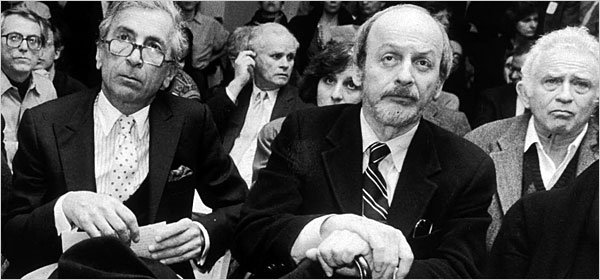
Getty photo of Gay Talese, left, with E. L. Doctorow and Norman Mailer at a gathering in support of Salman Rushdie held by the PEN writers' group, Feb. 22, 1989 from the Times.

Serving up security


Cyrillic spam
The Fight Against V1@gra (and Other Spam)

Tom Zeller Jr. in the Times: "For the end user, spam isn't that much of a problem anymore," said Matt Sergeant, MessageLabs' senior antispam technologist. "But for the network, and for people like us, it definitely is." ...

But spam continues to account for roughly 70 percent of all e-mail messages on the Internet, despite tough antispam laws across the globe (including the Can-Spam Act in the United States), despite vigorous lawsuits against individual junk-mail senders and despite the famous prediction, by Bill Gates at the World Economic Forum in 2004, that spam would be eradicated by 2006. ...

Mr. Sergeant said that just two men — [Leo] Kuvayev and Alex Blood, a Ukrainian who is rated the No. 1 junk mailer by Spamhaus — hammer the world's e-mail systems with five million messages an hour. "You're talking about being responsible for something like 10 percent of all e-mail on the Internet," Mr. Sergeant said, "from just two guys."
Wow, 10% of all email--that's astonishing. What is it about those Russians--from Spamhaus' list they make up half of the world's 10 worst spammers-- they always seem to be at the center of all trouble on the Internet....

The article's really interesting, details all the creative ways spammers try to get past filters.

Baby makes four
My Broker, My Therapist
Teri Karush Rogers in the Times: Brokers, like therapists, have to understand what buyers really want in order to help them get it. While that might seem easy, it is not, because buyers often don't know themselves what they would like — hence an old real estate maxim, "Buyers are liars."

In the course of probing for information, brokers sometimes encounter far more than they really want to know or need to know. Details that might make a therapist wince, or at least write faster.

"More so than any other profession, I think you get to see the window of people's inner souls in a kind of hyper-reality superquick time," said Rob Gross, a senior vice president of Prudential Douglas Elliman. ...

Sometimes, brokers hear about an important event in the couple's lives at the same time as one of the spouses.

[Brian K.] Lewis was showing a junior-four condo to a young couple when he happened to mention that a two-bedroom was available in the same building. The wife pressed to see it over her husband's objections. "He was saying: 'Why are you so adamant? We've already talked about a two-bedroom,' " Mr. Lewis recalled. "She just kept saying, 'We need it.' "

Finally, she laid her hand on her belly, and the men slowly caught on.

Then, "we all screamed and yelled," Mr. Lewis said. For him, that was just the start of the good news. Aglow with the impending change in their lives, the parents-to-be bought the two-bedroom.
I think some people don't spend enough time with their spouse--what a way to find out! It's funny how the article emphasizes 'the men' slowly caught on.

Guy lit
I Confess: One Theme, 30 Writers, a Trend
Charles McGrath in the Times: Chick lit. True crime. Diet books. Recovery memoirs. Books about Britney. The publishing industry is a staunch believer in the principle that too much is never enough. The latest genre to flood the shelves in possibly excessive numbers, you may have noticed, is the anthology, but not the sort we used to lug to class.

This new kind of anthology assembles first-person confessional essays, rather than, say, discussions of sanitation and personal hygiene in the Middle Ages, and is readily distinguished by an annoyingly cute title and a numeral specifying the number of writers who bare their souls on a range of intimate topics: "Maybe Baby: 28 Writers Tell the Truth About Skepticism, Infertility, Baby Lust, Childlessness, Ambivalence and How They Made the Biggest Decision of Their Lives"; "Roar Softly and Carry a Great Lipstick: 28 Women Writers on Life, Sex and Survival"; "Because I Said So: 33 Mothers Write About Children, Sex, Men, Aging, Faith, Race and Themselves." ...

Men have occasionally been known to write this kind of confessional lit. In response to "The Bitch in the House," for example, there was "The Bastard on the Couch: 27 Men Try Really Hard to Explain Their Feelings About Love, Loss, Fatherhood and Freedom." And men may even read these first-person anthologies, though not in great numbers, apparently, and seldom on the subway or in other public places. "Most of the ones aimed at men pretty much fail miserably," said Sally Wofford-Girand, an agent who has handled a number of the books. ...

The essays in this book present a fairly consistent narrative: the writer, a self-proclaimed idiot (the term of choice is actually a more anatomical one), after floundering around for years (though enjoying, as he modestly admits, a healthy amount of hot action on the futon), suddenly finds himself blown away by a "stone babe" who is "willowy" or else "gleamy eyed" and "leggy" and instantly commits, without a moment's thought or regret.

As David Owen writes, explaining his decision to marry quite young: "If you don't know what you're doing, simply gathering more facts is unlikely to improve the outcome."
What a great quote. Hopefully his wife knew what she was doing.

Need me to spot you?
Will the Real Traitors Please Stand Up?
Frank Rich in the Times: When America panics, it goes hunting for scapegoats. But from Salem onward, we've more often than not ended up pillorying the innocent. Abe Rosenthal, the legendary Times editor who died last week, and his publisher, Arthur Ochs Sulzberger, were denounced as treasonous in 1971 when they defied the Nixon administration to publish the Pentagon Papers, the secret government history of the Vietnam War. Today we know who the real traitors were: the officials who squandered American blood and treasure on an ill-considered war and then tried to cover up their lies and mistakes. It was precisely those lies and mistakes, of course, that were laid bare by the thousands of pages of classified Pentagon documents leaked to both The Times and The Washington Post.

This history is predictably repeating itself now that the public has turned on the war in Iraq. The administration's die-hard defenders are desperate to deflect blame for the fiasco, and, guess what, the traitors once again are The Times and The Post. This time the newspapers committed the crime of exposing warrantless spying on Americans by the National Security Agency (The Times) and the C.I.A.'s secret "black site" Eastern European prisons (The Post). Aping the Nixon template, the current White House tried to stop both papers from publishing and when that failed impugned their patriotism.

President Bush, himself a sometime leaker of intelligence, called the leaking of the N.S.A. surveillance program a "shameful act" that is "helping the enemy." Porter Goss, who was then still C.I.A. director, piled on in February with a Times Op-Ed piece denouncing leakers for potentially risking American lives and compromising national security. When reporters at both papers were awarded Pulitzer Prizes last month, administration surrogates, led by bloviator in chief William Bennett, called for them to be charged under the 1917 Espionage Act.

It was under General Hayden, a self-styled electronic surveillance whiz, that the N.S.A. intercepted actual Qaeda messages on Sept. 10, 2001 - "Tomorrow is zero hour" for one - and failed to translate them until Sept. 12. That same fateful summer, General Hayden's N.S.A. also failed to recognize that "some of the terrorists had set up shop literally under its nose," as the national-security authority James Bamford wrote in The Washington Post in 2002. The Qaeda cell that hijacked American Flight 77 and plowed into the Pentagon was based in the same town, Laurel, Md., as the N.S.A., and "for months, the terrorists and the N.S.A. employees exercised in some of the same local health clubs and shopped in the same grocery stores." ...
You forget sometimes how ironic truth can be.

Somewhere there has to exist footage from random security cameras that show NSA employees wiping down exercise equipment after a terrorist's used it... helping a hijacker reach a can of beans high up on a shelf... maybe spotting him while he lifts.

It's strange, I really should like Frank Rich as a political columnist more than I do. I liked him when he wrote for the Arts section--he's funny, writes well, always interesting. But for some reason reading his political pieces feels like eating your spinach.

Maybe because he's so predictable; strikes just the right note of aggrieved outrage, is so deft with his logic and language. His style reminds me a bit of Lewis Lapham's essays for Harpers--but Lapham always seemed to loop around in an original direction, connecting what looked like disparate observations.

Maybe Rich is like the typical artist or entertainment figure who's mastered their craft and then--used to the adulation and respect of his/her sphere--spouts off assuredly on the real world, little realizing how amateurish they sound.

Politics is unique in that it's a theater that everyone can and should participate in; lack of knowledge or understanding isn't a barrier to entry. And as I said, I do read Rich and find him pretty good. But for whatever reason, he still feels a little like a dabbler to me, someone who's striving to write important columns that the movers and shakers quote to each other.

In exactly the way that R.W. Apple Jr., who for decades covered politics for the Times, does not when he writes, nowadays about travel and food, (always mentioning his wife Betsey).

See, for example, Apple's article on eating in Shanghai. Maybe it would profit the famously-arrogant Rich to spend some time hoofing it around the globe with R.W. and his wife, taking time to talk to people and try their food.

Photo of Nan Xiang in Shanghai by Nelson Ching in the Times

Sheepish Abe

Z
The Top Hat Is Wool. So Is the Man Wearing It.:

Five years ago at lunchtime one day, Pedro Genao Rodriguez walked into the kitchen of the Rudolf Steiner School on East 79th Street and saw a teacher poking a barbed needle into a mass of unspun wool, fashioning the wool into a little gnome. Mr. Genao Rodriguez, who works as a custodian at the school, was curious.

"She told me the more times you poke the needle, the more compact the wool becomes," he recalled. The teacher gave him a bit of wool and a needle, introducing Mr. Genao Rodriguez to the craft of needle felting.

He started by making miniature birds and snowmen. Then he made a series of six-inch-long dolls representing members of the school's staff.

By 2003, the needle felting bug had bitten Mr. Genao Rodriguez so hard that he was inspired to make the biggest wool sculpture ever. As part of that pursuit, he wrote to Guinness World Records and inquired about what he described as "The Largest Wool Doll Ever Made." His chance of setting the record was good, he was told, because no such category existed.

Then came the matter of choosing a subject. Mr. Genao Rodriguez picked Abraham Lincoln, "my favorite person in history," he explained.

"He came from a very poor family," added Mr. Genao Rodriguez, a 43-year-old Dominican who immigrated to New York in 1992. "He's an inspiration for people around the world. Also, he was very tall. That's good for the record."

Mr. Genao Rodriguez resolved to create a life-size Abraham Lincoln out of wool. He worked diligently at night in his basement apartment in Corona, Queens; divorced, he lives with his mother, his 14-year-old daughter, his sister and his 16-year-old nephew. He ordered bags of wool from Maine and went through 75 three-inch barbed needles.

After 18 months of felting, his Lincoln was complete. Dressed in a three-piece black suit and a bow tie, with an alert expression in its pale blue eyes, the creation stands, true to life, at 6 feet 4 inches tall, not including the top hat. The work has been displayed at the Steiner School and at the City Reliquary, a museum of oddities in Williamsburg, Brooklyn.

Mr. Genao Rodriguez has received his application form for the Guinness record and is looking toward his next woolen feats. He dreams of making life-size figures of all the American presidents, with George Washington and Bill Clinton next up. And he said: "I'd like to make Latin American leaders. Good leaders, like Simón Bolívar. Or Sammy Sosa."
Wow... imagine a gallery of presidents, all made out of wool... does Disney know about this? What happens when you wash them? Would a Barry Bonds one have an extra-big head? Can you imagine a non-immigrant American doing something like this?

I guess some might say Mr. Rodriguez is slightly nuts. On the other hand, what have you done in your spare time over the last three years that's worth displaying?

Photo of Pedro Genao Rodriguez's Abraham Lincoln by Angela Jimenez for the Times.