Monday, April 17, 2006

Out looking for WMDs


Times Forgets to Check Voicemail

New York Observer: On Sunday, April 9, the New York Times reported on page A1 that the Vice President's former Chief of Staff I. Lewis (Scooter) Libby had been authorized to leak to former Times reporter Judith Miller that Iraq was "vigorously trying to procure uranium" to produce a nuclear bomb.

The Times piece said that Libby was told to overstate the intelligence.

But on Wednesday, Libby filed a correction to accompany his original court filings (from which the Times had gotten its information). The correction explained that he was not told to oversell the intelligence. Details of the letter were made available to the media on Tuesday night, and The Washington Post ran a piece on Wednesday explaining Libby's correction.

The Times, however, did not publish the new Libby filing until today, because, as an Editor's Note points out in today's Times, a voicemail and an email with the information "went unnoticed."

[Times correction, from the Times: Although Mr. Fitzgerald formally filed his corrective yesterday, accounts of it were provided to some news organizations on Tuesday night, and were the basis for news articles yesterday. The Times did not publish one, as other organizations did, because a telephone message and an e-mail message about the court filing went unnoticed at the newspaper. An article on the filing appears today, on Page A17.]
On the one hand, it's refreshing that the Times in its corrections section has always explained exactly what the mistake was, and why. Unlike most papers, which just say we made a mistake, here's what we should have said.

On the other hand, makes you wish all the other things that systematically go unnoticed at the Times could be so easily corrected.

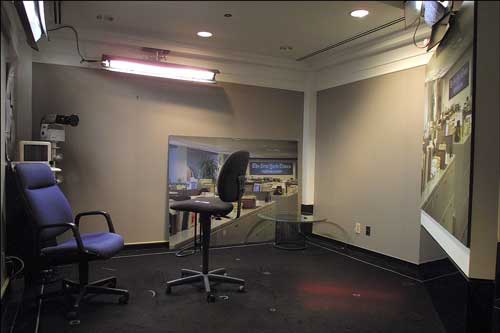
Photo of camera setup in the Times' D.C. bureau from Declan McCullagh Photography.

Thursday, April 13, 2006

Video next

If you ever wonder what the youth of America are up to when adults have their backs turned, just go to YouTube.com. Like MySpace, the site's aptly named--unlike the Friendster for kids site, though, YouTube--which lets anyone post self-created or 'found' video--will generally leave you shaking your head in admiration.

Hard to believe that a generation that can't spell and doesn't know there's another George Bush can produce such interesting and creative videos. Then again, it makes sense--adults are always surprised by what great things kids can do when left to their own devices, it's almost like we've forgotten what it was like to have oodles of free time and unlimited energy.

Adults are on YouTube too, of course, although most of what they post tends to be works created by other (more talented) adults, i.e. piracy. Then again, given I'd never have thought to have bought any of these videos even if I knew they existed, it's hard to see who's harmed.

Amazing things kids did-
-A school talent show, some freakily gifted kids: the Robot Video


-This is the new generation Asian American: Urban Ninja


-Classical music in the age of rock: Pachabel's Canon


-She's dangerous: Knife Skills


Great adult performances
-Video of Faye Wong, one of my favorite Chinese singers, singing Dreams by the Cranberries


-The Cranberries singing Dreams (it's a great song)


-Bob Dylan singing Girl of the North Country; may as well be from a different planet, it's so unexpectedly--authentic? innocent?


-A funny version of the Tokens' In the Jungle


-It'll break your heart, one of my favorite singers/songs: Iris Dement, Our Town

Ink and stick


Brazilian soccer player faces criminal racism charge

AP: Prosecutors on Wednesday charged a Brazilian soccer player with racism, a crime in Brazil, for insulting an opponent in a match last month.

Prosecutors in the southern Rio Grande do Sul state charged Juventude defender Antonio Carlos after TV images showed him shouting "monkey" during a state league match on March 5.

Antonio Carlos -- who previously played with Italy's AC Roma, Brazil's Palmeiras and Santos and Brazil's national team -- faces from one to three years in prison if found guilty.

Prosecutors said, however, the player can avoid a trial if he agrees to have 10,000 handbills made with the saying, "We are all equal," and "Say no to racism." He would have to help distribute the handbills during sporting events in the city of Caxias do Sul, where Juventude hosts its matches. Caxias is about 750 kilometers (465 miles) south of Sao Paulo.
This is... interesting. Either up to three years in prison--or distribute some handbills.

Wonder how many repeat offenders they get.

Photo of Antonio Carlos from Chilean newspaper La Tercera.

Wednesday, April 12, 2006

Latin to Greek


They feature Southerners at the top, hopefully this is the last we see of them.

10:33 p.m., the frat boys take off first--for Rome, on 8 a.m. train. Five minutes later the hippies get going. Then Joseph/Monica, few hours later, talk about how up and down they've been. Fran/Barry a few minutes later.

Frat boys get to train station, then hippies. Lake/Michelle leave a bit after midnight, ugh. And they start yelling at each other right away, he's just a jerk, swears at her. Ray/Yolanda are last, at like 1 a.m. But it's all good, big reunion at the station, which doesn't even open until 4 a.m.

They arrive in Rome, some cab, others take the subway to Trevi Fountain. Ray/Yolanda suck at train station, somehow. Frat boys at fountain already, find guy on scooter, now gotta go find horse carriages a mile away at Spanish Steps, a bit of a Da Vinci code commercial, it's like a puzzle/code. Dumb.

Why are frat boys so much faster than everyone else? J/M just getting to fountain, Metro riders are who knows where. Hippies are 3rd, then Southerners, then old people, than R/Y. Frat boys at steps, off they gotta go to Athens. Crack code, just says bring these papers to the pit stop. Not much of a code, put one sheet of paper over the other.

Everyone's bunching behind the frat boys at the steps, and cracking the code, then taking cabs to the airport. Frat boys at the airport first, get on 7:25 p.m. flight. J/M, hippies right behind them, then Southerners. Everyone's on the same flight; old people next, then R/Y--all on Olympic Air. Land, off to the Agora via cabs. Quite a happening leg, no commercial yet. Wow, for once frat boys near last--ooh, hippies are last. But Agora doesn't open until 8 a.m.; in a pouring rain everyone's looking for the clue box, some running, others content to let others find.

J/M get there first--a fast forward. Go to a restaurant, break plates until they find a marker, one out of hundreds of plates. J/M do it; R/Y take train to Isthmos Station, like a hundred plus miles away by train. Frat boys go for FF too, old people too. Southerners to train, hippies too. Wind up helping out R/Y with bus directions. Frat boys show up second at restaurant, pure luck at this point--and the frat boys get it. Off to Fortress of Rion, on coast. They waste some time smashing rest of plates. Old people get to restaurant, frat boys gone already. Ugh.

Southerners on train, hippies and R/Y catch it just in time. J/M having trouble getting a cab, say they're out of it. J/M squabble a bit on train to station, he lectures her. Old people taking cab, blame falling behind on not being able to run fast enough. Monica's crying at station, Joseph says it'll be okay; old people show up, they're on same train.

Nice view out at coast; hippies happy, white trash man says not as pretty as Italy. They apparently all get off train at wrong place, wind up taking bus. Get there together, roadblock: bungee jumping. Second group of couples get off at the right station, old woman says she'll do roadblock, then doesn't wanna do it, scared. Nice camera shots. R/Y go first, for once, off they go after Ray jumps. Detour: either Herculean effort--three ancient Olympic events, discus/javelin/wrestling. Or It's All Greek to Me--look for nine pieces of pottery, translate Greek letters to English, spell out city.

R/Y have a map (good), drive off. Hippies jump, they love it. Hmm, frat boys are really gonna have a huge lead. Hippies do Olympics. Southerners jump, he's cheering for her for once, doing Olympics too. J/M get there, she jumps, loves it, doing Olympics. Fran is totally scared, and is just standing there, freaking out, very loudly too.

Back from break, she jumps, is totally terrified. But does it, doesn't look happy afterwards. They do pottery. Southerners discover their map is all in Greek, he's cursing at her, they start freaking out. Idiots. Frat boys driving, pit stop already, and they're done. For cracking the code and being first, they get to attend Da Vinci Code premiere.

R/Y get to Olympics first. She tosses discus, pathetically, but good enough. Hippies may be lost... they're cool about it. Southerners are just yelling at each other. J/M get to Olympics as Ray's throwing javelin, he's having trouble. Quite a bit of trouble. As is Joseph, once they get there. Old couple just jamming with pottery. Southerners lost. Southerners stumble across letter thing, start picking things up. Hippies are totally lost. Into gas station, turns out they've been going the wrong way for--hours. They're like this is it, we're done; but civil about it. Oh no, the show's over if these guys are out....

They're apologizing to each other, back they go. Joseph gets javelin first, then Ray has more trouble. Old people get help translating word. Southerners are yelling at each other, per always. Joseph wrestles guy, they have to get him out of circle--through dumb luck he does. Off to pit stop, 107 miles by car... man, hippies are lucky this is probably a non-elim round. Ray finally makes javelin. They get wrestler out working together, currently in third. But then ask for where fortress is, woman says Patra, he looks on map, sees Petra. Ugh.

Southerners are just screaming at each other, this is not a good task, requires brainwork. Old people find city pretty quickly, off the go in 4th. Southern chick gets it, husband doubts it but then says good job. They're off driving, randomly; old people smash into tree, back window's destroyed. Ask for directions, in the right way. Olympics for hippies, wasting time celebrating. Southerners going the wrong way; she forces him to stop and breath, he's freaking out. Hippies get werstler out, after a while. They get directions.

Everyone's driving; R/Y get there second--that's amazing. They're not overly celebrating; get a penalty for not following clue correctly, 15 minutes for taking bus to train station, along with the other teams. J/M next, they wind up 2nd in actuality. R/L 3rd by a little bit. Southerners are giving up, driving. Hippies think they're last too. Old people are--where? Team #4. Hippies get there, astonishingly enough, before hated white trash. They're totally shocked.

Southerners show up last, just giving up coming out of car--hippies beat them even with penalty. Big kiss for Phil from both of them. Lake and Michelle are last. And are eliminated. He says they got along great most of the time; stressful times and you wanna blame your partner. She says afterwards their relationship works for them, they're getting by the best they can. Ugh.

Oh-oh, Ray and Yolanda are yelling at each other--off to the Middle East, hippies look like they're still behind too. Oh-oh.

Photo of Lake and Michelle from Amazing Race website.

Bad Day upside down


'Idol' turns 'Bad Day' into anything but

USA Today: Bad Day may be a sad sendoff for bounced American Idol finalists, but for viewers, it's bouncy good fun.
Daniel Powter's piano-driven pop tune has been the sonic backdrop for Wednesday departures of singers voted off the competition (Fox, tonight, 8:30 ET/PT). With coveted exposure on TV's ratings blockbuster, Bad Day is No. 1 on Billboard's pop chart and the nation's top digital track with 467,000 downloads sold.

"It grows on people. Everyone can sing it, and it's easy to whistle," Powter says. "I'm sure American Idol is a huge reason the song is what it is. I'm thankful, because it's getting my music out there."
It's totally an infectioous song; and the video's great too.

Kindof puts a smile on your face, no matter what sort of day you've been having.

Daniel Powter photo from Warner Brothers via USA Today.

Detroit makes history (?)


At the end of the day on Saturday, April 8, the Detroit Tigers at 6-0 had the best record in baseball. At the same time, the Detroit Pistons had the best record in basketball, and the Detroit Red Wings had the best record in hockey.

I'm not sure, but I don't think that's ever been done before. The hard part of the triple crown is basketball and hockey, which are both almost done with their seasons when baseball is just starting.

I know no team has ever won championships in both hockey and basketball the same year; I think the Pistons and Red Wings will set that record this year, but even if that doesn't happen, Detroit's already had a heck of a sports year.

Now if only those Lions could get with the program....

Team logos from LogoServer and sportslogo.net (since official team websites don't have them).

Repeating history


An Iranian Missile Crisis?

David Ignatius in the Post: The emerging confrontation between the United States and Iran is "the Cuban missile crisis in slow motion," argues Graham Allison, the Harvard University professor who wrote the classic study of President John F. Kennedy's 1962 showdown with the Soviet Union that narrowly averted nuclear war. If anything, that analogy understates the potential risks here.

What worries me is that the relevant historical analogy may not be the 1962 war that didn't happen, but World War I, which did. The march toward war in 1914 resulted from the tight interlocking of alliances, obligations, perceived threats and strategic miscalculations. The British historian Niall Ferguson argued in his book "The Pity of War" that Britain's decision to enter World War I was a gross error of judgment that cost that nation its empire.

Zbigniew Brzezinski, a former national security adviser to President Jimmy Carter, makes a similar argument about Iran. "I think of war with Iran as the ending of America's present role in the world," he told me this week. "Iraq may have been a preview of that, but it's still redeemable if we get out fast. In a war with Iran, we'll get dragged down for 20 or 30 years. The world will condemn us. We will lose our position in the world."

Brzezinski urges President Bush to slow down and think carefully about his options -- rather than rushing to stop Iran's nuclear program, which by most estimates is five to 10 years away from building a bomb, even after yesterday's announcement. "Time is on our side," says Brzezinski. "The mullahs aren't the future of Iran, they're the past." As the United States carefully weighs its options, there is every likelihood that the strategic picture will improve.
Brzezinski knows of what he speaks; he was Carter's security adviser during the Iranian hostage crisis. His quote about war with Iran ending our present role in the world is pretty chilling, but probably accurate.

Ignatius, on the other hand, is wrong to expand upon Allison's comparison to the Cuban missile crisis. When Iran has scores of nuclear-tipped missiles pointed at us from 60 miles away and the might of a superpower's arsenal backing it, then the analogy might fit.

It's interesting for a confrontation over nuclear weapons that Ignatius, like some other commentators and reporters, have pointedly ignored or else buried the section of Seymour Hersh's article that reveals:
One of the military’s initial option plans, as presented to the White House by the Pentagon this winter, calls for the use of a bunker-buster tactical nuclear weapon, such as the B61-11, against underground nuclear sites.
Throwing the word tactical in front of nuclear does nothing to change the fact that it's a Hiroshima and Nagasaki-like attack that the U.S. is contemplating. It won't result in the deaths of as many civilians, but that's entirely due to the Iranian government's refusal to use civilians as shields the way Saddam Hussein did.

The U.S. and Israel and Europe want to keep Iran from getting nuclear weapons in 5-10 years because we fear they may use it against Israel. So to do that, we're going to use nuclear weapons against Iran?

In terms of logic and planning, that's more Bay of Pigs than anything else.

Image of Cuba's Bay of Pigs stamp in various places on the Web.

Tuesday, April 11, 2006

Yellowface


Seeking Ancestry in DNA Ties Uncovered by Tests

Amy Harmon in the Times: Alan Moldawer's adopted twins, Matt and Andrew, had always thought of themselves as white. But when it came time for them to apply to college last year, Mr. Moldawer thought it might be worth investigating the origins of their slightly tan-tinted skin, with a new DNA kit that he had heard could determine an individual's genetic ancestry.

The results, designating the boys 9 percent Native American and 11 percent northern African, arrived too late for the admissions process. But Mr. Moldawer, a business executive in Silver Spring, Md., says they could be useful in obtaining financial aid.

"Naturally when you're applying to college you're looking at how your genetic status might help you," said Mr. Moldawer, who knows that the twins' birth parents are white, but has little information about their extended family. "I have three kids going now, and you can bet that any advantage we can take we will."

Genetic tests, once obscure tools for scientists, have begun to influence everyday lives in many ways. The tests are reshaping people's sense of themselves — where they came from, why they behave as they do, what disease might be coming their way.

It may be only natural then that ethnic ancestry tests, one of the first commercial products to emerge from the genetic revolution, are spurring a thorough exploration of the question, What is in it for me?
Ah, yes--it's only natural for white people to wanna become Native American, or Hispanic, or Asian American, when they want to, then go back to being white when they get tired of it....

It's an astonishing article. Not just the content, but the style--it's written as if there's no other side. Not that it's surprising anymore that the New York Times is tin-eared when it comes to race.

The worst thing about the article is the Times tries to present examples of 'the other side', like a black woman who uses DNA tests to confirm her Scottish heritage to claim a castle. Does the Times not understand that in a court of law, a descendant is a claim of fact that does not depend on when it came to your attention what your heritage is.

But when it comes to affirmative action programs, someone who's lived as a white person and is minimally a person of color is lying when they represent themselves as a person of color for the 2 seconds it takes to check a box.

Besides which, it's like when whites tag affirmative action programs reverse discrimination. No, reverse discrimination would be if blacks enslaved whites for 200 years. It's not a two-way street; in 21st century America you don't need to know anything culturally or go through anything societally to be generically white. You can't say the same if you're Asian American or Hispanic or African American.

It actually is why I feel bad for white Americans, but that's another day's post. I think the funniest part of the article, actually, is this girl:
"If someone appears to be white and then finds out they are not, they haven't experienced the kinds of things that affirmative action is supposed to remedy," said Lester Monts, senior vice provost for student affairs at the University of Michigan, which won the right to use race as a factor in admissions in a 2003 Supreme Court decision.

Still, Michigan, like most other universities, relies on how students choose to describe themselves on admissions applications when assigning racial preferences.

Ashley Klett's younger sister marked the "Asian" box on her college applications this year, after the elder Ms. Klett, 20, took a DNA test that said she was 2 percent East Asian and 98 percent European.

Whether it mattered they do not know, but she did get into the college of her choice.

"And they gave her a scholarship," Ashley said.
She thought being Asian American would help her get into college?!

I guess one problem with pretending to be something you're not is how telling your ignorance can be. Bet Ashley never thought reading an article like this would be of any relevance to her: Ending College Admission Quotas Against Asian-Americans.

Image of an unspecified monkey from various places on the web.

All the Queen's subjects


It's Queen night on American Idol--and I assume only Chris is happy. Am sure this show can survive three bad Tuesdays in a row, only question is whether some of the more fragile contestants will.

Opening tape shows original Queen performing We Are the Champions, We Will Rock You, and Bohemian Rhapsody--and what else? I guess we'll find out. They show Idols walking in and greeting band, so odd. Hmm, Kellie looks pretty good in previews; Taylor seems to be having a good time too.

Bucky up first; band says he's got a good attitude, is a good performer. Doing Fat Bottomed Girls... okay. In leather, wow, he's actually pretty good from the start, song fits his range. Drops some words, and enunciation is a problem as always, but very good choice. He's oozing confidence, growing into that Bo role more every week. Voice isn't that great, but not bad at all. Randy says good energy, bit pitchy but liked it. Paula says interesting that you kept true to who you are, it worked. Simon says good song choice, overall quite mediocore... hmm, Simon's back to trying to shape the show.

Ace up next, in striped shirt and leather pants. And more make-up than usual. Ryan talks to him before, he admits being outof his comfort zone this week. And him giving them an idea for the arrangement, and the band saying they don't think they're gonna play it that way. We Will Rock You. Another good song choice, he's just up there chanting though--letting the beat of the song carry everywhere along. Hmm, actually gets worse as he goes on; not really much you can with the lyrics, crowd not that into it. Not sure after all it was a good song to do, kindof boring. Randy says like a 5 or 6, just karaoke, didn't get it. Paula struggles to say she like he tried doing something different, took a risk. Simon says it was a complete and utter mess, it didn't work, you were forgetting the words, Randy was being kind--Randy chimes in yeah; Simon says he really hated it. Ace tells Ryan he thinks he rocked, dodges his questions about was it uncomfortable with Queen rejecting his ideas.

Kellie says her dad listened to Queen, band says she did pretty good with Bohemian Rhapsody, but a tough job ahead of her. In black leather outfit, heavy racoon mascara. Hmm, very different interpretation; interesting look/feel to it, her personality is really starting to come out, especially the theatrical side. Actually I really like it, she's totally performing, no fear at all, totally in control, totally transfixed watching her. Wow, one of the best things I've seen this year on this show, she totally nailed it. Randy says at first he was worried but you worked it out, was entertained. She's totally blossoming. Paula says good job. Simon says you're very brave, started weird but although it should've been hideous on paper, he liked it.

Well, if Chris doesn't rock this, the world's upside down. Doing an obscure song, Innuendo, band loves him, says he's got a real rock sensibility. In black shirt/black jeans. Song is pretty unmelodic, but he looks right doing it, just rips it out. Audience kindof not into it. Hard song to judge--totally unenjoyable, but I guess he did it about as well as you can. Randy is like I've been one of your fans, you didn't disappoint, you delivered. Paula liked it too, trips over herself trying to say to compliment him. Simon says they don't perform that song live cause it's not a very good song; best vocal, most believable, but disappointed because you didn't decide to entertain the audience at home, you could've had a moment tonight--but once again, too indulgent.

Next, Katharine, in a hideous red satin top and big black belt and pants--what a weird look. Don't Stop Me Now, band says she has a lot of joy/bounce in her; then changes her mind to Who Wants to Live Forever, to showcase her voice. Good start, very dramatic, all dark and slow. Ugh, then her voice is just all over the place in the middle, just off--powerful, but not pleasant to my ears. Big but yowling. A big miss for me, let's see what her judges think. Randy is like it's good to hear you go back to your element--a bit pitchy, and a bit too big for you at spots, but overall good. Paula says nothing, glorious voice, good job. Simon says you almost had a big moment, lightning director made you look good; overall one of the strongest tonight although some pitchy moments. Well, he's back lobbying for her.

Next Elliott, in shiny tan shirt and jeans, Ryan asks him beforehand about what he did pre-Idol; Somebody to Love, which he'd never heard before this week. Uh, okay... band tells him written with Aretha Franklin in mind. Say it's a hard song, but he did a good job. Ugh, totally not believable with this song, and is like off from the get-go. I think he's gone after this week--his voice is like thin, and rushed, and the whole thing just doesn't work. Wow, totally yowling in the middle. Whatever happened to sweet-voiced Elliott? It's like he's pushing so hard, has just gone off the deep end. Randy says probably the hardest song so far, some pitchy problems, but overall loved it, really dope. Paula says the best vocal tonight, great performance. Simon says you chose the tough one, kindof in and out performance, overall you probably pulled it off. Hmm, okay; don't agree.

Taylor sang We Are the Champions with the band, then decides to change it, to A Crazy Little Thing Called Love. Band liked his vocals on original, but he wants to dance. In shiny gray suit. And off he goes, kicks down the mike stand on his second try. Didn't even know this was a Queen song. Vocal just okay, but he's kindof entertaining. Bit too conscious at this point of his own appeal--none of the magic energy outof nowhere of his earlier days. Oh well. Randy is like welcome back, crazy man. Paula says you did an old song in a refreshing way. Simon asks him if he's drunk, says he thought it was ridiculous.

Paris closes, in black bustier-type outfit. Band says she's damn good, doing Show Must Go On. She loved being on stage; band says he likes everything about her. Yaay. Looking very adult in her look, and attitude. It's all dress-up; reminds me of Tina Turner. Powerful voice, slow and strong. But kindof a disjointed performance, never really got into it for some reason--song may be some of it, crowd reaction is a bit desultory. Overall, I always like her, but not sure about song choice--but she did seem to perform it well. Randy is like started out a bit rough, but you worked it out baby. Paula says everyone is finding out what a powerhouse you are. Simon says he thought it was all a little weird, and that's it. Uh-oh... too bad Queen's not voting.

Really enjoyed Kellie's performance, looking back on it. Fear for Paris.

Kellie, 3
Bucky, 1
Chris, 4
Taylor, 7
Paris, 8
Katharine, 5
Elliott, 6
Ace, 2

Screen grab of Paris by by C. Gomez via Flikr.

Monday, April 10, 2006

Year-round madness


Bracketolitics: The Road to the Final Four: Gregg Easterbrook and Grady White put together a funny NCCA-inspired bracket; although they wimp out by not picking a championship game (Hillary vs. U.S. military) or winner (ground troops always win).

Photo of camouflage basketball found in various places online.

Wednesday, April 05, 2006

Usual race


Amazing Race is at a new day and time, right before American Idol's results show. They start by recapping the season results to date. Was thinking it'd be cool if they tried to do shows that would be linked to current events/historical anniversaries, or even just better tied to the week that they air. So like next week's holy week for Catholics, they could be in Israel or something.

So, Sicily. They highlight the two couples likely to finish last today, the Southern hicks and the one non-white couple left. Hippies leave first, at like 2:11 a.m., gotta drive to nearby town. They say frat boys definitely dumb, can have a lot of good luck but will eventually run out. They take time to rub the tummy of a dog in the middle of the road. Frat boys are like 2 hours behind. Next, an hour later, Monica and Joseph. They don't have a map? Crazy. They take a map from a helpful passerby. They talked about how they can't believe people stop in the middle of the night for them.

Hmm, Fran and Berry, say when they first got married he had to go off the Vietnam. I'm beginning to like these guys more, they're just a few behind J/M. Hippies already in city, follow a cabbie to where the clue box is. Place doesn't open until 8:30 though. They create a 'team order' sign-in sheet, then go off to sleep. Stupid Southerners think they're shorted money, find it behind a flap. Idiots. And bigots. Stupid husband arrogantly just says he knows how to go; Dave/Lori a bit behind, off they go. Finally Ray/Yolanda, just a bit behind them. Funny, they both sit in front, usually the camera person does. They have to get directions too, not a great sign.

Catania--frat boys show up, hippies have been hanging out sleeping. Frat boys sign in too, they throw out the sign-up list after being fooled at first. Other teams start pulling into town, Italians seem happy to drive to site and have them follow. Old couple freak out a bit, frat boys and hippies are in, frat boys find clue box a bit earlier. Now they have to count stone heads along fence, find a guy and tell him how many there are. They all count 41, running around looking for guy, frat boys slightly in first.

Detour: Big Fish or Little Fish. Either pick up 32-pound swordfish from vendor, walk 1/3rd of a mile to a market, find a vendor and give him the fish. Or they go to the market, sell four kilos of a small fish. Both good teams decide to carry the fish. Old couple still lost, have to go out of town and come back in.

Southerners upset too, hitting rush hour traffic. Same with everyone else too. J/M get to maze third. Hippies following frat boys to swordfish guys, all four get their fish and off they go. Fratties run, hippies too. No shyness about shouting out destination, locals direct them. J/M differ, but they go with her count, which is right. They're gonna carry too.

Everyone looking for fish monger in marketplace, just yelling out his name, hippies find, frat boys second slightly. Now gotta drive to another city, find a place on the wharf. Back they go to the cars, as a group, run into J/M on the way out. Old people still lost, finally find it, in fourth. Hippies/frat boys work together to find location, off fratties go. They find groundskeeper, wife keeps calling out hellow, husband is like he's not gonna answer. They decide to sell fish.

Hmm, J/M carry fish in their hands, not on shoulders. Southerners crazy frustrated in traffic. D/L lost, D refuses to ask for directions. R/Y decide to park, go look for the place on foot. People won't help them, interesting, they comment on it. Old couple try to hustle fish, nobody's paying attention to them. Monica's complaining about fish all over her. They don't know who to give fish to, Monica gets mad. Old people finally find some people to buy from them. J/M get separated, he's mad at her, she throws fish down on ground, both of them are mad, meltdown and start yelling at each other, she says it's the worst thing she's ever done.

Some helpful Italian finally directs them, he says he wants to stab someone through the head, they're not at all gracious to get the clue, still swearing. Old couple still trying to hawk wares, and they do, off they go--a lot happier than J/M, say it was fun. Monica's jealous of cute/clean Italian women. Southerners show up, yelling at pedestrians and nearly running them down. They ask some guy if 41 is correct, he says yes, they slap five--but he's just some random guy, it's hilarious.

Old people on way out of town. Southerners carry fish, wifey says her kids weighs 40 pounds, can totally carry a 35-pound fish--they have no problem finding vendor, off they go in 5th. D/L lost, get directions finally, then some guy volunteers to lead them on his moped. Black couple find someone to talk to them, find the place too. Southern husband tells his wife to shut up, then doesn't admit she's the one who saw sign to lead them out. R/Y count 41, off to carrying fish--funny, fake sign-in sheet is still there, Ray glances at it. Hope R/Y remember where they park after all this.

Ray carries fish with one hand, D/L finish counting, off they go--to carry fish too. Meanwhile fratties into next city, apparently now in first. Roadblock--gotta play some kayak polo, score once for their team. Wow, that could be totally hard for some. R/Y drive outof town--oops, apparently the wrong way, they misunderstood directions. D/L buy a map, and off they go. Whoah, a map, what a concept.

Jeremy scores, pretty easily. Hippies show up, frat boys off to pit stop, spring somewhere in town. They score pretty quickly, it seems, off they go to pit stop. They're editing it to make it seem close, but I'm pretty sure frat boys will win easily, unless there's a screw-up. Old people and M/J next, the guys play--old man doesn't know how to paddle, young guy scores. Hippies take time to slap hands with people on the way to pit stop, frat boys get there first though. Hippies dance a jig past band to pit stop. Barry having troble throwing ball that high, but does eventually.

Southerners show up, in 5th. Wife does it, husband is just screaming at her, wonderful sight with his shirt off just livid on the sidelines. He's just yelling like a crazy man after they get the clue; J/M finish, then old people into fourth, then team white trash. Now race for last between R/Y and D/L. Ray gets there first, tries throwing it in from way off, then capsizes.... Makes it, off they go in 6th, so they should be okay--then D/L show up. He makes it, pretty quickly it seems like--now it's a footrace, but I think R/Y are far enough ahead they'll be fine, just gotta make sure they don't get lost.

And they make it first--I think this may be a non-elim leg, not a heck of a lot of tricky editing to psych people out. So they move up from last. D/L speculate it may be a non-elimination round--but they're wrong, out they go. They cry, proclaim their love for each other.

Next week should be great, team white trash vs. the only non-white couple.

Photo of Dave and Lori from Amazing Race website.

Whitewashed Idol


We'll be down to eight after this... should be interesting who the new member of the bottom three is. I'm guessing it'll be Elliott joining Ace and Katharine... but who knows, maybe Bucky will be down there. Hopefully none of my favorites.

Hmm, interesting, when they edit last night's moments they make it seem like Simon was nice, then "back to his old tricks", when actually if anything it was the opposite. They get Kenny Rogers on stage, he looks very hip and is totally comfortable in his own skin. Sings I Can't Unlove You, new song--so smooth and easy and confident. It's no Gambler, but not bad; Travis Tritt is in the audience, boy the stars are just dropping from the skies.

This week's Ford commercial is stupid. They go to shots of the contestants rehearsing with Queens--weird, since the show won't run till next week. Whoah, they're gonna split them into three groups of three, one of which is the bottom three.

Well, everyone's gonna wanna be with Taylor. Mandisa's in her own group; then Eliott joins her. Paris joins them... Hmmm. Ace starts the third group. Kellie joins Taylor, that's obviously the popular group. Chris joins that group too. Katharine and Bucky stuck with Ace. Interesting, it could be lowest to top, left to right across stage. They tell Taylor's group to go back, they're safe, of course.

Commercial for American Idol DVD game, that thing's gonna sell a million copies. I'm thinking Paris needs to do something special the next few weeks to move up to that top group--Kellie may be the most vulnerable up there. Wow, it's all flipped--Mandisa, Elliott and Paris are in the bottom three.

Hmm, top six are all white... interesting. Is there somesortof white backlash going on as the competition gets bigger? After all, last year it was Carrie Underwood vs. Bo Bice in the finals, a year after Fantasia won and two years after Ruben.

It really should be Elliott leaving... not sure what his fan base is. Paris is safe; just Mandisa and Elliott. And it's Mandisa--wow, what a crazy turn of events, like one of the best singers. Audience is totally stunned, as are the contestants. She tells her fans she blesses them in the name of Jesus.

I did like her, but as the competition went on she got a little tiresome. Probably not humble enough for all the kids out. She really performs her last song; gosh, next week is gonna be tough for Paris, only non-whitey left. It might be good for her vote totals if civil rights groups get on the case.

Photo of Kenny Rogers by C. Gomez via Flikr.

The Arab Office


Chief 9/11 Architect Critical of Bin Laden

Josh Meyer in the LATimes: To hear Sept. 11 mastermind Khalid Shaikh Mohammed tell it, Osama bin Laden was a meddling boss whose indiscretion and poor judgment threatened to derail the terrorist attacks.

He also saddled Mohammed with at least four would-be hijackers who the ringleader thought were ill-equipped for the job. And he carelessly dropped hints about the imminent attacks, violating Mohammed's cardinal rule against discussing the suicide hijacking plot. ...

Yet Mohammed describes a terrorist outfit fraught with the same conflicts and petty animosities that plague many American corporations. Mohammed describes himself in particular as having to fend off a chairman of the board who insists on micromanaging despite not knowing what he was doing. ...

Mohammed also resented a purported 20th hijacker, Mohammed al-Qahtani, imposed on him by Bin Laden, describing him as "too much of an unsophisticated Bedouin to function in a modern society." Al-Qahtani was turned away by a suspicious customs agent in Orlando, Fla., and never joined the mission. ...

Meanwhile, to Mohammed's chagrin, Bin Laden was repeatedly dropping hints about what was soon to come.

In one case, Mohammed said, Bin Laden told visitors to his Afghanistan headquarters to expect a major near-term attack against U.S. interests. In another, he said, the boss asked trainees at the Al Farooq camp near Kandahar "to pray for the success of a major operation involving 20 martyrs."

Both Mohammed and Atef "were concerned about this lack of discretion and urged Bin Laden not to make additional comments about the plot," Mohammed told his interrogators.

The interrogation summary also said he had resisted taking a sworn oath of allegiance, or bayat, to Bin Laden for as long as possible, "to ensure that he remained free to plan operations however he chose."

After Sept. 11, Mohammed finally relented, he said. Even then, he did so grudgingly, after he was told "that the refusal of such a senior and accomplished Al Qaeda leader to swear bayat set a bad example for the group's rank and file."
One of the failures of the U.S.'s policies in the Middle East is that there aren't more offices for Arabs like bin Laden and Mohammed to play out their power struggles. We've propped up repressive and incompetent dictators like the Saudi royal family and Hosni Mubarak (not to mention Saddam Hussein), accepting their hard-line promises of 'stability' at the expense of the always-challenging journey of economic development, in the process selling out the people of the region.

But articles like this do make me think we, at least, are beginning to recover from 9/11.

The shock of that day was so great that we understandably gave bin Laden and al-qaeda entirely too much credit for years afterwards. It's human nature to think that it required an evil mastermind, on the level of Satan, to take down the Twin Towers in one surgical strike. That, or advanced technology, which we haven't relinquished our monopoly on.

So it had to be the devil approach. But in doing so we elevated this desert rat, this rich man who stumbled into his anti-Americanism not from deduction or analysis but outof a fundamental failure to understand reality--like a newborn chick that latches onto a nearby farmyard dog as its mother, bin Laden in the depths of Arab shame and humiliation lashed out at the biggest thing he could see.

After 9/11 we turned him into a formidable adversary, when truth be told the WTC disaster had as much to do with our lack of experience in the large-scale evacuation of office buildings, and an engineering design that understandbly didn't calculate to withstand the precise impact of a jet and its full load of fuel.

Bin laden didn't plan to kill thousands that day, or bring down 100-story office buildings. He lucked into it; which doesn't make him any less bad, but it does make him less of a mastermind.

The real enemy we're battling isn't anything as neat and compact as a single bad man, or even a band of them. It's something much worse, a profound despair and emptiness that some feel they can numb only by taking on the biggest thing around.

In past centuries these men would've gone west; or sailed over the horizon to plunder and loot or find a wife and settle down. Now, boxed in by repressive regimes, years of inward-forced anger and shame explodes in terrorism.

Too bad we can't just send Osama and his ilk to Slough.

Image of Ricky Gervais in his role as David Brent from website for The Office.

Image of Khalid Shaikh Mohammed in numberous places on the Web.

Tuesday, April 04, 2006

Countrified


Ryan opens, in a spiffy suit for country night; Simon gets booed in the intro.... Wow, Kenny Rogers will be working with them! Hopefully they sing some of his songs. Talks to them about storytelling; Bucky looks right at home, strumming on the guitar.

Taylor first, doing Take Me Home, Country Roads. Rogers is very straightforward in his advice. Wearing all black sportcoat; seems tentative, all shackled up--no energy really. And isn't quite in sync with the band. Ugh, not good at all, totally out of his comfort zone and it shows; ending is best part. Randy says vocal just okay, no personality. Paula says no life, just sang it straight. Simon--safe, boring, lazy, sounded like song just chosen with no rehearsal. Very odd and subdued for Soul Patrol man.

Mandisa next, doing Any Man of Mine. Lots of words in the song, Kenny says--articulation will be key, good spirit. In crazy kente-ish colored top and jeans. Just too many words, it's okay. Unfortunate wardrobe choice, arms look like sausages. Quite poor song choice; chorus is the best part. Randy says it's gonna be another interesting night... didn't like song choice, ending was better but not good. Paula says you can sing whatever; not sure about song, voice is good. Simon thought song was horrible; cutesy and was happy when song was over.

Elliott next, Kenny says he oversings, he has great skills--tells him to be simple, you're not trying to impress people, you're trying to make them cry. In dark brown shirt, jeans; he's pretty good, but does oversing. Audience swaying to the song. None of these guys so far have the sense of timing you need for country songs; Elliott's the best of the three, but he's still a little too much with it. Randy says that was hot, good job. Paula gushes over him as usual, gets lost in a tangle of praise. Simon says good song choice, not great vocal, safe and a bit hesitant, bit nervous--Eliott says I was--Simon says do better in the future.

Paris next, in brown vest, cowboy boots and jeans, good look--and a new hairstyle. How Do I Live Without You--is that a country song? Big song, should be good; Kenny says she's very believable when she sings, powerful. She's totally classic, no way Fantasia could do this. As she said before, just feeling chill tonight. Anticipating big chorus... So smooth, and effortless. Big ending... wow, she hits it, crowd stands. Randy says tough song for you, front part bad, middle better, just allright. Paula struggles with her comments, not feeling like you connected with the song, not the emotion as usual--and gets booed. Simon disagrees with a big grin, crowd goes wild; thought it was very good, excellent choice of song... hmm, suspicious, hopefully her vote totals aren't down.

Ace is passionate and sings with his heart, Kenny says. I wish these kids would listen more to Kenny, he's very astute. Tonight I Wanna Cry; whoah, Ace is very good--all black; nice and slow and soulful. Wow, he's quite good, it just rolls out of him, so relaxed and soulful. And he's got the timing totally down. Hits the falsetto at the end, that was really good. Randy not feeling it, odd, says boring; liked just the end. Paula says she totally disagree, good song choice. Simon says you chose the right song, very good. Ryan says he's officially single.

Kellie, who should knock this outof the park. In hot red top, black. Ryan says some say you're just acting naive, what's up--she says nah, it's the real me. Shows her running up and hugging Kenny; he says she is who she is, wonderful charm. Singing Fancy, starts out in crowd. Swallows the words a bit. But very powerful once she gets on stage, so easy for her but a bit hard to understand. And chorus of the song isn't that great. She's good herself, not a home run though. Randy says it was great, song choice was very good, it's your night. Paula of course loves her. Simon says if you hadn't done well it'd have been a shock--I hated the song, but thought your performance was really good.

Whoopi Goldberg, oddly enough, in the crowd, I thought I saw her at the beginning. Oddly enough, Chris Rock too. Idol's Chris says his family all listens to country; Kenny says he'll be good, cares enough in his heart. Sitting on stool, and wow, he's good. Slow and soulful, in dark denimish shirt and jeans. He's really quite good, has the right crack in his voice. Definitely doing something different this week, very nice to listen to. Randy is like wow, really enjoyed it. Paula is like good job. Simon says it was nice to listen to, but contestants as a whole have chosen bad songs two weeks in a row now, people at home deserve better.

Katharine next, Kenny says good song choice, it's more sultry. Big beginning, and she sings well, camelish top, jeans. Has got that robotic look on her face again, but voice is pretty good, and fun. Brassy song, she belts it out. I don't like her, but didn't dislike the performance. Randy says good job. Paula says in your niche, cool. Simon says such a peculiar song, Katharine says you just don't like country music, it's okay, say it.

Bucky last. Kenny says 'interesting' song choice... hmm, why not do something normal Bucky. In cowboy hat, nice and slow, it's okay. Kindof mumbles the words, no idea really what he's singing about. He almost seems to be so caught up in the song he forgets about us. It's Not So Bad--and it isn't, not that great either though. He may be out, if he couldn't knock it out of the park tonight.... Randy says it was allright, bit pitchy. Paula just says it's your element. Simon says it sounded okay to him.

Ace, 5
Chris, 7
Elliott, 3
Paris, 4
Kellie, 6
Katharine, 8
Mandisa, 2
Bucky, 9
Taylor, 1

Photo of Mandisa by by C. Gomez via Flikr.

We need our half-naked fakirs


To Become an American

Fareed Zakaria in the Post: Many Americans have become enamored of the European approach to immigration -- perhaps without realizing it. Guest workers, penalties, sanctions and deportation are all a part of Europe's mode of dealing with immigrants. The results of this approach have been on display recently in France, where rioting migrant youths again burned cars last week. Across Europe one sees disaffected, alienated immigrants, ripe for radicalism. The immigrant communities deserve their fair share of blame for this, but there's a cycle at work. European societies exclude the immigrants, who become alienated and reject their societies.

One puzzle about post-Sept. 11 America is that it has not had a subsequent terror attack -- not even a small backpack bomb in a movie theater -- while there have been dozens in Europe. My own explanation is that American immigrant communities, even Arab and Muslim ones, are not very radicalized. (Even if such an attack does take place, the fact that 4 1/2 years have gone by without one provides some proof of this contention.) Compared with every other country in the world, America does immigration superbly. Do we really want to junk that for the French approach?

The United States has a real problem with flows of illegal immigrants, largely from Mexico (70 percent of illegal immigrants are from that one country). But let us understand the forces at work here. "The income gap between the United States and Mexico is the largest between any two contiguous countries in the world," writes Stanford historian David Kennedy. That huge disparity is producing massive demand in the United States and massive supply from Mexico and Central America. Whenever governments try to come between these two forces -- think of drugs -- simply increasing enforcement does not work. Tighter border control is an excellent idea, but to work, it will have to be coupled with some recognition of the laws of supply and demand -- that is, it will have to include expansion of the legal immigrant pool.

Beyond the purely economic issue, however, there is the much deeper one that defines America -- to itself, to its immigrants and to the world. How do we want to treat those who are already in this country, working and living with us? How do we want to treat those who come in on visas or guest permits? These people must have some hope, some reasonable path to becoming Americans. Otherwise we are sending a signal that there are groups of people who are somehow unfit to be Americans, that these newcomers are not really welcome and that what we want are workers, not potential citizens. And we will end up with immigrants who have similarly cold feelings about America.
All I can really say is amen. Zakaria gets it; reading his column makes me wonder if it's naive in this day and age to think that policymakers might change their minds if only they were exposed to the truth in the form of his well-written column.

I mean, how great would it be if every day every politician and business leader who's in a position of amplification were to read one thing that made him or her rethink what they've been pushing.

When was the last time somebody prominent came out and said you know, I was wrong before, now I understand, thanks to this, or that.

People do change their minds--usually through personal experience, though, like the senator who's against gay marriage until their daughter comes out of the closet and gives them emotional and personal reasons to alter course, as well as political cover (well, everyone knows daughters have their dads wrapped around their finger, we can't hold this against him).

So much more civilized to actually engage in an an exchange of ideas, then act accordingly. Rather than wait for the fickle finger of fate to push someone who's usually stuck in their rut anyway into opening their mind.

Oh well. Until the day when it becomes fashionable again to engage in meaningful discourse, when talking points and arguing your side become gauche, the choir can at least explore Wikipedia's entry on Zakaria.

Which reveals that he's one of those astonishingly accomplished Indians, along the path blazed by Tagore and Gandhi, who understand Western culture better than most American or European intellectuals do. You might even call him India's response to Thomas Friedman.

Fareed Zakaria photo by Sigrid Estrada via Zakaria's site.

Monday, April 03, 2006

America's story


An Immigration Debate Framed by Family Ties

The Times: During the heated immigration debate on Capitol Hill, some Republicans have portrayed immigrants as invaders, criminals and burdens to society. But for Senator Pete V. Domenici, Republican of New Mexico, the image that comes to mind is that of his mother and the day the authorities took her away.
It was 1943, World War II was raging and federal agents were sweeping through Albuquerque hunting for Italian sympathizers. They found Mr. Domenici's mother, Alda V. Domenici, a curly haired mother of four and a local PTA president who also happened to be an illegal immigrant from Italy. Mr. Domenici, who said he was 9 or 10 years old then, wept when his mother vanished with the agents in their big black car.

Now 73, Mr. Domenici stunned many of his colleagues when he stood up on the Senate floor last week and shared the story, which he has kept mostly to himself for much of his life.

But his powerful account reflects a broader reality that has gone almost unnoticed as Republicans have feuded over whether to legalize the nation's illegal immigrants. Among the most passionate Republican voices in this debate are lawmakers with strong immigrant ties, who have woven the strands of family history into an outlook that has helped shape their legislative positions.

The close connection has convinced some lawmakers of the importance of providing citizenship to illegal immigrants, while others say it should be granted more sparingly.

Senator Arlen Specter, Republican of Pennsylvania and chairman of the Judiciary Committee, which voted last week to legalize millions of illegal immigrants, said his parents came to the United States from Russia in the early 1900's. Senator Jon Kyl, Republican of Arizona, who supports a more limited temporary worker program, said he grew up listening to the stories of his grandparents, who arrived from the Netherlands sometime before 1910.

And Senator Mel Martinez, Republican of Florida, fled Cuba for Florida in 1962, when he was 15, and lived in orphanages and with foster families until he was reunited with his family four years later.

These men carry the memories of relatives who spoke with the sonorous accents of their homelands, fading black-and-white photographs of the newcomers to the United States and the names of villages in faraway places. All four support bills that would allow illegal immigrants to work here for a period, though their singular experiences have resulted in different perspectives on the question of whether the immigrants should become citizens.

In the 19th and early 20th centuries, when foreign-born senators and those with immigrant parents were much more common, their stories would have been unremarkable, Senate historians say. These days, the lawmakers say, their family histories — particularly those of Mr. Domenici, Mr. Specter and Mr. Martinez — give them something of an unusual vantage point.
There but for the grace of God....

This is why it matters that members of Congress reflect the society among them, why it matters that increasingly Washington is a millionnaire's club, why the Christian right's stranglehold on the GOP is bad for the party as well as the country. It's why diversity matters in the corridors of power, whether political or business or social.

Policy is still made by people drawing on their personal experiences. Narrow that pool of people and it becomes an echo chamber, with the outcome mediocrity at best and incompetence more generally.

Senator Domenici has always struck me as a decent person; his Senate website even has a Student's Corner. His bio starts: "Senator Pete V. Domenici was born on May 7, 1932 the only boy in a family of five children. His parents emigrated from Italy and settled in Albuquerque, New Mexico. As a young boy, the Senator helped out his father by delivering groceries for the family business."

As the Times article goes on to show, some in Congress have some more listening to do.
Representative Tom Tancredo, Republican of Colorado, one of the fiercest critics of efforts to legalize immigrants, said his orphaned father was around 11 when he arrived at Ellis Island from Italy around the turn of the 20th century and made his way to the Rocky Mountains.

Mr. Tancredo pondered a bit when asked whether his immigrant background had played a role in shaping his views. Then he thought back to his mother's parents, also from Italy.

"I certainly think back on the fact that their greatest desire was to be Americanized," Mr. Tancredo said. "This desire to cut with the old and attach to the new, speak English, stuff like that. If there was anything, maybe that was an influence." ...

Mr. Domenici sees it differently. Both his parents are dead, but his mind sometimes flies back to his childhood, to memories of his mother raising money for the local Catholic school, the smell of his father's cigars and that awful day back in 1943.

Mr. Domenici said he decided to tell his story when the hostile rhetoric about illegal immigrants started to boil. He said he wanted to remind his fellow Republicans that the sons and daughters of this century's illegal immigrants could end up in the Senate one day, too.

"I wasn't trying to impress anybody," he said of his story. "I think it just puts a little heart and a little soul into this."
AP photo of Senator Domenici via Las Vegas Sun.

Penguin documentary


(...I have no intent to infringe on any legal ownership rights. This page is only meant as a fan page to encourage the enjoyment of Chilly Willy cartoons. If the rights owner has any objections to this page, please inform me and I will remove it immediately.)

Note to Universal Studios: Please be aware that I have made numerous attempts to contact you concerning the legality of this page and to date have not received any response.
Enjoy the Chilly Willy page while you can; it's great, has a ton of episodes of the original cartoons, may even have them all. There's something about the site creator's disclaimer that makes me laugh, it's like a kid trying to forestall punishment by coming clean, but addressed to his stuffed animal.

It's one of my favorite cartoons of all time... the episodes were so cute, and Chilly Willy was a great combination of pluck and luck. Not sure cartoons like that could be made today; there's such a simplicity to them, no layers of hidden meanings or wink wink nudges for the knowing adults, and definitely no product placements.

Just well-animated cartoons with funny storylines. My favorite might be Baked Alaska.

Chilly Willy image via the site, which even teaches you how to draw him.

Saturday, April 01, 2006

If pricked


Attacking Iran May Trigger Terrorism

Post: As tensions increase between the United States and Iran, U.S. intelligence and terrorism experts say they believe Iran would respond to U.S. military strikes on its nuclear sites by deploying its intelligence operatives and Hezbollah teams to carry out terrorist attacks worldwide.

Iran would mount attacks against U.S. targets inside Iraq, where Iranian intelligence agents are already plentiful, predicted these experts. There is also a growing consensus that Iran's agents would target civilians in the United States, Europe and elsewhere, they said. ...

Speaking in Vienna last month, Javad Vaeedi, a senior Iranian nuclear negotiator, warned the United States that "it may have the power to cause harm and pain, but it is also susceptible to harm and pain. So if the United States wants to pursue that path, let the ball roll," although he did not specify what type of harm he was talking about. ...

Former CIA terrorism analyst Paul R. Pillar said that any U.S. or Israeli airstrike on Iranian territory "would be regarded as an act of war" by Tehran, and that Iran would strike back with its terrorist groups.
Would be regarded as an act of war? How about would be an act of war--I think if any country launched an airstrike against the U.S., we'd call that an act of war, so why wouldn't it hold true when we attack someone else?

It's an odd article, it boils down to: If Iran is attacked, it will hit back. Shocking! You don't say!

Of course it'd use terrorism--that's the weapon it has available to it. If we were attacked, we'd use anything in our arsenal, including and up to nuclear weapons. And I can guarantee that some of the weapons we use would kill innocent civilians.

Right now, we have the moral high ground against Iran. They've engaged in terrorism in pursuit of national policies, which sometimes amount to just making their enemies bleed.

But if we attack Iran, we legitimize their certain terrorist counter-strike. Persians have been around for thousands of years; they're a proud people, and there are a lot of them all around the world. Just as if the U.S. was attacked patriotic Americans all over the world would, love or hate the current administration, rally around it, same with Iranians. I don't think this is a war we want anything to do with, especially since we're in the right at the moment.

Give Iran time, like we did with China and are being forced to with North Korea. Things change; even if they are able to develop nuclear weapons, it's no worse than North Korea having nukes. After all, Iran is a democracy, albeit one mixed with a theocracy (Israel actually fits that category in some ways too, and a fair number of right wing Christians in this country would like us to as well).

Let's not legitimize the terrorist factions by an act of war.

1979 Raised fists poster by anonymous artist, (inscribed in Arabic There is no God but God) from one of my favorite exhibits ever, NYU's Grey Art Gallery's 2002 Between Word and Image: Modern Iranian Visual Culture.

Photo of Young Woman at Anti-Shah Demonstration, Tehran, 1978 by Abbas, from above exhibit.

Poster of 1979 silkscreen Women of the Revolution by Morteza Momayez, from above exhibit, inscribed Women are the companions of the revolution.

Blacks in Blackburn


Rice Tours Land of 4,000 Potholes

Glenn Kessler in the Post: If nothing else, Secretary of State Condoleezza Rice learned why the Beatles once sang about the 4,000 potholes here.

Rice on Saturday spent a second day touring the town made famous in a Beatles song for its "4,000 holes," still dogged by protesters opposed to the war in Iraq. As she met with a small group of Muslim leaders in Blackburn's town hall, the raucous shouts of the 300 demonstrators outside could be heard through the windows. The leaders said they gave her an earful on U.S. policy in the Middle East.

Rice's tour guide was British Foreign Secretary Jack Straw, who represents Blackburn in Parliament and who had visited Rice's home town of Birmingham, Ala., last fall. The idea behind the gesture was simple -- to get beyond the stale meetings of diplomats in foreign capitals and learn more about each other's countries and common histories. Birmingham had once been the heart of the Confederate south; Blackburn was a one-time boom town in the 19th century as its textile mills churned out garments made of imported cotton picked by Southern slaves.

But the visit appeared to have reopened old wounds about the Iraq war. About a quarter of the population is Muslim, and many of the protesters appeared to be of Muslim descent. They carried signs calling Rice a war criminal and denouncing the "war on Muslims." A planned visit to the town's Masjid-al-Hidayah mosque was canceled because of the protests.

Locals say there is little mingling between the Christian and Muslim populations. Some have even given Straw the pejorative label of "Black Jack" because they believe he tilts too much toward the Muslims.
Ah, Britannia--reliably racist, if nothing else. Scary thing is compared to the rest of Europe, it's actually progressive.

Can you imagine an American politician with a label like that? Burned Rice? Yellow Bush? Brown Bloomberg? Pretty clear we're separated by more than a common language in this case.

Even if we're both obsessed with municipal services, the 60s and the Beatles.
The British press has had a field day with the controversy, dredging up every possible Beatles cliche about Rice's "Magical Mystery Tour." The Times of London ran an editorial cartoon of Rice and Straw holding up a hole-ridden sign labeled "The Case for War." The caption said: "The four thousand holes of Blackburn, Lancashire."

The expression comes from a lyric penned by John Lennon titled "A Day in the Life," in which he sings "I heard the news today, oh boy, 4,000 holes in Blackburn, Lancashire."

After Rice appeared stumped when a reporter Friday asked her about the lyrics, Straw explained that the roads were once rather poor in Blackburn, and Lennon had seen a newspaper article about a man "with a clipboard" who had counted every pothole in the town.

Rice smiled at every turn and seemed unperturbed by the fuss, prompting one British journalist to dub her ability to quickly turn on the charm "Insta-Rice." She argued that "the protesters make my point -- that democracy is the only system that allows people to be heard and be heard peacefully."

Straw, a supporter of the Iraq war who had been a liberal activist in his youth, said he "was not embarrassed in the least" by the reception Rice has received in his district. He noted the anti-Rice organizers had promised to bring in "busloads and busloads" of protesters but failed to do so.

"I didn't think they did very well," Straw said, adding "If they'd asked me, I could have done better for them."

Letting her guard slip a little, Rice injected, "I'm glad they didn't ask you."
AP photo and caption of Jack Straw with Condoleezza Rice holding up a Blackburn Rovers shirt bearing her name by Matt Dunham.

Taiwan's dialogue with the gods


Hou Hsiao-hsien has been one of my favorite directors since I saw a retrospective of his films at the Smithsonian's Freer Gallery of Art in 2000. A press release put out at the time by Taiwan's U.S. 'embassy' said:

Hou Hsiao-Hsien, from Taiwan, was named best director of the 1990s by film critics writing for the Village Voice, Le Monde, and Vogue. Nevertheless, his films are impossible to find in commercial release in the United States. Drawing on traditions from Chinese landscape painting and theater, Hou explores oblique staging devices, long takes, deep perspective, distanced and zig-zagged action. As a consequence, his films are densely textured, stylized, rich in detail, and emotionally nuanced.
Hou's often referred to as the favorite director working today of other directors, and is a darling of some film critics (others hate his slow pace and tend to not understand his non-Western sensibilities). So I was looking forward to watching on DVD one of his more recent works, Millennium Mambo.

But I found it only okay. I didn't really get it, in the sense that half the movie I had to work to keep straight what was happening, and afterwards I sat there and wondered if what I understood was all there was. If it were a film by a no-name director I wouldn't even have bothered, and would've just dismissed it as an impressionistic look at two relationships in the life of an amazingly cute woman, played by Shu Qi.

The two best reviews I could find were by Manohla Dargis, when she worked for the L.A. Times, and a review in Slant. Dargis' review reads:
A story about getting lost in a dream, Hou Hsiao-hsien's "Millennium Mambo" opens with a vision of the sublime. With the camera trained on a woman walking in slow motion, a voice-over explains that once upon a time this dazzling creature was a slave to love. The woman tried to escape her lover, but she kept returning to the scene of her sadness "as if under a spell or hypnotized." She returned only to have her heart broken again and again. As we discover, she also came back to give us the gift of her story.

The woman on screen is called Vicky (Shu Qi) and, although it's never stated explicitly, this is her story. That story, which unfolds entirely in flashback, mainly involves Vicky's unhappy relationship with two men 10 years earlier just as the world was moving from the second millennium into the third. Then in her mid-20s, Vicky feebly tried to extricate herself from a long-term relationship with a boyfriend her own age, Hao-Hao (Tuan Chun-hao), even as she was entering a new romance with an older man named Jack (Kao Jack). Along the way with each man, there were fights, a little lovemaking and a lot of hanging out; mostly, though, in a story about the seductions and perils of memory, there were moments in time.

In "Millennium Mambo," men and women drift from moment to moment unmoored from the here and the now. Unlike the characters in director Hou's previous films — including his masterpieces "The Puppetmaster" and "Flowers of Shanghai" — Vicky and her friends don't have strong connections to specific places, to a home or a history. It's telling that her story goes back only as far as the startof her relationship with Hao-Hao as if she had been born the first time he saw her. Maybe she was. Once a bystander to her own life, Vicki floated in a narcissistic haze. She had burned as brightly as the colors that light up every scene — the film pulses with hot purples, electric greens and violent reds — and with equally useless beauty.

"Millennium Mambo" is the 15th film from Hou, a leader in Taiwan's cinematic new wave of the 1980s. Although widely considered one of the greatest filmmakers working today, with each new movie considered a major event (everywhere but here, that is), "Millennium Mambo" is the first of Hou's features to secure a U.S. release.

That pathetic fact partly speaks to the impoverished state of foreign-language distribution in this country, where French trifles command more attention than the greatest movies from Taiwan or China. There are all sorts of reasons for this type of cinematic prejudice, including the unpleasant reality that many of this country's cultural gatekeepers seem more comfortable when a filmmaker is named Jones or Smith rather than Chow or Kim.

Given the magnificence of Hou's previous films, I wish I loved "Millennium Mambo" more. There's wonderful promise in Hou's attempt to make a movie about the kind of woman who's usually part of the scenery, standing prettily off to the side while the action swirls around her. Yet perhaps because Vicky is that kind of disposable ornament, Hou never manages to turn this beautiful conceit into a woman. Yet as always with this filmmaker, the visual pleasures are enormous and often deeply touching. One of the most ravishing images in a film filled with ravishing images is of Vicky gently lowering her face into some freshly fallen snow. As she raises her head laughing, the camera lingers on the impression she's left behind. In the snow, we see the traces of a self already melting into a memory.
I'm glad Dargis, like me, was left slightly disappointed; most of the other reviews talked about how great the film was, an accessible masterpiece, etc.--sometimes mindless praise is damning, especially when there's a faintly PC-air to the once-over-lightly-now-let's-get-to-the-real-films reviews.

And although Dargis's review is one of the best ones she, like everyone else, generally talks around the film, filling out her review with padding about Hou and speaking in generalities about the film's atmosphere, without being clear about what the film's plot is and therefore being unable to explain what the film's really about.

It's a common technique critics use--they fling words and concepts around about the film's atmosphere, technical details and the director's body of work so as to come across as knowing without saying anything and risk being wrong, and rather than providing a close reading and grappling with what actually happens in the film under review. Critics hope the reader wind up with too much dust in their eyes to notice.

It's only the amateurs who are naive enough to actually try to to pin down what a film's about, and to give a straightforward opinion of good or bad (the only consistent exception to this is Jonathan Rosenabaum of the Chicago Reader, who in his only published comment about MM contracted the interviewer's effusive praise and said: "I've seen it at least three times, and didn't like it any better the third time than I did the first. Apart from the beginning and ending, I don't much like it at all, I'm afraid.")

The other review I thought was decent was byEd Gonzalez in Slant magazine, who wrote:
"Looking at the youthful friends around me, I find that their cycle and rhythm of 'birth, age, illness and death' are moving several times faster than those of my generation," says auteur Hou Hsiao-hsien about his sexy and transfixing Millennium Mambo, a departure (read: more techno music) of sorts for a director known for less youthful pictures like The Flowers of Shanghai and The Puppetmaster. The film is an ethereal, opiate-induced chronicle of a young girl (a flower of Shanghai if you will) whose life is preciously unexamined. Vicki (Shu Qi) lives with her abusive disc jockey boyfriend Hao-Hao (Tuan Chung-Hao); when she finally leaves him, she befriends a mobster, Jack (Kao Jack), who doesn't bring her any closer to joy. The film begins at the end, with a noticeably free Vicki walking down a footbridge before she disappears into the dark shadows of a staircase below. The camera stops—or, more accurately, it lets go. Very little happens in the film (hence the Hollywood Reporter's frustration) because Hou's subject is (once again) stasis. Just as the forward momentum of Hou's images seemingly summons Vicki toward a life of transcendence, the girl's elegiac voice-over (positioned 10 years in the future) suggests that she did persevere the ennui and doping of her young life. Some of the most beautiful passages in the film evoke the paralysis of modern living and the promise of change: Vicki leaves an imprint of her face on the snow and an 80-year-old grandmother yearns for another 20 years (so she can see how much the world around her has changed). The second-person perspective of Vicki's voice-over ravishingly intensifies Hou's fixation with the disconnect between our past and present lives—that inexplicable, instantaneous moment in time when we leave a ghostly self behind.
I agree with his point that MM centers around time/change/pace of life, and I find the snyposis to at least not be misleading or downright wrong.

The snow scene is great, as is a scene where the camera stays in front of Vicky as she stands up out of the sunroof of Jack's car as they drive down the road at night, with her white shirt flapping around her in the wind and a look of glee on her face.

But I think the opening scene is the movie's best. I'd describe it as a long take lasting minutes of Shu/Vicky from the back as she walks down--bounces, really--a pedestrian bridge, hair flying and every so often looking back through the camera, as a techno beat plays in the background. The passageway is lit with row after row of horizontal fluroscent tubes which slowly scroll by as the camera follows her vertically forward. The angle makes it seem like the walk goes on forever; after a bit she starts to narrate over the scene, in the third person, a few lines about her and her boyfriend; how she keeps trying to break away and how he somehow keeps getting her to come back.

This scene is where Vicky first describes herself as "under a spell, or hypnotized" and it's a key line I think (Hou thinks so too, she repeats her opening lines verbatim near the end of the film, where you really feel the truth of it).

In my experience Hou's interested in two things that American critics underestimate or are blind to: human obsession/longing that's simultaneously destructive and the only way to pass time; and Taiwan's place in the world. I think the former helps explain why in MM the characters are always smoking, drinking or doing drugs; and why Vicky is unable to break away from the abusive Hao-hao.

The film unfolds in a series of flashbacks that's not always sequential; the conceit is that the events take place in the months bridging the new millennium, and Vicky's narrating from 2009. It's interesting to me that Hou does that--he chooses not to show any scenes from 2009, so it's literally just a disembodied voice from the future, almost like God narrating over the lives of these confused humans; it's a voice that could just as easily have been set in 2002 or 2004 or 2006--so I assume he deliberately chooses 10 years to accentuate the fact that what the narrator says isn't always going to be accurate, memory being what it is.

And it isn't. The narrator breaks in like every 20 minutes or so for like a minute to recount something while the on-screen action shows the aftermath of what she's describing. The action on screen then goes back to show what she started narrating a minute ago, and unfolds from that point forward, usually stopping before getting to the last thing she narrates, which then is never shown (he threw a thermos at me; or the cops then arrested me).

The action always more or less follows what she says, but usually of course it's more complicated than how she flatly recounts it. Further, sometimes as she's narrating the scene that's playing out seamlessly shifts forward in time to match her recollection, so one theme of MM is definitely how time and memory mix.

Actually, it's like a mambo--one step forward (as she speaks the scene often shows the aftermath of what she's narrating), one step back (she stops narrating, the scene flashes back to show what she just said).

Further, a timeline of the movie's scenes overall is something like, with 1-18 being chronological order from earliest to latest:
18--2009 Vicky narrating
1--2000 Vicky walks (I'm assuming the opening scene is the earliest, she's carefree)
11--Vicky is at a dinner where Jack's friend does magic for a group
12--Vicky comes home, fights with her boyfriend Hao-hao (he threw a thermos at me)
2--Vicky meets Hao-hao, recounts how he said they're from different worlds
3--Vicky and Hao-hao are visited by the police (we were arrested)
5--Vicky hangs out with Jack, a gangster, while working as a bar hostess
6--Vicky meets some half-Japanese bartenders
17--Vicky goes to Japan to hang out with bartenders she met
7--Vicky and Hao-hao fight after one of his parties at their place
8--Vicky's in bed, Hao-hao comes in and says we're from two different worlds
13--Vicky's in a bar with Jack's group, Hao-hao comes and breaks up with her
14--Vicky goes to Jack's place, and he takes care of her, and tries to help her
15--Vicky becomes Jack's girlfriend; he gets a call, the magic trick was a theft
16--Vicky follows Jack to Japan where he's trying to flee the magic trick fallout
17--Vicky hangs out in Japan with the bartenders she met

So time's definitely a big part of the film; I think the millennium comes into play in part because a lot of people thought of it as a chance to do something big in their lives, but like Vicky just wound up doing more of the same. Also, there's an obvious political dimension to it, with a new century being a chance for countries to look back at the old, take stock, and perhaps start a new era.

I haven't read anthing that mentions the political dimension of the film, but I think it's the second key thing Hou is exploring, along with time. In short, I think he's using the character of Vicky to explore Taiwan's place in the world, caught between the West and the East, at a moment in time when we may be transitioning from the American century to the Chinese one.

Taiwan/Vicky has been caught in this abusive relationship with China/Hao-hao, where she keeps trying to break away (but not really) and the jealous and paranoid China/Hao-hao/her past keeps getting her to stay in the status quo relationship. Meanwhile, in response to and then to counter-balance/protect her from the craziness she starts up a relationship with the West/Jack. China/Hao-hao know about it, but in part because of the economic advantages of that relationship China/Hao-hao tolerate it; also, if push came to shove there's not much China/Hao-hao can do about the other relationship (in the movie Jack's a well-to-do gangster/businessman).

Going along with this interpretation, Hou is exploring what happens when the relationship between China and Taiwan self-destructs (in the film, Hao-hao slashes Vicky's clothes up) and Taiwan is left with the decision of finding a new model for the future (Vicky finding a real job), or continuing its dysfunctional pattern.

In the film, from my sense in the pivotal scene at Jack's apartment he less wants her to be his girlfriend (he knows he'd always have to take care of her if she stays the way she is) and more wants her to clean up her act for her own sake. It's actually a pretty apt metaphor for the U.S. view on Taiwan--we're a reluctant protector (American boys dying for Quemoy and Matsu?!) and it's obviously nowhere near an equitable partner. If it could become a normal country in a normal world we'd be happy.

Further, if you want to read the film literally, Vicky winds up (perhaps) finding a different and happier life in Japan with someone who's half-Japanese, half-Taiwanese. The scenes in the snow in Japan have a dreamy, fairy-land quality; maybe Hou is saying if Taiwan wants a model and partner it needs the third path of developing its relationship with Japan, rather than the U.S. or China as the two factions on the island want.

Alternately, depending on your politics, you could see the abusive Hao-hao being the U.S., and the gentlemanly Jack being China (despite the backwardness of the names in that case).... One thing that would support this view is Hao-hao wearing a pullover that reads "Army" in English (Vicky wears a similar shirt)... on the other hand, maybe American military gear is just in in Taiwan right now, in a scene in a bar the back of some bystander's shirt reads U.S. Navy Seals.

Hmm, all this makes me think the film was better than I initially thought.... Come to think of it, with a few other of Hou's films I've left the theater feeling disappointed, but upon further reflection found myself thinking about things for hours and 'figuring' things out that made me want to watch the film again.

He's a hard director to love, unlike his countryman and fellow genius Edward Yang. (Incidentally, my favorite Yang film--one of my favorite films period--prompted my favorite critic Jonathan Rosenbaum to write in a seminal article in the Chicago Reader: "I have no doubt that the 230-minute version of A Brighter Summer Day--which I was lucky enough to see in Taipei, and which will play at the Film Center on November 15 and 20--belongs in the company of key works of our era: Kira Muratova's The Asthenic Syndrome; Bela Tarr's Satantango; Kiarostami's Close -up, Life and Nothing More, and The Taste of Cherry; and Hou's trilogy--City of Sadness, The Puppet Master, and Good Men, Good Women.")

Interestingly, a quick Google search turns up the fact that in the Bantu language of West Africa, the word 'mambo' means conversation with the gods. It's too bad that for the most part film critics, and American audiences, are missing from the discussion when it comes to Hou and his peers.

Uncredited photo of Shu Qi as Vicky on a variety of sites.

Uncredited photo of Hou Hsiao-hsien from CinaOggi