Friday, March 24, 2006

Stranger in a strange land


Immigration Debate Is Shaped by '08 Election

The Post: President Bush's effort to secure lawful employment opportunities for illegal immigrants is evolving into an early battle of the 2008 presidential campaign, as his would-be White House successors jockey for position ahead of next week's immigration showdown in the Senate.

Bush called on Congress yesterday to tone down the increasingly sharp and divisive rhetoric over immigration, as he renewed his push for a guest-worker plan that would allow millions of illegal immigrants to continue working in the United States. But Bush's political sway is already weakened by public unease about the war in Iraq and by Republican divisions.

Senate Majority Leader Bill Frist (R-Tenn.), whom Bush helped elect as party leader, is threatening to bring a new immigration bill to the Senate floor early next week. It would tighten control of the nation's borders without creating the guest-worker program the president wants.

Meanwhile, Sen. John McCain (Ariz.), a rival of Frist's for the Republican nomination, is promoting Bush's call for tougher border security and the guest-worker program as he embraces the president to shore up his standing with Republican leaders. In the House, Rep. Tom Tancredo (R-Colo.) is garnering support for a long-shot presidential bid with his fierce anti-immigration rhetoric.

And after weeks of sitting on the sidelines, Sen. Hillary Rodham Clinton (D-N.Y.) jumped into the immigration debate Wednesday. She declared that Republican efforts to criminalize undocumented workers and their support networks "would literally criminalize the good Samaritan and probably even Jesus himself."
Uh, okay.... You'd think the Post would expand on that quote by Hillary, either in the next paragraph or somewhere else in the article. But they don't.

So let's go to the trusty New York Times to explain, in the clunkily headlined Mrs. Clinton Says G.O.P.'s Immigration Plan Is at Odds With the Bible:
Senator Hillary Rodham Clinton invoked the Bible yesterday to criticize a stringent border security measure that, among other things, would make it a federal crime to offer aid to illegal immigrants.

"It is hard to believe that a Republican leadership that is constantly talking about values and about faith would put forth such a mean-spirited piece of legislation," she said of the measure, which was passed by the House of Representatives in December and mirrored a companion Senate bill introduced last week by Senator Bill Frist, a Tennessee Republican and the majority leader.

"It is certainly not in keeping with my understanding of the Scripture because this bill would literally criminalize the Good Samaritan and probably even Jesus himself," she said. "We need to sound the alarm about what is being done in the Congress."

Mrs. Clinton, who is running for re-election this year and is leading in polls for the Democratic presidential nomination, spoke at a news conference in Manhattan with more than 30 immigrant leaders after meeting with them privately.
Hmm, nothing else in the article addresses it either. So we turn to Google News, and after some time find the original remark that apparently triggered this whole line of argument; here's the Rocky Mountain News article in its entirety:
Rep. Tom Tancredo has accused leaders of some of the country's biggest religious denominations of being out of step with their own followers on the issue of illegal immigration.
Tancredo, a Littleton Republican, released a statement Tuesday blasting the U.S. Catholic Church, Episcopal Church, Evangelical Lutheran Church in America, United Methodist Church, Presbyterian Church (U.S.A.) and Hebrew Immigrant Aid Society for lobbying against a border-enforcement bill that passed the U.S. House of Representatives last year.

"The faith community must step forward and tell leftist activists that undermining border security is not a religious imperative," Tancredo said.

"I call on the conservative majority of churchgoers to contact the activists who are misrepresenting their beliefs."

Various religious groups have lined up against the House-passed bill, which calls for building a fence along portions of the U.S.-Mexico border, plus tougher enforcement against illegal immigrants and those who employ them.

The Washington, D.C., office of the Presbyterian Church (U.S.A.) issued an alert to members saying, "This enforcement-only bill is anti- immigrant, unfair, and unjust."

Elenora Giddings Ivory, of the denomination's Stewardship of Public Life advocacy program, said the church's position on immigration is based on the scripture passage Matthew 25, verses 31-46, which talks about nations being judged, in part, by how they treat strangers.

"We have a position that supports compassionate immigration policy. So any bill that comes forward and does not fit with a compassionate understanding of immigration policy would be held up to that," Giddings Ivory said.

She said a bill pending in the U.S. Senate, by Sens. John McCain, R-Ariz., and Ted Kennedy, D-Mass., comes closest to meeting the church's ideal, based on its proposed guest-worker plan. The Catholic bishops also support that bill.

The Senate is expected to begin debating immigration legislation as early as next month. Then its version must be reconciled with the House-passed version.

"Joseph and Mary had to flee persecution. Jesus was not born in his home community," Giddings Ivory said. "Jesus and his family perhaps would have been locked up with a strict border approach to immigration."

But that kind of argument offends Tancredo, a member of the Evangelical Presbyterian Church.

"As a person of faith, I was offended by these radical advocates invoking God when arguing for blanket amnesty," Tancredo said. "If we really want to be a compassionate faith community, we must enforce the law and end the border charade that lures hundreds of people through the deadly desert every year."

Tancredo, leader of the congressional Immigration Reform Caucus, has vowed to fight various guest- worker plans, including McCain- Kennedy language, calling them tantamount to amnesty for people who broke the law to get into the country.

Jeanette R. De Melo, communications director for the Catholic Archdiocese of Denver, said the church does not support "blanket amnesty" for illegal immigrants, adding, "The idea that the choice is between completely 'open borders' or (a) homegrown Berlin Wall is misguided. Neither option is practical or just."
It's all very interesting. Obviously Jesus would not favor enforcing the letter of the law over the spirit; so anything that calls for tightening immigration rules in a country built by immigration is pretty suspect from any sort of Christian perspective.

As for calling Jesus an illegal immigrant--well, who knows technically, not sure you can compare laws from 2,000 years ago. But he was certainly not at home under the tyranny of Rome in Palestine.

Would he be at home in America today?

Georges Henri Rouault's Head of Christ via Wikipedia.

Thursday, March 23, 2006

Girls not dolls


Adopted in China, Seeking Identity in America

Lynette Clemetson in the Times: ... Since 1991, when China loosened its adoption laws to address a growing number of children abandoned because of a national one-child policy, American families have adopted more than 55,000 Chinese children, almost all girls. Most of the children are younger than 10, and an organized subculture has developed around them, complete with play groups, tours of China and online support groups.

Molly and Qiu Meng represent the leading edge of this coming-of-age population, adopted just after the laws changed and long before such placements became popular, even fashionable.

Molly was among 61 Chinese children adopted by Americans in 1991, and Qiu Meng was one of 206 adopted the next year, when the law was fully put into effect. Last year, more than 7,900 children were adopted from China. ...

Jane Brown, a social worker and adoptive parent who conducts workshops for adopted children and their families, says the families should directly confront issues of loss and rejection, which the children often face when they begin to understand the social and gender politics that caused their families in China to abandon them.

Ms. Brown also recommends that transracial adoptive families address American attitudes on race early, consistently and head on.

"Sometimes parents want to celebrate, even exoticize, their child's culture, without really dealing with race," said Ms. Brown, 52, who is white and who has adopted children from Korea and China.

"It is one thing to dress children up in cute Chinese dresses, but the children need real contact with Asian-Americans, not just waiters in restaurants on Chinese New Year. And they need real validation about the racial issues they experience."
I think if you need to read a newspaper article to learn that dressing up your kid from China in 'Chinese dresses' and introducing them to waiters in Chinese restaurants isn't an adequate path, your kid's in big trouble.

The article's actually pretty inadequate; it glosses over the big issues of white families adopting Chinese kids, makes it seem like you can outsource your kid's cultural identity, just drop them off at a camp or two. There's a reason why black social workers pressured the system in the 70s to stop placing black kids with white families. Are white parents in any way prepared to raise an Asian American kid? How much of a responsibility do they have to impart their kid with the cultural armor necessary to survive in what's still a racist society? What are the implications for our relationship with China? Are these kids better off in orphanages among their own, if their adoptive parents wanna just raise them white?

Oddly, the article never mentions learning Chinese--maybe in conjunction with your son or daughter?! Watching Chinese films, reading Chinese literature, learning Chinese history--yeah, hard stuff, not just dropping them off to learn some Chinese dances or something.

And maybe even adopting the Asian American form of parenting... you don't want your kid, after all, to be the only Asian American kid who can't do math.

Photo of from the left Hope Goodrich, Celena Kopinski, Mei Lan Fogarty and Qiu Meng Fogarty, all adopted from China by American families, by Jennifer A. Altman for the Times.

Wednesday, March 22, 2006

The sky falls for one

So we're almost at ten.... We'll see who gets sent home tonight; I hope it's Bucky, fear it'll be Lisa. Will also be interesting to see who's in the bottom three; I liked Katharine, Kevin and Bucky least. 35 million votes, says Ryan; 2.5 million more than last week I see. Recap is okay, Chris and Simon get big screams as they're shown on tape. They're painting Lisa to be cut already... and portraying Ace as the big hit, which is wrong. I'm telling you, they're in the bag for Katharine and Ace.

Today's Ford commercial is not bad and kindof fun, beach theme; Mandis looks aboslutely huge; Kevin seems cool. Ryan makes a joke about how they've transformed Kevin's life and can do the same for you.

Barry Manilow comes out to sing, get a big hand. He seems to have trouble hearing; they pump his new almbum, and he sings Love is a Many-Splendoured Thing. Totally like Clay Aiken; and I think he's off, bit flat. And they bring out the idols, including Bobby Bennet, who sang Copacabana at some point as one of the top 12 guys and then was cut.

So the results... one by one. Ace is fine; not in the bottom three. Mandisa, she'll be fine--and is. Elliott... slight chance here, but he's safe. Kellie, she's fine. Chris of course too. Paris, should be okay; it's like you don't want to be near Lisa right now. Katharine, and she's safe, ugh. Hmm, so odd-they reveal the bottom three all at once as the last three sitting, Kevin, Bucky and Lisa.

Wow, so Lisa survives another week, making her friend Paris very happy. Wow, and Kevin is gone... Paris looks to be in shock; Ryan is sad that Chicken Little is leaving. Good highlights reel, just a good kid, looks like he's getting a bit teary-eyed watching it all. He does have moxie. And he thanks his friends still up there. His performance, like is usually the case, is better without any pressure. He goes over and sings to the final 10, such a class act. Too bad they cut out before he's done singing....

Oh well; next week Lisa or Bucky, then whichever one's left, then who knows--a lot can happen on this show in two weeks.

Goring the sport


First Stadiums, Now Teams Take a Corporate Identity

The Times: Sports fans have long been accustomed to stadiums and arenas taking on corporate brand names. Consider Busch Stadium, where the St. Louis Cardinals play, the Washington Redskins's FedEx Field and, of course, the home of the Houston Astros, known briefly as Enron Field.

But the recent purchase of a Major League Soccer team by the energy drink company Red Bull has taken naming rights a step further. This month, the soccer team formerly known as the MetroStars converted to the New York Red Bulls.

It is a name change that some marketers hope will open a new front in the commercialization of professional sports.
Hmm, I've been waiting for this to happen. It definitely crosses a line; my hope is that in 20 years we won't look back on this as a non-event. Like how very few people now remember that the NHL's Anaheim Mighty Ducks are named after a Disney film.

Whenever I watch old sporting events on ESPN Classics, it strikes me how clean--or bare--the field, stands, uniforms looked. And the telecasts themselves, my gosh; so uncluttered, simple, straightforward.

It looks strange, but in a sad way, like I wish it didn't look strange. My hope, actually, is that a bunchof companies name teams after themselves, and then the teams go out and play horribly or the athletes go crazy and embarass the companies.

I do think professional athletes in the four major sports will resent playing for a team named after a beer or something. There's still something about comradery and the linkage between a team and its city that's pretty powerful.

After all, studies have shown teams who wear black play differently and are perceived differently by officials; ultimately big companies may well have to choose between fielding a team of winners, or one of schills.

In the meantime, I think sports journalists should just keep calling New York's MLS team the Metro Stars. Just like the Denver Post refused to call Mile High stadium Investco Field. Heck, if a company wants advertising in the media, it generally has to pay the media company for it, and it runs clearly defined as an ad, not mixed in with editorial content.

New soccer team logo via the Times.

From whence we came


In the Jungle, the Unjust Jungle, a Small Victory:

Sharon LaFranier in the Times: As Solomon Linda first recorded it in 1939, it was a tender melody, almost childish in its simplicity — three chords, a couple of words and some baritones chanting in the background.

Elizabeth Nsele said her father's song about the sleeping lion had roots in a hard childhood protecting cattle.

But the saga of the song now known worldwide as "The Lion Sleeps Tonight" is anything but a lullaby. It is fraught with racism and exploitation and, in the end, 40-plus years after his death, brings a measure of justice. Were he still alive, Solomon Linda might turn it into one heck of a ballad. ...

From there, it took flight worldwide. In the early 50's, Pete Seeger recorded it with his group, the Weavers. His version differed from the original mainly in his misinterpretation of the word "mbube" (pronounced "EEM-boo-beh"). Mr. Seeger sang it as "wimoweh," and turned it into a folk music staple.

There followed a jazz version, a nightclub version, another folk version by the Kingston Trio, a pop version and finally, in 1961, a reworking of the song by an American songwriter, George Weiss. Mr. Weiss took the last 20 improvised seconds of Mr. Linda's recording and transformed it into the melody. He added lyrics beginning "In the jungle, the mighty jungle." A teen group called the Tokens sang it with a doo-wop beat — and it topped charts worldwide.

Some 150 artists eventually recorded the song. It was translated into languages from Dutch to Japanese. It had a role in more than 13 movies. By all rights, Mr. Linda should have been a rich man.

Instead, he lived in Soweto with barely a stick of furniture, sleeping on a dirt floor carpeted with cow dung. ...

Indeed, few people knew until Rian Malan, the South African author and songwriter, documented the inequity in 2000 in Rolling Stone magazine. In a telephone interview this month, Mr. Malan said he was stunned "by the degree to which everyone was relying on the Lindas never asking the question" of why they were paid so little.

Mr. Malan's article embarrassed several major players in the American music industry and brought both Mr. Friedrich and Mr. Dean to the family's defense.

The Lindas filed suit in 2004, demanding $1.5 million in damages, but their case was no slam-dunk. Not only had Mr. Linda signed away his copyright to Gallo in 1952, Mr. Dean said, but his wife, who was also illiterate, signed them away again in 1982, followed by his daughters several years later.

Ms. Nsele contends the family was hoodwinked by a South African lawyer, now deceased. Mr. Friedrich said the lawyer appeared to have worn two hats, simultaneously representing the family and the song's copyright holders. In their lawsuit, the Lindas invoked an obscure 1911 law under which the song's copyright reverted to Mr. Linda's estate 25 years after his death. On a separate front, they criticized the Walt Disney Company, whose 1994 hit movie "The Lion King" featured a meerkat and warthog singing "The Lion Sleeps Tonight."

Disney argued that it had paid Abilene Music for permission to use the song, without knowing its origins.

But for a company built on its founder's benevolent image, the case "had all the makings of a nightmare," Mr. Dean said — a David and Goliath story in which Disney raked in profits from the song while Mr. Linda's children toiled as maids and factory workers, lived without indoor plumbing and sometimes had to borrow from their lawyer for food.

In February, Abilene agreed to pay Mr. Linda's family royalties from 1987 onward, ending the suit. No amount has been disclosed, but the family's lawyers say their clients should be quite comfortable.

A representative for Disney would not discuss the circumstances behind the lawsuit, but the company said in a statement that Walt Disney Pictures had licensed " 'The Lion Sleeps Tonight' in good faith" and was pleased that the litigation had been resolved "to everyone's satisfaction."

Some injustices cannot be redressed: in 2001, Mr. Linda's daughter Adelaide died of AIDS at age 38, unable to afford life-saving antiretroviral treatment.

"I was angry before," said Ms. Nsele, who, as a government nurse, is one of the few of Mr. Linda's descendants who is employed. "They didn't ask permission. They just decided to do anything they wanted with my father's song."

"But now it seems we must forgive, because they have come to their senses and realized they have made a mistake," Ms. Nsele said. "The Bible says you must try to forgive."

"Not 'try,' " her 17-year-old daughter Zandile corrected. "It says 'forgive.' "
The Tokens' version of The Lion Sleeps Tonight is one of my favorite songs; so melodic and yet interesting, smooth and soaring, with great lyrics. The Times has five versions of 'the song' on their website--I mean, it's definitely some of the same notes and the concept comes down pretty much the same, but the original version is so raw as to almost be another song. But it's close enough that there's obviously been a wrong comitted here.

But not sure how much of a role racism plays in this story, as the piece's intro claims. Think it's more the classic tale of the ignorant being taken advantage of, either by people with no conscience or people/corporations who choose to see/hear/speak no evil. Which is just as much of a sin as racism, in this case it's a passive aggressive version of it.

Interesting how the defense is always we didn't know--does that defense work when Disney goes after people for illegally downloading music? It's your duty, especially if you're a multimillion-dollar company with the resources to aggressively try to push punitive intellectual propery laws, to know the provenance of what you exploit to make money.

Bad enough Disney has been and will try to continue living off one man's mouse indefinitely, as it keeps pushing through legislation to extend copyright for totally unreasonable periods.

At least pay the piper when it's someone else's lion you're milking.

1941 photo of Solomon Linda, left, the composer of Africa's first megahit, with the Original Evening Birds, via the Times (and ironically uncredited).

Tuesday, March 21, 2006

Barry's bunch


Blogging off tape. I guess we find out tonight who deserves to be in the top ten. Tomorrow will tell who's got the fan base. Usual pre-show silliness; contestents stroll across the stage, songs from the 1950s. Hmm, interesting, Ryan asks Simon if it's too early to say who the top three will be, in response to Simon predicting on some shows his pick--Simon says no, Ryan asks how he thinks that makes the non-picks feel, he says not very good.

So it's Barry Manilow, again. Odd, you'd think this show could get a bigger current star than him as it keeps growing. Oh well; they show him working with the kids out in Vegas, talks about how much he loved working with them.

Mandisa first, says she didn't know much about him but has a new-found respect; funny, he gushes over her more than she over him. Also she doesn't agree with his advice, decides to do her own thing, and Barry says she was right. Odd; she's smart, tape-records her session with him. She's singing I Don't Hurt Anymore, in black dress. Hmmm, nice breathy beginning. She's trying something different tonight; showing her range. Bit Marilyn Monroey actually,
but with a real voice. Wow, big notes in the middle. And a huge ending, can totally see her tongue... nice, she can really sing. Crowd goes nuts, keeps applauding. Randy says he's speechless, a classy, unbelievable performance--hmm, words are more awestruck than his body language. And Paula is pretty calm. Simon says she's blossoming, calls it a very sexy performance; not acting blown away though although he says he absolutely loved it. Looks a bit like Oprah.

Next up Bucky, singing Buddy Holly's Oh Boy. Not very melodic in practice, Manilow says it feels long, not much happening. Oh-oh. Bucky talks about how great it is that Barry's so excited to be working with them. He's in a jean jacket top and jeans. Does his own thing with the song, but not sure it's that great of a song to work with. It's definitely boring, not that much there, but Bucky seems to be having a good time. Randy says good song choice, talks around his performance; not the best vocal, but liked the choice. Paula echoes great choice, good solid performance. Simon calls it a pointless karaoke performance, a so what performance. Ryan asks Simon at the end if Bucky can grow and be there at the end, Simon says it can't get any worse for you, it's a below-average performance. Odd, Ryan keeps asking panel how Bucky can get better. Why so much attention, and negative at that....

Paris, yaaay. Singing Fever. Manilow says it's a very mature song; wow, just based on practice you can tell it's going to be good. Manilow says it's shocking she has that kind of depth and power in her voice... Manilow says she has an enormous career ahead of her. In orange dress. Wow, a lot of attitude and control, walks very purposefully. Hard to take your eyes off her; vocally it's nothing so special, but hard to tell, it's building to something. There's like tension here. Audience loves it, including Constantine. Wow, a very big reception. Randy says it started out
okay, by the middle it made him remember how she started first audition, at the end you blew it away. Paula loves her look; vocals were impeccable. Simon says this is what you do best, keeps it short. Hmm, suspicious. I liked it; again, it's been a while since she's blown me away, keep waiting for that to come back, but in the meantime she's definitely right at the top. I think she needs to do something she knows she's great at, like Billie Holiday.

Next, Chris, doing Walk the Line. He likes the lyrics... equates it to his current situation, staying true to his wife while on the road. Says he really liked working with Barry, very genuine; Barry says Chris's version knocked him out. Out of all of them, he says Chris has a great handle on who he is and his strength. Looking forward to this. Black shirt, jeans. Hmm, a very interesting version, rocked up. My gosh, he's so ready to tour and make records, looks so sincere; and a powerful look. It doesn't quite build to anything; whoops, and now it takes off... he totally rocks out at the end. I think actually it loses something here, liked the quietly powerful part better. Crowd goes nuts; as does Paula; wow, audience is just totally going crazy. Randy says maybe not the best vocals, but you put your own spin on it; you're ready baby. Paula says you're one of the ones I can't wait to see what you do; you should already be touring. Simon says not the best vocal, because you made it your own; and you're the first artist who's refused to compromise. I think it's more like he's fine with who he is, and doesn't have an abundance of talent to mess around and experiment. He's lived a lot already, wants to get to being a pro.

Hmmm, Katharine's doing Ella Fitzgerald. Lucky she's not following Paris. In purple gown, hmm, looking a bit like Paula--and definitely looking fat. I totally don't like her, she rips a bit on Simon for not knowing her last name on TV. Come Rain or Come Shine. Wish Paris had sang this song. Katharine definitely doesn't have the likeability factor. Nice beginning though, although a bit overly-breathy. She has a brassy voice; reminds me of Katherine Zeta Jones. Doesn't have the commanding presence of a Paris or Chris either; tries hard though. You get the feeling she could thrown a hissy fit at some point; and oddly enough, song just isn't that enjoyable, it's a lot of big notes, but no sense of flow, almost piercing at times. Big ending though. Eh, it was okay. Randy says not his favorite vocal performance, but it was strong, and you worked it out. Randy trails off; Paula says tough song choice, only you could pull it off (uh, ok...) and you'll be one of the contenders all the way through. Simon says he thinks tonight you turn into a star; again, so odd, they keep puffing her up, says he luvved it. She's so nuts, makes some almost crass comments before the break.

Next, Taylor--who is getting closer to that Steve Martin crazy line, wearing some shiny silverish outfit like something outof the Jerk. Singing Not Fade Away; they show him singing Mandy as he walks in to meet Barry. Manilow calls him a whiskey tenor, likes his tone. Oh boy, crazy dancing right off the start. Lotsof energy, it's just fun wathing him sing, he's such a showman. Gotta be careful not to become too self-indulgent. Not a very melodic song, he's just performing it. He's very self-confident, definitely helps. Close to Dana Carvey doing Church Lady when he dances out in the audience. Eh, it was okay. Randy says you're having so much fun; not sure it was a challenging song vocally, but I love you. Paula says someone should turn your performances into an exercise video, you're one of a kind. Simon is like sorry, but... crowd drowns him out in boos. Says it was a complete mess, some hideous party performance. Tells Paula she's talking rubbish, it's a singing competition not a dancing competition. A lot of back talk and shrieking among the panelists.

Next, Lisa, looking very Vanessa Huxtableish, green top, tan shorts and big poofy hair. Ryan asks how she felt about being in the bottom last time, she says all she can do is do her best, not sure what else to do. Singing Why Do Fools Fall in Love. Barry's surprised at how well she knows the song, impressed by her musical abilities. It's a very Broadway rendition, nice to listen to. Wow, she totally shows off her big voice in the middle. A bit disjointed for some reason, start and stopish. Not sure this'll win her any more fans, she's probably topped out in any case; there are some very nice moments, but overall although I like it not thinking it's amazing. Randy says it was a good performance, just allright for him. Paula likes how she got back to her youthfulness, good energy, big career ahead of you. Simon says it was okay, felt like he was trapped in some sortof high school musical. Lisa at the end says happy birthday to her big brother Billy, who's 21--the way she says it is so genuine, reminds you she really is just a kid and a great one at that.

Kevin up; Barry says he's the sweetest of all of them, picked the perfect song, When I Fall in Love. He says it's fitting for him, as a 16-year-ol he says he's yet to experience it, looking forward to it. Barry wanted it to be more vulnerable, innocent, instead of belting. His hometown paper, Newsday, ran a good profile of him. Just sitting at the edge of the steps, polo shirt and dark slacks. Reminds me a bit of someone a few years ago singing that song from American Tail, Somewhere Out There... you can see what he's trying to do, therefore it doesn't entirely work. Not left hanging on his every word, not entirely believable; not quite cringe-inducing like that other performance was, but definitely just okay. And in the audience--Jasmine Tries. Randy says it's one of his favorite songs, pretty good, sees something of himself in him. Paula likes his moxie, people adore him. Simon says, I like you. You're like a man, you take it; not the best version ever, but you know your audience and I think they'll love that version.

Elliott next, in button-up shirt with tie and jeans. Says beforehand he didn't like Barry that much, but after meeting him was a true Barry fanalow, didn't realize how great he was. Singing Teach Me Tonight. Barry says he needs to become a better storyteller, but sings great--just needs to remember not to sing it straight, caress it a bit. Elliott is calling him a genius by the end. His vocals are a bit off at the start, but definitely less stiff than he's been. Not that oh-so-sweet voice we've heard before, though. Worried about him, not sure who his fan base is. Seems to be trying a bit too hard, instead of just sitting back and singing... it's really just okay, with some very nice moments that remind you of how great he can be. Randy says it was maybe the hardest song to sing tonight, you worked it out despite the rough spots. Paula says she has goosebumps, she was moved; you're so needed in this competition. Simon says the singing was fantastic. And that's it. Definitely a good, hard-working contestant, and a likeable guy.

Kellie! She says she called her grandpa, who said do Patsy Cline. So she does, Walking After Midnight. Barry says he didn't know the song, being a Brooklyn boy, but it was good. Says she's very young, needed to be reminded about what this song's about. She really gets into it after they talk about it, fun to watch. In yellow top and jeans, walks out very sassy. Her voice definitely is a little small for this stage of the competition. Looking much less Dolly Parton. Good tone though, great song choice. None of that sense of desperation that they talked about in rehearsal. Feel like she's yet to just let go and lay it all out on the line. Shows off some range here, she has a better voice than I remembered. It's also a bit brassy, but more real somehow, especially at the end. Randy has this look on his face, like wow/whoah. Great song choice, good performance. Her mike dies out on her. Paula says you were a tigress tonight, a true, authentic performance. Simon says you totally nailed it, was just great, welcome back. Not much to contribute to Ryan's attempt at small talk, she's edefinitely growing up and finding herself.

Finally, Ace. Good placement for him, he needs to be remembered. Doing In the Still of the Night. Hmmm.... Barry wasn't sure jazzy version would work. Kindof talks around it all, says he wound up liking it. Ryan gets some little girl outof the audience to introduce Ace. In dark blue shirt and jeans. Very much working the song; I think he's back, it's interesting to listen to, lets him play to the audience. Elliott could learn from him. Looks straight into the camera; he's quite good, I'm actually enjoying this. Some pitch problems, but ends on a very nice falsetto, per Barry's advice. Randy is totally happy, says you're back, you made it your own. Paula says that's probably your sexiest performance to date. Simon says not the best vocal tonight, like five others better--but one of your stronger performances. Some crazy Asiatic girl in the audience is wearing a red beanie with ACE written on it.

It's funny, I usually like most of them more on the recap at the end than during their actual performance, good editing. Crazy Taylor is doing some weird robot thing in the background as Ryan talks us out. Barry's singing tomorrow, hope it's Mandy.

Paris, 3
Chris, 4
Kelly, 10
Ace, 11
Mandisa, 1
Lisa, 7
Elliott, 9
Taylor, 6
Katharine, 5
Kevin, 8
Bucky, 2

Photo of Barry and the kids from FOX via Yahoo.

Dragon's bait


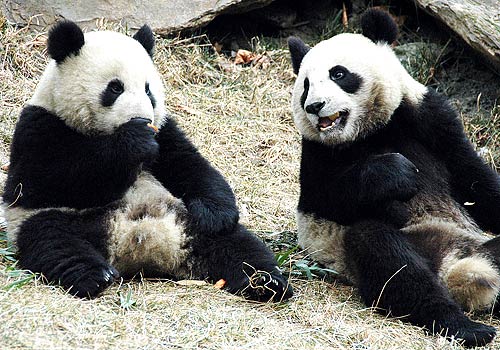
Attack of the Pandas

LATimes: ... China's latest weapon in its increasingly effective charm offensive against Taiwan is an offer of giant pandas. Who would think of turning down two lovable animals that zoos around the world can only dream about, you might ask?

The government of archrival Taiwanese President Chen Shui-bian, for one, which finds itself tied in knots over the offer. Let one panda's nose in the tent, Chen and his allies fear, and you buy into Beijing's claim that Taiwan is part of China, a notion impossible for the pro-independence government on the island to accept.

"The pandas are a trick, just like the Trojan horse," said lawmaker Huang Shi-cho of the Taiwan Solidarity Union party. "Pandas are cute, but they are meant to destroy Taiwan's psychological defenses."

Unfortunately for the Chen camp, most Taiwanese appear happy to have their psychological defenses destroyed by an animal that has melted hearts for centuries. One poll found that more than 70% are in favor of accepting the gift. ...

China, a nation that doesn't vote for its leaders, encouraged millions to vote for the pandas, or at least their names, announcing the choice of "Tuan Tuan" and "Yuan Yuan" — a play on "unify" — before hundreds of millions of Chinese New Year TV viewers. Chen, whose government is expected to make a decision whether to accept them by early April, quickly suggested they be renamed "independence" and "nation-building."

"Peaceful pandas vs. bellicose Chen," screamed a headline in the China Daily, the English-language Communist Party newspaper distributed in China. ...
This article is funny. The sad part though is it's true--relations between China and Taiwan right now are on a knife's edge, something symbolic like this could push things over one way or another.

China's leaders are canny, and patient. Taiwan's are at least aware of what's going on, but are divided. I'd say take the pandas but only on the same terms as other countries has; the LATimes goes on to detail the roles these cute furry animals have played in international politics from the Cold War on--has there ever been such incongruous bedfellows as pandas and China's communist leaders?!
Chinese panda diplomacy dates at least as far back as the Tang Dynasty when Empress Wu Zetian (624-705) gave a pair to Japan's emperor as a goodwill gift. But it reached its zenith in 1972, when President Nixon made his landmark trip to China, landing a pair of pandas that went a long way toward humanizing the isolated Communist state.

"At the height of Mao's panda diplomacy, they were involved in more foreign peace overtures than [Henry] Kissinger," Frank McNally wrote recently in the Irish Times. In retrospect, he added, perhaps the animals rather than the former secretary of State should have received the controversial 1973 Nobel Peace Prize. ...

"It was a very deft move by the Chinese leadership," said Chas Freeman, Nixon's interpreter on the trip.

In return, the Americans sent back a pair of musk oxen. "We took them to the cleaners on that trade," Freeman said. ...

As "panda-monium" raged, London decided it too wanted a pair. In 1974, it sent a delegation to Beijing headed by Prime Minister Edward Heath, but the timing never seemed right to broach the subject. Finally, near the end of the visit, Heath got up his nerve, realizing it was now or never.

"The Chinese cracked up," said Michael Brambell, retired mammal curator at the London Zoo. "They told him: 'We wondered when you'd get around to asking.'" ...

Between 1958 and 1982, Beijing sent 23 pandas to nine countries. But soon international friendship alone wasn't enough to seal a deal. Increasingly, cash was king. With zoos tripping over themselves for the furry prizes, China embarked on an increasingly controversial multiyear "rent-a-panda" program. ...

State Forestry Administration figures released last year show the number of pandas in the wild in China has risen by more than 40% to 1,590 from 1,110 in the 1980s. About 160 are in captive breeding programs worldwide.


Photos of Tuan Tuan and Yuan Yuan by Niu Yixin/ AP/ Xinhua.

Pinning the tail


FBI Was Warned About Moussaoui: Agent Tells Court Of Repeated Efforts Before 9/11 Attacks

The Post: An FBI agent who interrogated Zacarias Moussaoui before Sept. 11, 2001, warned his supervisors more than 70 times that Moussaoui was a terrorist and spelled out his suspicions that the al-Qaeda operative was plotting to hijack an airplane, according to federal court testimony yesterday.

Agent Harry Samit told jurors at Moussaoui's death penalty trial that his efforts to secure a warrant to search Moussaoui's belongings were frustrated at every turn by FBI officials he accused of "criminal negligence." Samit said he had sought help from a colleague, writing that he was "so desperate to get into Moussaoui's computer I'll take anything."

That was on Sept. 10, 2001.

Samit's testimony added striking detail to the voluminous public record on the FBI's bungling of the Moussaoui case. It also could help Moussaoui's defense. Samit is a prosecution witness who had earlier backed the government's central theory of the case: that the FBI would have raised "alarm bells" and could have stopped the Sept. 11 attacks if Moussaoui had not lied to agents. But under cross-examination by the defense yesterday, Samit said that he did raise those alarms -- repeatedly -- but that his bosses impeded his efforts.
The Moussaoui case is really quite a mess. I think really the government is banking on the jurors being prejudiced, rather than believing they'll analytically convince them of anything. Cause I'm not sure how the government expects to get the death penalty with an emperically illogical central theory, which the L.A. Times made explicit in an article last week:
Moussaoui unexpectedly pleaded guilty last year to capital murder for having a role in the Sept. 11 conspiracy; the government has made it a top priority to win the death penalty under the theory that -- although he was in jail at the time of the attacks -- he could have prevented them by telling the FBI about the plot.
Didn't Richard Clarke and the Minneapolis FBI agent and a whole host of CIA analysts all prove that telling the FBI about a plot doesn't prevent anything?

Heck, under the FBI's analysis that if only they had known all would've been averted, you actually could prosecute President Bush.

Courtroom sketch of Zacarias Moussaoui by Dana Verkouteren/ AP via USA Today.

Anyone's game


Japan, and Its Fans, Embrace New Title of World Champion

The Time: SAN DIEGO, March 20 — The white flags with the solitary red circles were scattered around Petco Park, growing more and more prominent with each inning. Every time Japan scored another run or made another slick play Monday night, the fans raised those cherished flags, shook them and waved them. Then they waited.

Could this drama really become a dream come true? Could Japan really be the class of the World Baseball Classic? The fluttering flags offered the answer. They almost never stopped flying, the Japanese almost never stopped repelling Cuba during a 10-6 victory, and they snatched the championship of this inaugural event.

So Japan, which qualified for the semifinals only after the United States was surprisingly eliminated with a loss to Mexico, ended Cuba's refreshing ride through the tournament. The Cubans were almost not allowed to compete, but they were given permission, and the mysterious men in red performed admirably against some teams loaded with major league players.
It's kind of a snippy article; Jack Curry fails to mention had Japan not lost a game to the U.S. on a bad call, it wouldn't have needed Mexico's win. Further, visiting teams of American all-stars have been getting beat for years on their tour of Japan, and the Japanese and Cubans are widely known as the class of international baseball competitions, so it's not as odd an outcome as Curry seems to think.

No matter, facts speak for themselves. Including these at the end of the article: "Derek Jeter and Ken Griffey Jr. were the only Americans to make the all-tournament team. ... The attendance for the 39 games was 737,112."

Maybe Bud needs to rename the World Series--call it the U.S.-Toronto championship.

Caption and photo of Sadaharu Oh, Japan's manager, thrown into the air by his players after their victory in the first World Baseball Classic, by Chang W. Lee in the Times.

Outside the ivory ivy tower


The Freshman: Talib in Luce Hall

Chip Brown in the Times: ... Before Sayed Rahmatullah Hashemi opened the Yale course catalog last summer, his education had been painfully unacademic; his reading list mixed the Koran and Persian poets with the grimmest primers of poverty and war. He was the sixth of seven children, born in 1978 in the Arghandab River valley village of Kohak, where his parents were born. They were Pashtuns — the dominant ethnic group of southern Afghanistan and parts of western Pakistan. For centuries the Arghandab valley had been the breadbasket of Afghanistan, famous for its grapes and pomegranates as well as for the fierce Pashtun clans that bloodied the armies of Alexander the Great and a litany of subsequent invaders. Rahmatullah arrived the year before the Soviet invasion, the most savage conflict of all. Many of the mud-brick homes and orchards of the family's village were obliterated by napalm; the whole region was salted with small, beguilingly shaped "bat mines" designed to blow the hands off children. Two of Rahmatullah's sisters were pulled alive from bomb rubble; an aunt was not so lucky, another of the estimated 1.5 million people killed during the 10-year Soviet occupation. ...

He did not like to dwell on the past, much less advertise it. To avoid alarming eavesdroppers, he referred to his former compatriots as "the Tangoes." But sometimes the past had a way of finding him. At the start of the fall semester, he made his way to the Henry R. Luce Hall at the Yale Center for International and Area Studies. He had a 1 o'clock class — PLSC 145, Terrorism: Past, Present and Future, with Prof. Douglas Woodwell. It was a popular new offering; hardly a seat was open. As he stood in the back hunting for a place to sit, he realized that he had been in Luce Hall before. Four years earlier. March 2001. The university saved a seat for him that afternoon, down on the stage. He was the featured speaker, a "roving ambassador" from the Islamic emirate of Afghanistan. He was 22 years old. The newspapers said 24, but he had been misrepresenting his age for a long time. Twenty-two years old and a member of the Taliban — at that moment, in fact, the very face and voice of the regime in America. Per decree, his beard was full, his head swaddled in a turban. He was dressed in an Afghan tunic and loose-fitting pants. Neither he nor anyone else in Luce Hall that day could have foreseen the catastrophe approaching or what peculiar fate was in store for him. He could remember looking out at the faces of the Yale students in the audience. They were his age, his generation — after a fashion they were taliban, too, talib being the Arabic word for seeker or student — but they sat on the far side of an abyss, and not in his wildest dreams could he have imagined himself as one of them. ...

"When I first met him I was a little anxious," recalls [Richard] Shaw, who last year became dean of undergraduate admissions and financial aid at Stanford. "My perception was, 'It's the enemy!' But the interview with him was one of the most interesting I've ever had. I walked away with a sense: Whoa! This is a person to be reckoned with and who could educate us about the world." ...

When the fall term started, he made a lot of new friends. He spoke Urdu to Fahad Khan, a Pakistani junior, and Pashto with two sophomores, Ahmed Khattak, who grew up in Pakistan, and Hyder Akbar, who was born in Afghanistan but raised in the U.S. Rahmatullah didn't mention his background, but his friends put two and two together.

"God, it's you!" he shouted when he saw Rahmatullah again.

"Shut up," Rahmatullah said. Pashtun friendships are often characterized by a certain brusqueness.

"Fahad, Hyder, Rahmatullah, me — we fight every day," Ahmed says. "We have lunch together. At 6 o'clock we meet for dinner at the Slifka Center. We sit together and eat food off one plate and talk about things. Sometimes we make fun of the Taliban. Every day we come up with something to fight about. We pretend to be only mocking, but we're genuinely angry. Friendship to a Pashtun means you have exclusive rights to abuse each other. After dinner we go back to my suite in Davenport and play foosball or stay up late playing Civilization. Rahmatullah loves the equality of how people are over here. He's very down to earth. He gets a lot of respect at Yale. If you want to test a man's character, either give him power or take it away — and see how he responds. I'm proud to be his friend."
It's another great NYTimes magazine article, they've really more interesting under their new editor, Gerald Marzorati. The piece is long, but well worth reading; does a good job of showing Hashemi in all his complexity, for better or for worth. Although I think the headline doesn't quite capture the piece, more telling is that Hashemi's name doesn't even appear until about 1/10th through the article.

Of course, this being America, there's also Alumni clash over Hashemi
Yale Daily News: Rahmatullah Hashemi '09 has become the focal point of a nationwide debate over his admission to Yale as a special non-degree student, precipitating extensive media coverage and heated conversation among University alumni.

Since The New York Times Magazine published an article last month detailing Hashemi's past as a former diplomat for the foreign minister of the Taliban and his current life as a Yale student, many alumni have spoken out publicly either against or in support of their alma mater's decision to admit him last summer.

Yale administrators have generally been silent on the issue, and President Richard Levin declined to personally comment on Hashemi's presence at the University. Hashemi has said he plans to apply for regular degree status this May.

"We acknowledge that some are criticizing Yale for allowing Mr. Hashemi to take courses here, but we hope that critics will also acknowledge that universities are places that must strive to increase understanding, especially of the most difficult issues that face the nation and the world," Yale spokeswoman Helaine Klasky said in a statement.

Carolyn Claflin, acting director of the Association of Yale Alumni, said the Times story has elicited a spike in alumni communication with the office, with a variety of sentiments behind the contact.
I think some people are nuts--I say we should be trying to get as many willing ex-Taliban, current Taliban, al-Qaeda, etc. leaders as possible into our universities. These people exist and we're not going to be able to kill them all--far better to engage those who are interested in learning and let them see what our country is really like, then boycott them and push them back into the arms of their extremist kin.

I'm pretty confident once they've seen America and lived among us--willingly--their views will change.

Photo of Sayed Rahmatullah Hashemi by Reuben Cox in the Times.

Monday, March 20, 2006

Insourcing


Another Way to Bring Out That Inner Rapunzel

The Times: Many other American women also want long thick hair and are willing to pay thousands of dollars for extensions, spurring growth in one more business centered on beauty. ...

The trend in the United States has increased demand for human hair in Russia, Europe and India, where many women wear their hair long. At least two large traders buy trainloads of hair from Hindu temples, where women are known to cut off their hair as a way to give thanks when their prayers are answered.

David Gold, the founder and chief executive of Great Lengths, a hair distributor, said the money that his company pays for this hair goes to the temples as well as to schools and hospitals in India. Great Lengths sells $80 million worth of human hair extensions each year.

Great Lengths started in 1990 in London and now employs about 500 people in factories in Italy, Tunisia and India who wash, separate, dye and ship the hair worldwide. Its biggest recent source of growth has been the United States, Mr. Gold said.
Wow, it's amazing--we're literally buying hair intended for the gods! Of course, we then alter it.

Oh well; I was about to cite a recent Times article:
Roger Dobson and Abul Taher report in The London Times (www.timesonline.co.uk) on a study suggesting blonds began having more fun in the Ice Age.

According to the study, North European women evolved blond hair and blue eyes at the end of the Ice Age to make them stand out from their rivals at a time of fierce competition for scarce males.

The study argues that blond hair originated in the region because of food shortages 10,000 to 11,000 years ago. Until then, humans had the dark brown hair and dark eyes that still dominate in the rest of the world. Almost the only sustenance in Northern Europe came from roaming herds of mammoths, reindeer, bison and horses. Finding them required long, arduous hunting trips in which numerous males died, leading to a high ratio of surviving women to men.

Lighter hair colors, which started as rare mutations, became popular for breeding, and numbers increased dramatically, according to the research, published under the aegis of the University of St. Andrews. ... However, the future of the blond is uncertain.

A study by the World Health Organization found that natural blonds are likely to be extinct within 200 years because there are too few people carrying the blond gene. According to the W.H.O. study, the last natural blond is likely to be born in Finland during 2202.
But, alas, I first came across A story too good to check, again, from Regret the Error:
Mistakes have a way of multiplying. For just one example of this, see the tale of the fake Britney Spears quotes. It happened again recently when the Sunday Times (UK) retold an old, incorrect tale about a WHO study that never was. From the Times piece:

A study by the World Health Organisation found that natural blonds are likely to be extinct within 200 years because there are too few people carrying the blond gene. According to the WHO study, the last natural blond is likely to be born in Finland during 2202.

This hoax WHO study was first reported by several US and UK media outlets back in 2002. UPDATE: A reader wrote in to note that Snopes has managed to find several earlier press references to soon-to-be-extinct blondes, the first of which dates back to...1865! Read it here.

The Sunday Times's recent story was then excerpted in the New York Times, a paper that had published an article about the hoax back in 2002. (Props to Gawker for spotting the recent Times item and putting two and two together here.)
And indeed, the Times appended a correction that reads:
An excerpt in the Reading File column last Sunday from an article published last month in The Times of London about the evolution of blond hair included a reference to a study, attributed to the World Health Organization, that predicted that blond hair would become extinct in 200 years. In 2002, after the first news reports about the study, W.H.O. said it had never done research on the subject and that it had no knowledge of how the reports originated.
Now here's the kicker--as Gawker notes, the Times in 2002 ran Stop Those Presses! Blonds, It Seems, Will Survive After All
Apparently it fell into the category ''too good to check.''

Last Friday, several British newspapers reported that the World Health Organization had found in a study that blonds would become extinct within 200 years, because blondness was caused by a recessive gene that was dying out. The reports were repeated on Friday by anchors for the ABC News program ''Good Morning America,'' and on Saturday by CNN.

There was only one problem, the health organization said in a statement yesterday that it never reported that blonds would become extinct, and it had never done a study on the subject.

''W.H.O. has no knowledge of how these news reports originated,'' said the organization, an agency of the United Nations based in Geneva, ''but would like to stress that we have no opinion of the future existence of blonds.''

All the news reports, in Britain and the United States, cited a study from the World Health Organization -- ''a blonde-shell study,'' as The Daily Star of London put it. But none reported any scientific details from the study or the names of the scientists who conducted it.

On ''Good Morning America,'' Charles Gibson began a conversation with his co-anchor, Diane Sawyer, by saying: ''There's a study from the World Health Organization, this is for real, that blonds are an endangered species. Women and men with blond hair, eyebrows and blue eyes, natural blonds, they say will vanish from the face of the earth within 200 years, because it is not as strong a gene as brunets.''

Ms. Sawyer said she was ''somewhat of a natural blonde.''

Jeffrey Schneider, a spokesman for ABC News, said the anchors got the information from an ABC producer in London who said he had read it in a British newspaper.

In London, The Sun and The Express both reported that unnamed scientists said blonds would survive longest in Scandinavia, where they are most concentrated, and expected the last true blond to hail from Finland.

The British accounts were replete with the views of bleached blonds who said hairdressers would never allow blondness to become extinct, and doctors who said that rare genes would pop up to keep natural blonds from becoming an endangered species.

Journalists in London said last night that the source of the reports was probably one of several European news agencies that are used by the British press, but it remained unclear which one.

Tim Hall, a night news editor at The Daily Mail, said the report was probably distributed by The Press Association, Britain's domestic news agency. ''Several papers picked it up,'' he said.

But Charlotte Gapper, night editor at The Press Association, said that although it had considered running the report on Sept. 27, it had decided not to after talking to the World Health Organization.

''We didn't do that story because we made an inquiry to the World Health Organization first,'' she said. ''They told us that report was two years old, and had been covered at the time. They said it had been picked up again that day by a German news agency.''

She added that she did not know which agency the organization was referring to.

Dr. Ray White, a geneticist at the University of California at San Francisco, said that the disappearance of a gene for blond hair ''sounds patently incorrect.''
There are too many funny quotes in that story; the whole thing is hilarious, and leaves you wondering what's happening over at the old grey lady nowadays.

Photo of Indian Barbie from Kattis Dolls.

Gun-toting Germans


David Letterman

The Times: Germany won the most medals in the Winter Olympics. And today, they had a big victory parade. And--this was kind of odd--it started in Berlin and ended in Poland.
The beauty of this 'joke' is you could stick in Paris, Belgium, Austria, Holland, Prague, really a lot of places, and still have it work. Not London, though... or Moscow. At least not yet.

AP photo of German multi-gold medalist Michael Greis by Rudi Blaha via Canoe.

Found world


The creator of Sherlock Holmes, Sir Arthur Conan Doyle, was an odd guy. I first felt it reading A Study in Scarlet, which halfway through suddenly shifts into a narrative about the first Mormon settlers of Utah, which although interesting and related to the bulk of the novel's classic mystery plot, nevertheless has this unnatural, almost forced air about it.

Reading that, it made sense to me that Doyle felt trapped by the success of the Holmes stories, that he tried to end the series by killing off Holmes, only to be forced by public pressure to bring him back. He desperately, it seems to me, wanted to write about very different things than want he was knew he'd always be known for doing. In contemporary terms, it'd be like if Stephen Spielberg really wanted to devote himself to making Bollywood films.

I recently reread the collected works of Sherlock Holmes, and found myself disappointed with the mysteries themselves. It seems to me that Holmes solves most of them with information the reader isn't privy to, guided either by similar cases he's studied, or else the gleaning of data based on his arcane knowledge of things like cigarette ash.

And after a while the twists begin to feel formulaic--long-lost people mentioned up front usually make a reappearance, often committing murder most foul with knowledge and out of motives linked to their long stays abroad.

What's most interesting to me, actually, is the picture of the 19th-century British mentality that emerges from the stories. Everyone is can-do about everything; no dusty corner of the world or obscure branch of human knowledge is beyond reach, if one properly applies himself. It's definitely mind over matter, and mind over others as well.

Dr. Watson, it seems to me, in some ways is at the center of the novels, as we see everything through his eyes and Holmes' character seems bent around the facts of each case.

Oddly, though, Watson seems to grow not a whit over the course of the four novels and 56 short stories. His voice remains the same and he never fully emerges as a flesh and blood person in his own right, just like Holmes would wither away were it not for the 'mystery' that pulls each story through.

A contrast the greater when you read Patrick O'Brian's Aubrey/Maturin books, themselves set in (early) 19th century England.

At any rate, here are some passages that stuck in my mind while reading some of Doyles' non-Holmes works online (he's out of copyright).

The Lost World, chapt. 15: At night we could hear from amid the trees the long-drawn cry, as some primitive Ezekiel mourned for fallen greatness and recalled the departed glories of Ape Town. Hewers of wood and drawers of water, such were they from now onwards.


The Poison Belt, Chapt. 4: The flippancy of the half-educated is more obstructive to science than the obtuseness of the ignorant," said he.

Chapt. 5: "What's the matter with the motor-car? Why should we not go in that?"

"I am not an expert," said Challenger, pulling at his beard reflectively. "At the same time, you are right in supposing that the human intellect in its higher manifestations should be sufficiently flexible to turn itself to anything. Your idea is an excellent one, Lord John. I myself will drive you all to London."

"You will do nothing of the kind," said Summerlee with decision.

"No, indeed, George!" cried his wife. "You only tried once, and you remember how you crashed through the gate of the garage."

"It was a momentary want of concentration," said Challenger complacently. "You can consider the matter settled. I will certainly drive you all to London."

The situation was relieved by Lord John.

"What's the car?" he asked.

"A twenty-horsepower Humber."

"Why, I've driven one for years," said he. "By George!" he added. "I never thought I'd live to take the whole human race in one load. There's just room for five, as I remember it. Get your things on, and I'll be ready at the door by ten o'clock."

Sure enough, at the hour named, the car came purring and crackling from the yard with Lord John at the wheel. I took my seat beside him, while the lady, a useful little buffer state, was squeezed in between the two men of wrath at the back. Then Lord John released his brakes, slid his lever rapidly from first to third, and we sped off upon the strangest drive that ever human beings have taken since man first came upon the earth. ...

At the last dreadful moment, brought suddenly face to face with the realities of life, those terrific realities which hang over us even while we follow the shadows, the terrified people had rushed into those old city churches which for generations had hardly ever held a congregation. ...

And now I come to the end of this extraordinary incident, so overshadowing in its importance, not only in our own small, individual lives, but in the general history of the human race. As I said when I began my narrative, when that history comes to be written, this occurrence will surely stand out among all other events like a mountain towering among its foothills. Our generation has been reserved for a very special fate since it has been chosen to experience so wonderful a thing. How long its effect may last--how long mankind may preserve the humility and reverence which this great shock has taught it--can only be shown by the future. I think it is safe to say that things can never be quite the same again. Never can one realize how powerless and ignorant one is, and how one is upheld by an unseen hand, until for an instant that hand has seemed to close and to crush. Death has been imminent upon us. We know that at any moment it may be again. That grim presence shadows our lives, but who can deny that in that shadow the sense of duty, the feeling of sobriety and responsibility, the appreciation of the gravity and of the objects of life, the earnest desire to develop and improve, have grown and become real with us to a degree that has leavened our whole society from end to end? It is something beyond sects and beyond dogmas. It is rather an alteration of perspective, a shifting of our sense of proportion, a vivid realization that we are insignificant and evanescent creatures, existing on sufferance and at the mercy of the first chill wind from the unknown. But if the world has grown graver with this knowledge it is not, I think, a sadder place in consequence. Surely we are agreed that the more sober and restrained pleasures of the present are deeper as well as wiser than the noisy, foolish hustle which passed so often for enjoyment in the days of old--days so recent and yet already so inconceivable. Those empty lives which were wasted in aimless visiting and being visited, in the worry of great and unnecessary households, in the arranging and eating of elaborate and tedious meals, have now found rest and health in the reading, the music, the gentle family communion which comes from a simpler and saner division of their time. With greater health and greater pleasure they are richer than before, even after they have paid those increased contributions to the common fund which have so raised the standard of life in these islands.

Chapter 6: TWENTY-EIGHT HOURS' WORLD COMA UNPRECEDENTED EXPERIENCE CHALLENGER JUSTIFIED OUR CORRESPONDENT ESCAPES ENTHRALLING NARRATIVE THE OXYGEN ROOM WEIRD MOTOR DRIVE DEAD LONDON REPLACING THE MISSING PAGE GREAT FIRES AND LOSS OF LIFE WILL IT RECUR?

Underneath this glorious scroll came nine and a half columns of narrative, in which appeared the first, last, and only account of the history of the planet, so far as one observer could draw it, during one long day of its existence. Challenger and Summerlee have treated the matter in a joint scientific paper, but to me alone was left the popular account. Surely I can sing "Nunc dimittis." What is left but anti-climax in the life of a journalist after that!
Uncredited painting of Doyle via the official site of the Sir Arthur Conan Doyle Literary Estate

Trying something new


Iranians See Talks With U.S. as Historic

Karl Vick in the Washington Post: Iran's acceptance of direct talks with the United States over Iraq is being regarded among Iranians as a major foreign policy development, a historic if still tentative departure from 27 years of official enmity that held the government of the "Great Satan" as one to be spoken against, but never with. ...

Vehement opposition to the United States has been a pillar of Iran's theocratic system since 1979, the year an angry population overthrew the monarch Washington had helped install 26 years earlier in a coup engineered with the help of the CIA. From the U.S. side, a similar enmity was embedded in policy when student militants overran the red-brick U.S. Embassy in Tehran, taking 52 Americans hostage and holding them for more than a year.

The United States severed diplomatic relations with Iran, and over the next quarter-century both countries consistently found a reliable villain in the other.

Inside Iran, however, an appetite for rapprochement grew along with a population whose youthful majority had no memory of the revolution.

In 2002, a poll found that three-quarters of Iranians surveyed favored talks with the United States. The pollster was thrown in jail, but the reality drove a quiet competition between Iran's two rival political forces. ...

"Whoever could take the prize" of U.S. rapprochement would, it was widely believed, dominate Iranian politics for the foreseeable future, said Mehdi Karrubi, a moderate cleric who was speaker of the last parliament dominated by reformers.

The competition, however, had paralyzed the effort: Neither side would allow the other to reach out to the United States without risking accusations of betraying the Islamic revolution.

That changed last year, when conservative clerics edged reformists out of government, unifying Iran's elaborate ruling structure for the first time in nearly a decade. It also cleared the way for the opening to Washington, and even reformists urged the conservatives to act.

"This might be a historic irony, but it's true the state is in 'harmony,' " said Mostafa Tajzadeh, a prominent reformist theoretician, speaking before the announcement of the direct talks. "No time has been more convenient for talks between the two countries. We are less sensitive than at any time since the revolution."

A few conservatives quietly urged the same. Behind the scenes of Iran's conservative establishment, insiders whispered about the prospect of negotiations. ...

"The public image the U.S. has made of Iran is a monster. They have to do something, at least break a horn," [Tajzadeh] said. "There is only a small chance. This is negotiation.

The public also appeared to welcome news of talks. "I think both sides should take advantage of this opportunity. They should be friends," said Kobra Mehdipour, 68, clutching her chador against the March wind.

Asked who in Iran might feel otherwise, she said, "There might be some illiterate people in the provinces who want to be friends with other countries but might be under the influence of some kind of propaganda."
Vick's article is one of the few informed, unbiased looks at Iran I've seen lately. The quote from the old woman is funny--part of Iran's problem has been part of it's population has always been willing to through in its lot with the West rather than with its own 'illiterate people in the provinces', an economic and psychological gap that was only enhanced by the U.S. puppet shah.

So it makes sense that, just as only Nixon could go to China, only a hard-line conservative government--American as well as Iranian--could talk to the other side.

And once you start talking, it's kindof hard to paint the other side as a monster, somehow non-human; it's why the Israelis refuse to talk to the Palestinians, and why from Israel's point of view they'd rather we continue to listen to them on Iran rather than the Iranian government.

Uncredited photo of Iranian president Mahmoud Ahmadinejad from China's Peoples Daily online.

March 19, 2006 photo of President George W. Bush by Jonathan Ernst/ Reuters.

Sunday, March 19, 2006

Old West sheared by new


Spielberg Series Sued for Haircut

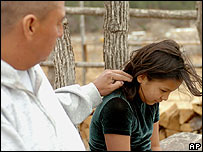
BBCNews: A family from the Mescalero Apache tribe is suing the producers of a Steven Spielberg TV series for cutting their daughter's hair for the show.

The family said the hair of Christina Ponce, aged eight, was cut without regard for their tribal customs.

"It's part of our culture not to cut a girl's hair until her Coming of Age ceremony," her father Danny Ponce said.

"The only ones allowed to do that are the parents." His daughter had been acting in mini-series Into the West.

Mr Ponce added that "nobody asked for permission" before a stylist cut Christina's hair. He said he had filed his claim in the US District Court in Albuquerque. ...

Her hair was cut by a stylist to "make her look more 'Indian' and like a male Indian child because the movie casting call failed to produce sufficient young male extras of Indian heritage", the papers state. ...

"Just because you're wealthy, you don't do something without checking first," he said.
There's something about this story that rankles, isn't there. Taps into the whole Hollywood sense of entitlement, of how they see the rest of the world as material to be shaped to fit their view of reality.

What's authentic for Hollywood generally seems to be warped by ignorance, dumbness, laziness and lack of interest in anything but money and sex. Actors and directors could be so much more than they are--they have carte blanche to explore any subject, illuminate any issue. It's pathetic with the world as their canvas all they explore are car chases.

You'd if you're going to be working on a television series about the West, the least you could do is learn a little about the people you'll be working with. It's an attitude that starts from the top down; as I've said before, I think Spielberg is not a bad guy, but I don't have the respect for him I have for others.

I feel bad for the stylist--I'm pretty sure it's not like she felt like the Native American tradition is silly and meaningless and violated it knowingly. It's an interesting ritual, I know for Hindus for example a baby's first hair cut is significant; makes me think of the Sampson/Delilah story as well. I wonder how hair came to be imbued by such importance; I guess for ancient man power was in your body, so losing any part of it was cause for concern.

Sortof like how Hollywood feels about counterfit DVDs.

Photo of Christina Ponce and her father by the AP via BBCNews.com.

Saturday, March 18, 2006

Following in the footsteps


The Great British-Pakistani-Muslim Hope

Pat Jordan in the Times magazine: Amir Khan is a slender 19-year-old with smooth skin the color of café con leche. His handshake is weak, his long, delicate fingers as easily crushed, it seems, as the stem of a flower. He began boxing when he was 8, in the tough old mill town of Bolton, in northern England. He is a British citizen of Pakistani descent and a practicing Muslim. At 11, he was a boxing prodigy. By his teens, he was the best young amateur boxer in the United Kingdom. In 2003, when Khan was 16, he won a gold medal at the Junior Olympics, which were held in the United States. One opponent at the event told him that if he fought at the Olympics the next year in Athens, he would "shock the world."

So, Khan says: "I went home and looked at the rules. You had to be 18 to compete in the Olympics." He petitioned the British Amateur Boxing Association to make an exception, but the A.B.A. refused. Khan threatened to fight for Pakistan. The A.B.A. relented, and that summer Khan was named the sole member of the British boxing team. "It would have been an embarrassment to have no boxer on the British team," he says.

Khan advanced to the gold-medal bout by, as the press variously put it, "outclassing," "demoralizing" and "hammering" his first four opponents. His graceful style elicited comparisons with Sugar Ray Leonard and Muhammad Ali. Khan said that his goal was to show British Asian youths that they could achieve whatever they wanted. A British paper claimed Khan was "fighting for all of us" — for white Brits and their countrymen in the immigrant communities.

In the final, Khan faced Mario Kindelan, a 33-year-old three-time world champion from Cuba, who was considered the best fighter in the world, pro or amateur, in the 132-pound weight class. Kindelan had fought hundreds of senior amateur bouts, Khan a mere handful.

Millions of viewers in the U.K. watched on TV as Kindelan outpointed Khan 30-22 for the gold medal. Afterward, the 17-year-old Khan was the toast of Britain, besieged by TV and print media, lawyers, promoters and sponsors who asked him what kind of after-shave he used. And he was the subject of a national debate: should he turn pro and become rich now, or should he remain an amateur until the 2008 Olympics and seek glory for the U.K.?

The debate was effectively settled in May 2005, when Khan met Kindelan in Bolton for an amateur rematch. "The kid took the Cuban to school," Frank Warren, a boxing promoter known as "the Don King of British Boxing," told me. After the fight, Khan, with no amateurs left to challenge him, turned pro and signed with Warren's Sports Network. Warren, in his 50's, had a plan to make Khan a world champion and a millionaire by his 21st birthday.
People like Khan are becoming more and more commonplace. Michelle Kwan, Tiger Woods, Michelle Wie, Apolo Anton Ohno.... Like all of them, Khan seems like a great person, someone with good parents who gets it and is playing the game on his terms. Regardless of what others want him to do.

It's interesting that whites who still think of anyone non-white as somehow foreign have such a sense of entitlement, even ownership, when it comes to non-white athletes. It's almost like they feel like they're the arbiter of whether that athlete's behavior is acceptable or not.

The infamous example of this, of course, is Muhammad Ali. Whom some whites still refer to as Cassius Clay (like Yusuf Islam will always be Cat Stevens to some). I'm not sure people appreciate how important Ali was and is... he was the first athlete to truly transcend sports, not because of what others made of him (like Jackie Robinson) but because of what he forced others to make of him. His independence didn't stem from overwhelming wealth or ability; it was from pure force of ideas.

I'm not sure any athlete anywhere has ever done what he did--in addition to dominating his sport, he became one of the most influential political figures of his time. Because he was an American, maybe billions in the 3rd World knew of his stance against the Vietnam war and racism and in a very real way he became their spokesman at the tables of power.

Khan has to stand up for a few million Muslims in an island nation of 60 million, a second-tier player on the world stage whose whites are still struggling to come to terms with all the non-whites who have come 'home' to the mother country. It's a tough task, but it's not quite like being black in 1950s America--to be frank, the rest of the world isn't looking to the UK for leadership on anything anymore so the impact of how Khan ultimately plays will be mainly felt by the British.

Ali, on the other hand, shook the world.

Photo of Amir Khan by unidentified photographer via BBC website.

Photo of Muhammad Ali knocking out Sonny Liston in 1965 by Neil Leifer via Sports Illustrated's Tribute to Muhammad Ali gallery.

Same old new France

Protests Over French Labor Law Widen

The Times: Students, joined by teachers, workers, retirees, opposition politicians and labor union leaders took to the streets of more than 100 cities and towns throughout France on Saturday in the latest nationwide protest against the government's new youth labor law. ...

The protesters want the abolition of a new law known as the First Employment Contract that would allow employers to fire new workers under the age of 26 without cause after two years.

Designed by the government to help ease the crisis of chronic high unemployment, particularly among disadvantaged youth after riots last fall in the suburbs, the law is seen by its opponents as a step toward eroding long-cherished employment rights and benefits.

Protesters point out that the law was pushed through Parliament without debate and charge that it is age discrimination. They have dubbed the law the "Kleenex contract" because young workers could be dismissed without cause — or discarded like a facial tissue.

Twenty-three percent of French citizens under the age of 26 are jobless; in some of the major city suburbs, the figure is nearly double that.

Under sunny skies in Paris on Saturday afternoon, the police, anticipating trouble, urged shopkeepers along the march route to shut down.

But the demonstrations started peacefully, with balloons and music of the Rolling Stones and Madonna. Protesters were joined by parents with children. Officials from the major unions distributed banners and flags from the back of trucks. Vendors sold hotdogs and kebabs.
23% jobless, in some areas nearly half?! Wow... wonder how many of those with jobs are selling hotdogs (and kebabs). How can France consider itself a serious country--with a seat on the Security Council no less!--with numbers like that, and with a law that allows young people to be fired for whatever reason? How does that help young people feel like they have a stake in society?

It's so weird to see how absolutely medieval seemingly-peer countries are in certain areas. France and its ilk need to stop pretending they're still world-class and get its house in order--they really have no right preaching to other countries.

Photo of Parisian demonstrators by Mehdi Fedouach/AFP via surprisingly slick Le Monde.

Going for 16

Watching George Washington vs. Duke--hopefully GWU wins, and hopefully the local station stays with the game. Good game so far, GWU sticking close 16-22 despite quite a few turnovers and shooting 36%. It's not about the score a lot of times, it's about what the score should be based on how you're playing. Right now if it weren't for great offensive rebounding GWU should be down by like 15, every time down it seems like they're getting multiple chances.

After a stellar first day of the tournament going 13-3 was only 10-6 yesterday--worse, lost one final four team, Kansas, two final eight teams, MSU and Iowa. So in total have already lost four sweet 16 teams.

Meanwhile this game has gotten away from GWU, Duke now up 34-20. Basically they shut down GWU on the glass and the Colonials have kept turning the ball over. Problem for GWU is Duke is a great front-runner in the tournament, they just put their feet on your throats. Or your chest.

Nana Papa Yaw 'Pops' Mensah-Bonsu--whose parents are from Ghana and who was raised in London--goes out with two fouls, lead is now 16. J.J. Reddick gets his 2nd foul too. Difference is his team has a cushion. GWU is now missing a lot of shots inside, they're getting good drives but aren't finishing. Not sure the upset is gonna happen today... although they did come from 18 down in the second half the other day. Crazy, officials are letting Duke guy grab the jerseys of the GWU guard on defense and manhandle him. It's getting a little crazy with 2:30 left, diving for loose balls and everything, even though they're down 14 it feels more competitive for some reason. Crowd is behind them now, too, even though it's Greensboro, Duke's home away from home.

Regis Koundjis cuts the lead to 11 from the line, he's from the Central African Republic. After some back and forth GWU holds for last shot of the half, 7th Duke block but still Colonial ball. Then a missed 3 but Dukie travels, for GWU ball with 1.6 left, another missed 3. So 26-37 at the half.

Profile of Tennessee's team at halftime, funny quote from a player, they didn't wanna be third in Knoxville, behind women's basketball and football. Winning breeds support--and the women's team, until proven otherwise, will be #1 at Tennessee.

Second half starts, GWU gets some easy inside baskets but Duke hits its shots too, back up by 15, then biggest lead at 17. Very close to getting out of hand.

Wow, a GIGANTIC length of the court drive and slam by Danilo Pinnock, just charges the entire team with energy and cuts lead back down to 13. My gosh! Then Dukie misses a wide-open slam, the momentum mimght be shifting here. 13:30 left in the game. Down to 11, 7-0 run for GWU. This team just does not quit, keeps playing. Tenacious D, bails out Duke with a cheap foul. Steal and dunk by Pinnock, down to 9... back to 10 after one free throw, then like the 4th traveling violation for GWU.

Ugh, couple of made Duke shots, some missed GWU shots, and Duke's back up by 13, with the ball.... Game ends with Duke 74, GWU 61. Oh well, was exciting for a while.

Thursday, March 16, 2006

Madness gets going

The opening day of the NCAA men's basketball tournament didn't disappoint--an overtime game, a double overtime game, and three top-3 seeds being pushed to the wire. Best game so far was 8 George Washington coming from 18 down in the second half to beat 9 UNC Wilmington in overtime by 3.

I've correctly picked all 11 games so far except one (12 Montana beating 5 Nevada), including the two other upsets, 11 Wisconsin Milwaukee beating 6 Oklahoma and 10 Alabama beating 7 Marquette.

Sometimes in this tournament not picking the upset is the way to go--my theory is when there's a lot of parity overall the slightly better teams win.

Watching 5 Syracuse try to claw back against 12 Texas A&M... these 5-12 games are always crazy. Since I have the Orangemen going out in the next round anyway, it's cool if the upset happens. Now 6 Indiana vs. 11 San Diego State on the other hand.... Announcers are very pro-Syracuse, I think they're gonna lose, down 6 with just over a minute left and Gerry McNamara's on the bench with a groin injury.

Oh well, looks like I'll be 12-2, with the other two games currently going against me too. Better than the Big East, which is 0-4 today.

They switch to the Indiana game--they're within one, with a chance to finish the three-point play. Meanwhile, the team USA baseball team just lost to Mexico 2-1, amazing. So the U.S. is out of the inaugural World Baseball tournament, having lost to Canada, South Korea (which is undefeated so far) and now Mexico, and having beaten South Africa, Mexico earlier and Japan. The semifinalists are South Korea, Japan, the Dominican Republic, and Cuba.

Oh well, poor Bud Selig, everything he touches turns to dross. Back to IU, Mike Davis is out as coach after this tournament. And IU is falling apart a bit, went from being tied to down by three with SDSU at the line, lead now five. Ugh. IU guy misses both free throws, even worse.

Turns around just like that--IU hits two free throws, SDSU--coached by ex-Michigan coach Steve Fisher!--turns it over, but then horrible 3-point IU shot attempt and then they foul. Some very bad basketball down the stretch for IU; SDSU misses though, IU grabs ball, misses three but then gets the board and the shot.

One point game, SDSU crazy three miss, now IU foul, not a great call by the refs. SDSU makes both, three points down; nice drive by Hoosiers, one again. Wow, crazy play--SDSU guy had ball poked away into back court, could've grabbed it back but thought he couldn't (if the other team hadn't touched it he'd be right), just standing over ball, IU guy dives on floor and on the jump ball possesion is IUs.

Wow. IU puts up a crazy three-pointer, after getting a pass tipped--just pure luck, suddenly up by two. Game's over, SDSU throws the ball the length of the court, out of bounds. That's basketball for you--in the blink of an eye you go from in command to down and out. IU makes two free throws, wins 87-83. Wow.

Just one game still going on tonight, Washington up by double digits over Utah State, but CBS signs off at 12:30. So time to test the free webcast....

Wow, it's a totally ridiculous system. They put you in the 'general admission' line, I'm currently 136 in line. Gotta wait about 2 minutes before they let people 'in' again. Good timing, Utah State's cut the lead to 7. 20 turnovers for them, though, with the latest one.

Commercial blasts on this thing. It's like you're afraid to click on anything, don't wanna get kicked outof line. Hmm, some promos apparently aren't streamed online, so they fill the space with a stay-tuned graphic. They couldn't have sold an ad to someone for $1 instead?

Back, the arena's half-empty, ridiculous. Momentum starting to swing back to Washington, amazing that UTSU isn't out of it with 14 more turnovers than the Huskies. Good announcer, Dick Enberg, for a late night game.

Game's back and forth, Washington up 7 with about 4:30; in my experience the lower seed never wins when they're down by this margin, usually they have to be up and hold on. Lead now 8 after a 3/2 swap. Washington hits another 3, this game is over--up by 9, 3:30 to play. Whoops, except Utah State hits 3 back. Down to 3, another 3 for Washington. 9 point lead after UTSU hits a 2 in response. UTSU gets a steal, let's see if they can cut to 7 or 6... Timeout instead from UTSU.

So far 4 graphics instead of commercials in like 10 minutes. At least run an ad for a CBS program! Anyway, Washington winds up winning, 75-61.

So I'm 13-3 after day 1.

Wednesday, March 15, 2006

Scare thrown into them


Watching on tape, Ryan opens, conveniently standing next to some deranged member of the audience holding an I love Ryan sign. Wonder if there will be any big surprises tonight.... 32.5 million votes cast outof last night's show, wow. They recap the show, showing Paris last as the best, even though Chris' was universally seen as the top performance.

To break; I like that commercial where that woman dances to Black Eyed Peas in the dressing room to music from her cell phone while trying on jeans, so much energy; amazing how some people when they dance can create a sense of space with just a few feet to work with. Come back to goofy commercial for some car, Chris lead; set in the wilderness, it's really bad actually.

Stevie Wonder on stage, gets a heartfelt standing ovation. Sings a song off his new album, ugh. Wish he'd just sing the things we know. :-) It's kindof a boring song, at least to me. Good beat, but didn't hold me obviously. Ending pretty good, he starts doing runs and stuff. Ryan has this really goofy smile on his face, then quickie promo with 'The Loop' people in the audience.

Three lowest vote totals... Hmm, Kevin or Ace, whoah, Ace is in the bottom three! Just assuming it's Kevin, people start booing, Paula says she doesn't get it, Randy says he's a little shocked. Simon says he's a little surprised, wake-up call; choose better songs, perform better. Well, I liked his performance second-least, still a bit shocking to see him here.

Back from break, Paris next, and she's safe. Kellie next, looking nervous, but she should be fine. And she is too. Taylor, he's totally fine; crazy sweeping spotlights makes everyone look weird. And he's safe. Then Chris, big screams from the audience; safe, of course. Melissa, good look for her. Hmm, good, put in with Elliott, one of the two--obviously Melissa. And it's her, she has on a cool outfit, black with some turquoise and other shiny stuff. Mandisa, she's safe; and is. Katharine, she's fine, and is. Lisa and Bucky, it'll obviously be Bucky. And--oh my gosh, it's Lisa! Whoah!

Ace and Lisa are ridiculous, they both have big grins though, Lisa looks pretty confident. Melissa should be the one to go.... Two of my bottom three, I had Lisa at six. If she doesn't go now she'll go soon, she fills the superior singer but no rabid fan base niche. And Ace goes back to safety, crowd very happy, long, slow, walk back. And Lisa's safe, Melissa goes out. Oh well, deservedly so. They show her clips, to You Had a Bad Day; then she sings, but my tape cuts off, so oh well.... It's sortof too bad, was starting to like her a little, but she's the one I liked least.

Photo of Melissa McGhee from FOX via MSNBC.com